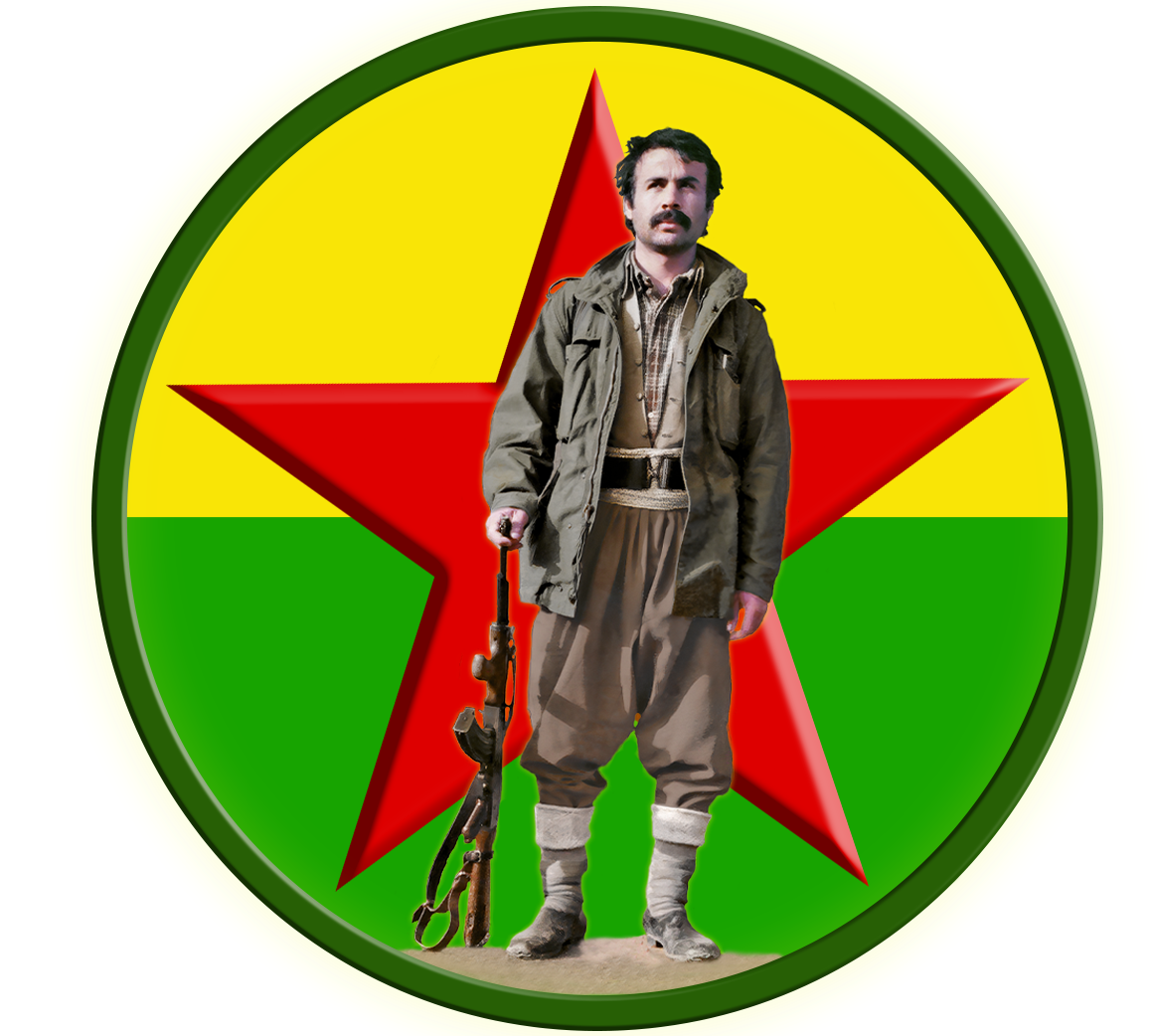
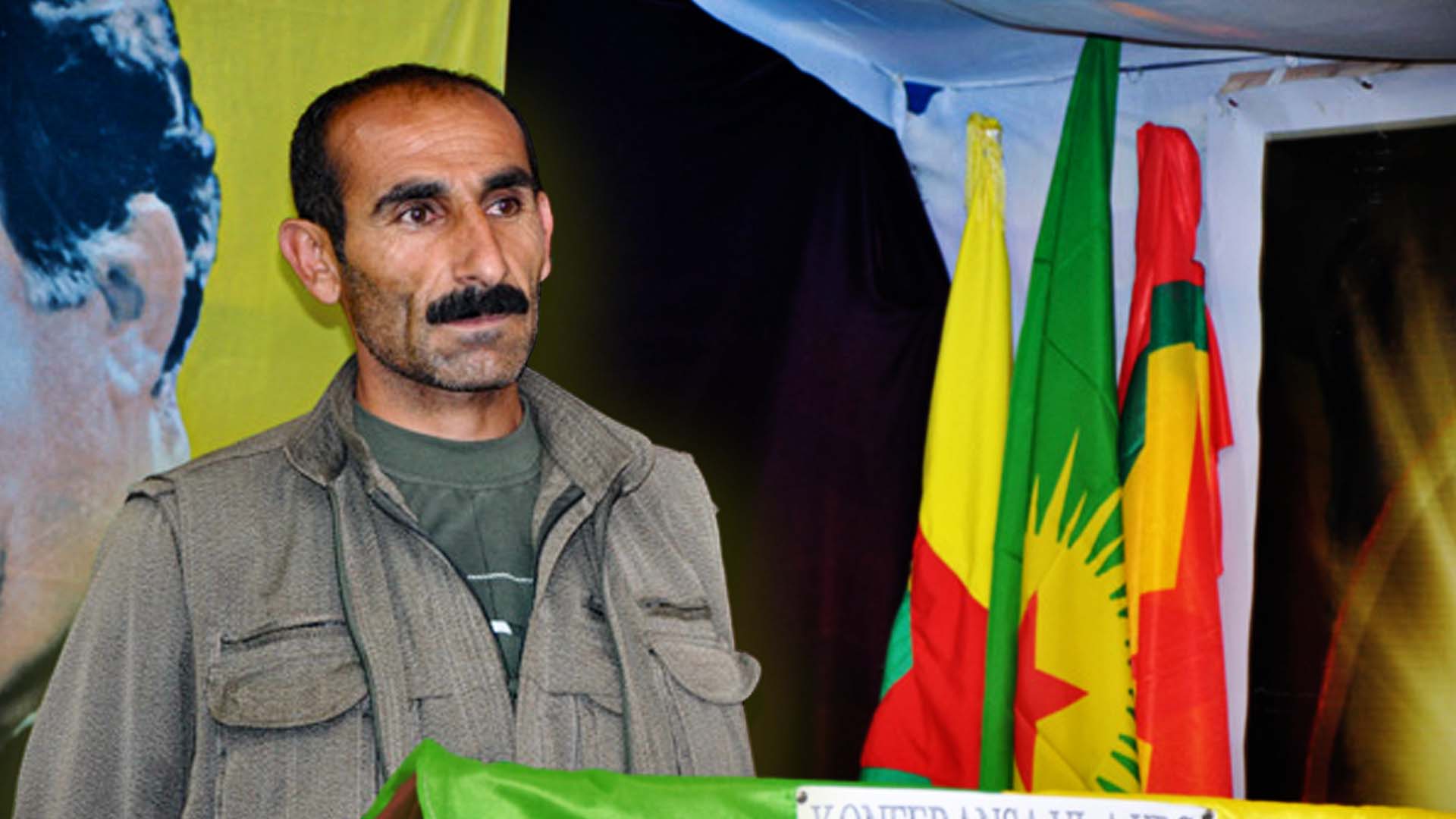
Among the fearless and the daring, he was the most fearless and the most daring
How can one describe Comrade Mehmet Goyi? Who could truly describe a guerrilla who lived for twenty-four years without averting his eyes from even a single wound? When struggle is mentioned, when action is mentioned, when descending into the squares in defiance of the enemy is mentioned, and of course when confronting the forces occupying Kurdistan is mentioned, who could truly describe Comrade Mehmet Goyi, one of the first names that comes to mind?
I met Comrade Mehmet Goyi eighteen years ago in the Haftanin area, immediately after the 5th Congress. He was a company commander in the Eastern Storm Regiment, one of the two Storm Regiments formed by the decision of the 5th Congress. I, meanwhile, had been assigned to that unit as a political commissar. It was then that I came to know Comrade Mehmet Goyi, and for eighteen years we would share hundreds of events and memories together in the same places.
The name Mehmet Goyi indicates that he came from the Goyi tribe. The Goyis are generally known for their courage. As one of our comrades wrote regarding the Goyis:
“The Guyan tribe represents a reality outside the tribal structure we usually know. In this tribe, there is no tribal chief. Of course, there is a tribal consciousness — and a very widespread one, as we have seen many times throughout the history of our armed struggle — but there is no tribal chief. Likewise, there are no aghas of the kind we are accustomed to seeing elsewhere. The institution of aghaship, which has been a curse upon the Kurdish people in Kurdistan, does not exist here. It does not function here. Within this tribal structure, you cannot find a sheikh, because you cannot find the kind of fragmentation we mentioned above. There are seyyids, and they have social respect.
When we evaluate all these realities, we see that they not only make the people of this region more upright and honorable, but also enable them to develop with greater talent and initiative. They become more determined and sharp. They are enterprising. There is no timidity. There is always vitality, movement, and dynamism. Each person is his own agha. This gives rise to a very firm personality structure. Especially when the social reality of withdrawing into the depths of the mountains, of remaining distant from ‘civilization’ — and even willingly living in this way — combines with the steepness and inaccessibility of these mountains and the harshness of living conditions, it creates a personality structure that is resistant, stubborn, and uncompromising toward life.”
All the Goyi tribal characteristics listed above existed in Comrade Mehmet. Perhaps even more could be added. Although Comrade Mehmet was a member of the Goyi tribe, he was born in 1967 in the city center of Van and grew up there. He was originally from the village of Mijîn. Mijîn, meanwhile, had always been one of the most advanced bases of the guerrillas and freedom fighters in Botan. It was not for nothing that Mijîn was called the village of the PKK members. And it was not for nothing that the fascist Turkish state brutally burned and destroyed the village of Mijîn in 1994.
Yes, Comrade Mehmet Goyi grew up in cities. Yet, as we said, even though he grew up in the city, he was a true Goyi. Alongside all the positive qualities of the Goyis, the education he received in the city, his early encounter with labor, and the enemy oppression he witnessed firsthand made him incredibly unyielding toward the enemy.
As Comrade Mehmet Goyi grew older, he worked in construction in different parts of Turkey and Kurdistan with his uncle Ömer, whom he loved deeply and who would later fall as a martyr while he was a refugee. In this way, he grew up witnessing firsthand the humiliations developed against Kurds and the contempt that already existed toward them. Although he spent his youth working on the one hand, his interest in Kurdishness was great. He played football beautifully. Even after many years had passed, it was still possible to see this football style in the mountains of freedom. In his youth, he was also known for never bowing down to anyone.
Before the 1990s, after completing his military service in the Turkish army, he understood the reality of the Turkish state much more clearly. While all these developments were taking place in his inner world, the sounds of the guerrilla’s machine guns were rising beside him in Kurdistan. One day, he opened his heart to his uncle and told him that his heart belonged to the mountains. His uncle was not someone distant from Kurdish politics. He was also someone who knew that the price of Kurdish politics was heavy. For this reason, although he did not tell Comrade Mehmet not to go, he said: “This work is difficult. There is going, but no return. It is an honorable and dignified task. If you will represent our honor, then go.” Comrade Mehmet also had a cousin who had already joined the ranks of freedom. Therefore, once he thought of the mountains, there was no turning back for him. Once he made a decision, what remained for him was to fulfill the requirements of that decision.
Yes, Comrade Mehmet joined the ranks of the PKK in 1989. These were years when many people still did not dare to join the guerrilla. The difficulties were many. But as someone who had completed military service and, in a sense, had been hardened through many labor-intensive jobs, he had already been tested and tried.
As soon as he received his first training, his long marathon began. His first practice took him to the highlands of Başkale, Çatak, and Gürpınar. Then, after Xakurke, he carried out guerrilla work in these areas for several years.
When one says guerrilla, surely one of the first names that will always come to mind, alongside Comrade Sarı İbrahim, is Comrade Mehmet Goyi. Just as Comrade Sarı İbrahim was a legend at the highest level of being a guerrilla, we must place Comrade Mehmet Goyi beside him as a guerrilla legend of the same level.
As we said, first of all, there was almost no place in all the highlands of Eastern Botan where he did not set foot. In 1994, he crossed for the first time into the Besta area, the heart of Botan. There he received cadre training, and this time turned his direction toward Hakkari. In the Levine area of Hakkari, he was a company commander. Those were harsh years. They were the years when Mrs. Tansu Çiller, who sheds tears these days, declared: “We will not give even a single pebble; either it will end, or they will end.” And against this, they were also the years when our party wanted to make a very powerful breakthrough. Comrade Mehmet took twelve comrades from his unit and planned an action against a fortified battalion and its hill, which essentially held the security of the Hakkari brigade, even though it was called Hakkari city.
We said above that he was fearless. He was daring. Once Comrade Mehmet made a decision, even if the whole world came against him, it could not make him take a step back. And indeed, without taking a single step back, taking a very limited number of comrades with him, he charged with his galloping heart against fortified strongholds as if in ancient times. In this action, three of his comrades fell as martyrs, while he himself was seriously wounded. Many years later, when our party leadership said, “You attack windmills with spears like Don Quixote,” it was this action that was being referred to. On the one hand, there was an attack against thousands of soldiers with an unbelievable level of courage and with heart alone; on the other hand, that heart was not accompanied by reason, which is the foundation of civil courage. This paradox is perhaps the essential character inheritance that has remained to the Kurds from the first day of history until today.
Perhaps the most important lesson Comrade Mehmet learned in the guerrilla struggle was this lesson. After this incident, he became much more sensitive at a higher level and approached guerrilla warfare with greater sensitivity. Although he went south for treatment while seriously wounded, he did not remain there long and returned once again to the battlefield. Alongside Comrade Adıl Bilika, he turned this time toward the west of Botan. He participated in dozens of actions and achieved many successes. During this period, he also commanded Comrade Erdal Engin Sincer. Comrade Mehmet was a platoon commander in Comrade Adil’s mobile company. Comrade Erdal, meanwhile, was a newly developing platoon commander. In Botan’s famous Serhatan action, Comrade Mehmet was one of the assault commanders. The other assault commander was Comrade Erdal. The hill was swept clean. Exactly nineteen weapons were seized. And this mobile unit continued its autumn actions.
In 1995, Comrade Mehmet was a company commander in the Storm Regiment that would operate on the Eastern Front.
After the spring of 1995, this time he was the first platoon commander in Rojhat Bluzeri’s mobile unit in the Hakkari highlands.
At the end of 1995, he was again a company commander. In 1996, under the battalion command of Comrade Rojhat Bluzeri, he fought in the front ranks in Hakkari as a company commander.
Toward the end of 1996, he went to the leadership field for training, received training personally alongside the leadership, and in 1997 returned once again to the Hakkari battalion, this time as Comrade Rojhat’s deputy. As soon as he returned to the Hakkari battalion, on May 14, 1997, he carried out many actions on the Zap front against the Turkish state’s Israeli-backed operations. Afterward, as the Hakkari battalion crossed to the north, because of Comrade Mehmet’s action-oriented character, he remained in the south along the Avaşin line against the enemy operations being carried out there, and in those areas too he brought forth many actions. Then in 1997, he once again returned to the Hakkari highlands.
The year 1997 was the year when the Hakkari highlands were turned into a graveyard for the enemy. On the one hand, there was Comrade Rojhat Bluzeri’s extraordinary planned and precise guerrillaism and fighting spirit; on the other, Comrade Mehmet’s daring; and of course also the tremendous fighting spirit of Comrade Eşref Nodiz — Davut Karakoyun, a sharp militant almost like another version of Comrade Mehmet Goyi; as well as Hamza Gundık Remo, Fırat Êzidî, Ari Hezex, Agir Pet, and many other guerrilla legends — hearts that made Hakkari a swamp for the Turkish army that year. There was almost no day without an action. There was almost no moment when a blow was not struck against the enemy. That year, more than sixty weapons were seized. Dozens of actions were carried out. Those were years when the enemy did not dare to go outside, even in the city center of Hakkari.
That autumn, the Hakkari forces spent the season in the highlands, because for the first time the Hakkari forces were going to base themselves in the highlands. The plan belonged to Comrade Rojhat Bluzeri. However, Comrade Rojhat Bluzeri was seriously wounded and had to go abroad. For this reason, the main burden of the winter basing fell upon Comrade Mehmet. That winter, the winter of 1997–1998, the Hakkari forces spent the season in the Beytüşşebap highlands with exactly 127 comrades. Before entering the winter base, many basing materials were seized during an intense enemy operation. For this reason, the basing site had to be changed. Even while there was snow on the ground, the place was still being prepared, and supplies were carried mostly on backs from a distance of twenty hours — easy to say, but extremely difficult in reality. And while carrying these supplies, Comrade Mehmet was always the one who led with the highest level of morale and motivation. Later, when they were forced to change their location again before the winter ended, the feet of twenty-five comrades were burned by the snow. Once again, it was Comrade Mehmet’s revolutionary militant stance that raised the force back to its feet.
In 1998, practical work in the highlands began early. In August 1998, after the martyrdom of Comrade Rojhat Bluzeri at the Masiro water, Comrade Mehmet became the commander of the Hakkari front. Later came Xakurke, Gare, Zap, Mahsum Korkmaz, the command of the Amed province, and then again the Main Headquarters, Kandil, Zap, the PKK Hearth, and the Southern Headquarters. After the military council meeting held in 2011, he returned once again to the Hakkari area as the commander of the Van province.
At the military council meeting, it was stated that it would be important for Comrade Mehmet Goyi to write down and turn into a book what he had experienced in war since 1989, and that this work would serve as training material for the HPG forces. It was decided that he should carry out such a work.
How can we truly describe Comrade Mehmet, who for twenty-four years, as a war commander on all fronts, took part in the most active actions in every area and always stood at the very front line?
As I expressed above, I knew Comrade Mehmet for eighteen years. We stayed together face to face in many areas. At one point, we stayed uninterruptedly for four years in the same area and most of the time in the same unit. At his side, I served as political commissar, platoon commander, company commander, and we were always together in the same commands. For this reason, he was perhaps the comrade with whom I spent the most time in the struggle. Side by side, in the same areas, in the same practices…
For me, Comrade Mehmet Goyi always somewhat resembled İnce Memed. With his personality that bowed to nothing, his rebelliousness, his honorable and upright stance, he always left an impression. You might not agree with everything he did; you might also have criticisms. But in the face of his unbowed personality, you would respect him. You would respect his laboring character. You would respect the way he always lived intertwined with the comrades. You would not only respect his manliness, his courage, and his defiance of everything — especially fascism — you would also admire him.
Yes, many fighters who stayed with Comrade Mehmet admired him. Especially those who stayed with him in the middle of war were certainly captivated by him. To be with Comrade Mehmet in the most critical moments of clash and action — if I were to express it in a single word — was a joy. It was a pleasure. When you were beside him, it was as if there stood an indestructible mountain, one that would not be shaken even by the strongest earthquake. No fighter beside him would experience cowardice; they could not experience it. Comrade Mehmet Goyi would never allow such a situation in the first place.
When he went to the PKK Hearth, it was tradition that everyone who arrived would introduce himself to the structure of the hearth. Comrade Mehmet introduced himself as well. The comrades who were present at that moment later told me about it. They said he uttered words such as: “I am Mehmet Goyi. I have fought against the Turkish state, the Iranian state, the Arab states, imperialism, and the whole crowd of collaborators, and from now on I will continue to fight against them.” I was not present in that environment, and I did not ask Comrade Mehmet about this. But the Mehmet Goyi I knew truly had this character. Even if the whole world came against him, even if the world gathered and attacked him, he was someone who would fight to the end without taking a single step back and without deviating even a millimeter from his cause. With his height, which was not very short but still below average, his body that could be called thin, and his body torn apart dozens of times, this comrade with such an enormous heart defying the entire world truly awakened admiration in people. It made him loved. It made him accepted.
He was honorable, manly, and fearless in this way, but he was also not someone who accepted everything immediately. Within the struggle, for example, he never accepted any commander who did not fight. Perhaps at times we did not find this correct, perhaps we discussed and criticized it, but for him, the duty of someone who had taken on the role of commander was to fight. If he did not do this, then “he is not a commander and does not deserve command.”
Of course, it was not simply that Comrade Mehmet only valued those who were warlike. He also had comrades whom he valued greatly, even though they had not created great epics in war. But these comrades contributed greatly to life. They were educators. They had command over life. And of course, they also had organizational mastery. Comrade Mehmet truly loved comrades who were like this and who did not pretend to be great commanders. In other words, perhaps the issue was not whether someone fought or did not fight; the issue was whether an individual openly expressed what he truly was. Comrade Mehmet was a very genuine, very straightforward comrade. For this reason, as he took on more and more duties within the struggle, he also experienced difficulties from time to time. Because if your responsibilities increase, then your language, your approaches, and your style must also correspond to that. Leading twenty people is one thing; leading five hundred is another. If you are leading five hundred people, your language must be more inclusive, more constructive, and more political. Otherwise, it becomes truly difficult to move so many different colors together — especially in a hard task like war. Especially in a field like war, where the human psychological state is so influential. You cannot always say everything exactly as you wish. You must evaluate by taking many factors into consideration. That is why Comrade Mehmet’s straightforwardness, though not always, sometimes created difficulties for him.
In the most advanced practices of war, this directness, especially in environments where he himself was directly present, produced very positive results. Or, because everyone saw how he put himself into the work, it drew everyone along. But in environments that were not like this, he suffered from its difficulties. Once, he had newly come south from the Amed province. The first thing he said was: “There is a lot of trouble here. There are many newcomers. You cannot train them by showing them the enemy face to face, so you cannot say whatever you want to everyone. But in the north, there is the enemy and there is you. Everything is more comfortable, simpler: either you do it or you do not. You cannot blame this place or that place. Whatever you are, that is what you are.” This is exactly the quality that made me compare him to İnce Memed.
And of course, there are many characteristics of Comrade Mehmet that could be told. He was extremely emotional. Comrade Mehmet, who in his outward appearance was very harsh — or appeared to be so — had a notebook that he kept hidden. In this notebook, he would write the names of comrades who had fallen as martyrs beside him. He would also draw stars in his notebook; each star would bear the name of a comrade who had fallen beside him. He had short poems he had written for each comrade. As I said, he would not allow anyone to read them. And no one knew that he kept a diary. As I said, in outward appearance he had a very, very harsh image. Everyone knew him that way. When, at the 2011 military council meeting, he was asked to write a book about his war memories, he said words that meant something like: “No, I cannot, it will not work.” When I told the organizational leadership that Comrade Mehmet kept a diary, those most surprised were our organizational leaders. Because no one could believe that Comrade Mehmet would keep a diary. But Comrade Mehmet had kept a diary for years and years. He had written about the martyrs. He had short but full poems. All of these were realities connected to his extreme emotional depth. For this reason, one could not know Comrade Mehmet from afar; one had to live with him, to share the same blanket and eat from the same bowl.
There is, of course, much to say about Comrade Mehmet. In particular, one cannot pass without mentioning the comradeship between Comrade Mehmet and Comrade Rojhat Bluzeri — Lezgin Yorgun. In the history of the struggle, one of the comrades Comrade Mehmet probably loved most was always Rojhat Bluzeri. Some told me how he cried when Rojhat Bluzeri fell as a martyr. He was devoted to him unto death. Perhaps the commander with whom Comrade Mehmet worked best in the history of his struggle was Comrade Rojhat. I myself witnessed that Comrade Rojhat also loved Comrade Mehmet very much. While they were carrying out guerrilla work together in the Hakkari highlands, it was Comrade Rojhat who pulled and drove things forward, but the one who implemented Rojhat at the highest level was Comrade Mehmet. That is why the successful Hakkari practice still lives on tongues as a legend.
Yes, when we speak of Comrade Mehmet, we must also add Comrade Eşref Nodiz — Davut Karakoyun. From the first day of joining until his martyrdom, Comrade Eşref and Comrade Mehmet lived like twins. It is perhaps rare in the mountains of freedom for two people to live so closely bound to one another and perhaps to resemble one another so much. Whenever Comrade Eşref came to my mind, Comrade Mehmet always came with him. And whenever Comrade Mehmet came to my mind, I always remembered Comrade Eşref.
“One clear feature of our Comrade Mehmet Goyi is the agility of his intelligence. His enterprising nature. His initiative. Because of these qualities, wherever our Comrade Mehmet Goyi was present, he surely left the enemy helpless, cornered, and powerless. While leaving the enemy in such helplessness, he always knew how to protect the comrades who stayed with him in the best way. That is why all guerrillas wanted to stay with him.
When we say Mehmet Goyi, what comes to mind is claim, will, and revolutionary endurance. So much so that despite a body which at times was almost torn to pieces, he never held back from revolutionary work for even a minute. Despite being seriously wounded in 1994, his walking once again that same year as a commander in the front ranks, in the heated atmosphere of war, despite his weakened body, shows his unbreakable will, his steel-like claim, and an endurance that truly astonished everyone.
In short, to know Comrade Mehmet Goyi, one had to be with him on the battlefields. One had to practice comradeship with him. Because as a PKK fighter, throughout the twenty-four years since he took his place in the freedom struggle, he was always a PKK militant who participated at the highest level. Our Comrade Mehmet Goyi undertook many party duties in many places. From fighter to member of the HPG Council, from fighter to provincial commander, Comrade Mehmet Goyi served in different duties, and as his comrades in struggle, we will always remember him.”
Yes, we who stayed with him, the fighters who learned war under his command, and those who took part in the same work with him will certainly, absolutely, sow within ourselves the culture of resistant, stubborn, steadfast freedom struggle that Comrade Mehmet left us in defiance of the enemy. We will remain bound to him, certainly and absolutely, and like him, we will be right in the heart of the struggle so that his dreams may be realized.