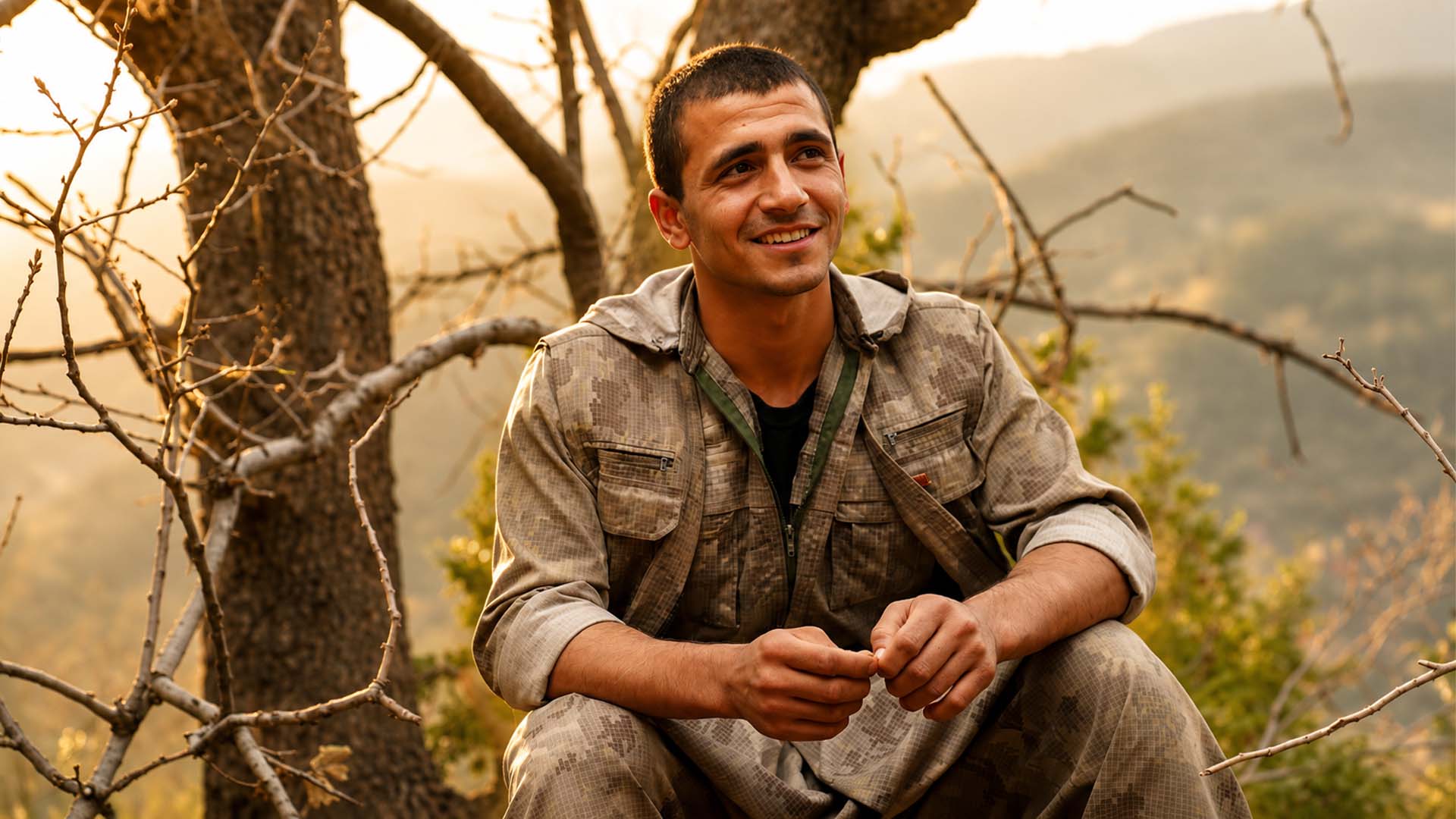
He used to say: “I will become a fighter who will never be forgotten.”
Thought, but what kind of thought? Feeling, but what kind of feeling? Life, but what kind of life?
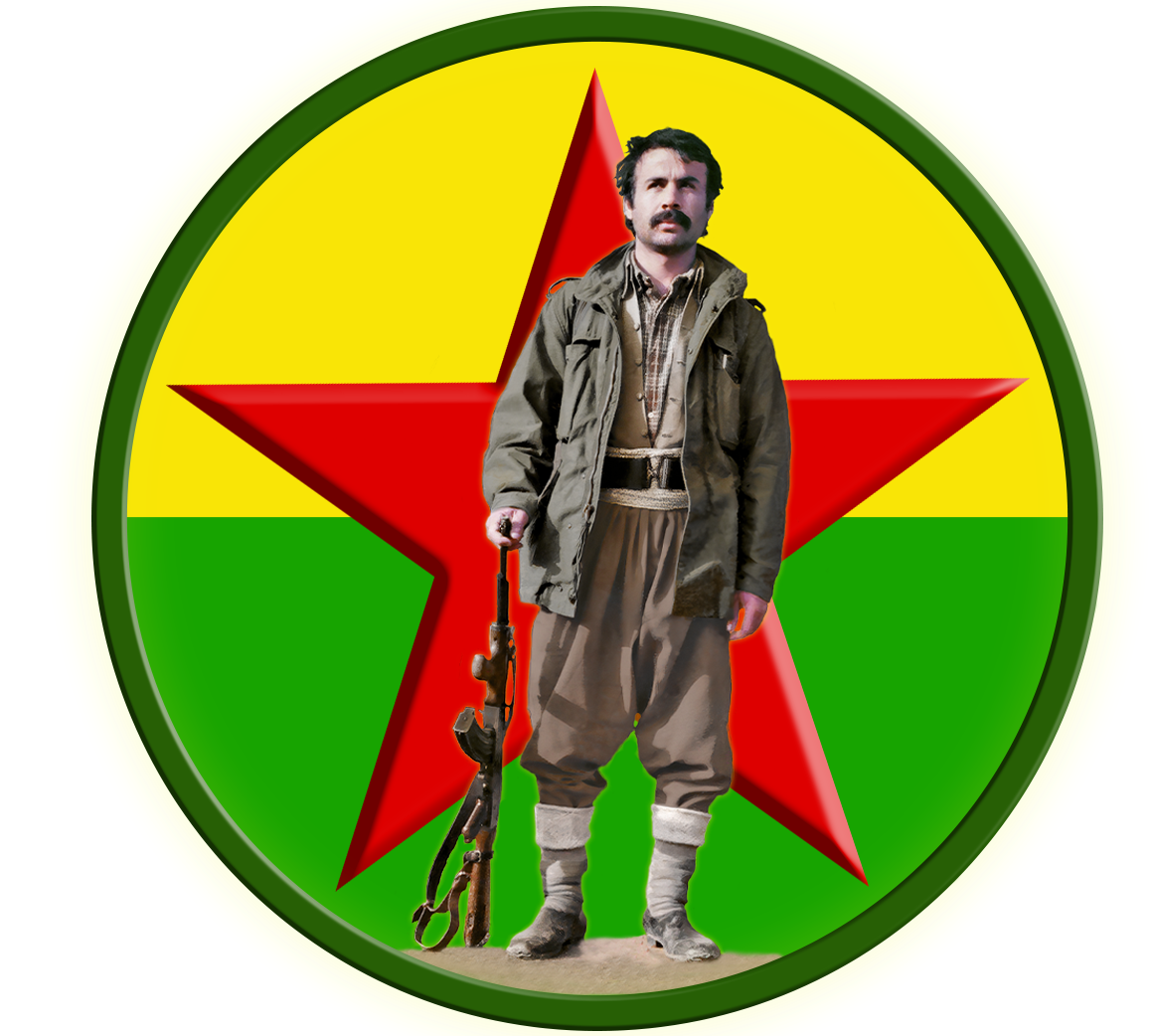
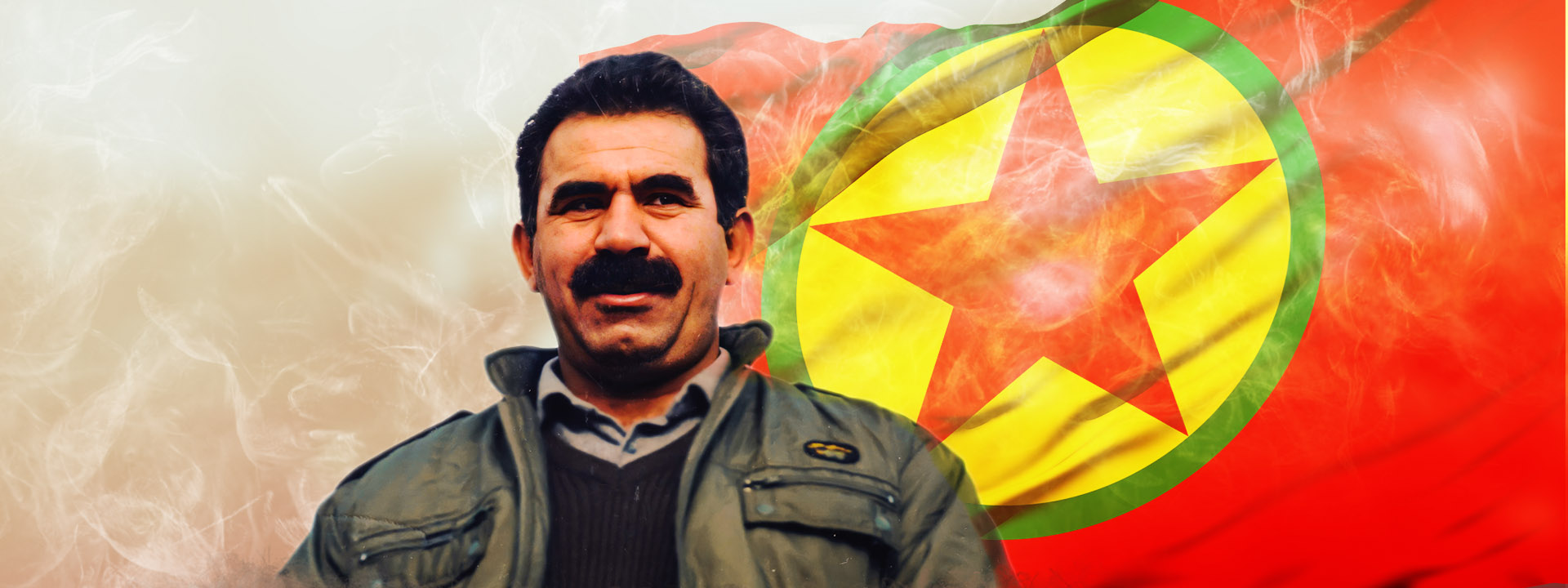
These questions were always turning in his mind, and he was searching for their answers. His name was Elî Demlexî. He grew up with that name, and later, until his final moments, he ran toward the summits with his name. He used to say: “I will become a fighter who will never be forgotten.” The majesty of the mountains found its place in his personality. Like falcons on the free summits, he became a person of will and courage. With the will in his heart, he wanted to follow in the footsteps of Martyr Ezîz and Martyr Rojbîn, and to become an example for his people.
When the Kurdistan Revolution began, it revealed a truth. This truth was not only the freedom of the Kurdish people, but at the same time the freedom of the other peoples of Kurdistan and the Middle East. Within this revolution, the Kurdish, Arab, Turkmen, and Armenian peoples pursued their freedom together. The battle was great, and the enemy was being struck step by step on the battlefield. Those who had planted hopes of freedom in their hearts knew that this was a battle to be freed from subjugation and to build a common life together.
The roots of the unity of peoples grew green like a sapling with the Rojava Revolution. The Rojava Revolution, which developed through Leader Apo’s idea of the Democratic Nation, especially influenced the Arab people and all the peoples and faiths living in the region. This revolution of freedom became a new breath for the peoples, enabling them to unite with their culture, art, language, philosophy, and concepts of freedom, and to create a free and shared life. Elî Demlexî also lived with this truth in the winds of the revolution; he loved, thought, deepened himself, and made himself a true comrade of the revolution.
“He Walked in the Footsteps of Martyr Faysal Abu Leyla Toward the Revolutionism of Peoples”
Elî opened his eyes to the world in the city of Manbij, in a family from the Demlexî tribe. Those who protect their identity can become true patriots. Elî’s family was also connected to its roots, and at the same time had very good relations with other peoples. Elî grew up with this truth.
At school, the Baath regime used schools as a main field to promote Arab nationalism and separate peoples from one another. Despite all these efforts, Elî did not fall under the winds of nationalism, because he had not grown up in such a family and environment. He left school in the sixth grade and began working.
The Rojava Revolution had a great influence on him, but he experienced the main impact when his city was liberated from the darkness of ISIS. Elî, together with his family, like thousands of other families, saw this liberation from darkness as opening his eyes to life once again. For him, that black, emotionless, colorless, lifeless existence was left behind, and a free life began. Through this influence, he came to know the ideas of Leader Apo. He was especially influenced by Martyr Faysal Abu Leyla and the martyrs of the Manbij liberation campaign, and a new path began to open before him step by step.
On this path there was selfhood. On this path there was an honorable freedom. On this path there was the bringing of a life left in darkness into the light. He, too, walked toward this light.
“He and His Sister Turned Their Faces Toward the Fields of Revolution as Two Comrades”
Newness creates great excitement in a person’s horizons. In every new stage, a person feels, understands, and gains important experiences. Hopes that become knots in the throat suffocate a person more and more with time, and every wind brings with it lost loves. In order to untie and overcome these knots, one must take new steps. For Elî, this step led him toward the revolutionism of peoples.
The people of Manbij celebrated the day their city was liberated from ISIS as a day of celebration. Many young people tied their existence to the revolution and turned their faces toward its ranks. Elî and his sister also knew that freedom could only be realized by taking responsibility. If they wanted to gift free tomorrows to the peoples, they too had to fulfill what fell upon their shoulders. With this depth of understanding, he and his sister turned toward the ranks of the revolution with firm determination. In the ranks of the Rojava Revolution, he and his sister, in the same trenches, fought the war of dignity like two comrades whose hearts beat for freedom.
In 2017, he began his work. In his first step, the story he had carried until then under the name Elî would now continue under another name. This name was the name of the hope that had branched out in his heart and in the hearts of millions: Azad. He took the name Azad Serab. Azad was a young man of thought and belief, and he wanted to realize his hopes. This hope would make him one of the symbols of the brotherhood of peoples and the Democratic Nation.
In 2019, when the Turkish state’s attacks on the Rojava Revolution increased, Azad saw the need to develop himself militarily, and he advanced very quickly in many branches. He approached military practice as an art and wanted to become an expert in this art.
“The Freedom March Toward the Mountains of Kurdistan”
There are some people whose names carry them forward, and there are others who turn their names into a great story. Azad, in order to achieve the freedom of peoples, turned his face toward the mountains of Kurdistan as a worthy young man of the Arab people and joined the great battle. This step made him deeply joyful, because he was stepping toward truth, toward freedom, and he was enlarging the enthusiasm in his heart so that the feelings suppressed within him could grow green once again.
He was now a guerrilla in the heights of the mountains. Each of his steps would become an epic, a hope, and a seed planted with longing. Without recognizing any pause or barrier, he joined the works and duties of guerrilla life. From his very first moments, he became beloved within the comradeship of the Freedom Movement, and he was deeply loved for his humility, longing, and courage.
The greatness of his heart shone on his face. He never let the smile of freedom leave his face. This was what made him loved. For him, the tambur was the sound of hope. In every touch upon the strings of his tambur, one could see how great his feelings were. In one of his reflections, he said: “The tambur is the sound of a lost love. We are following this love step by step. For us, this love is nothing other than freedom.”
These words were a truth in Kurdistan. They removed within themselves the differences and divisions of religion, language, culture, belief, and nation. With his melodies and the sound of his tambur, wherever Azad was, he gave spirit to that place and gathered all his comrades around him. His comrades always wanted to feel the smile on his face and sing songs of freedom to the sound of his tambur. Azad’s smile was filled with hope and purpose; especially when he smiled in the midst of war, it became a source of morale and motivation.
“With Great Persistence and Desire, He Turned Toward the Fields of Resistance”
He strengthened the reasons for his participation day by day. He knew that the existing resistance was for the liberation of all peoples. For this reason, with great desire and insistence, he wanted to take his place on the front lines. Because he was a person of trust, he took his place in mobile teams. In camouflage, concealment, and military discipline, he never made concessions. In this respect, he became a concrete example in the field.
The war in the Medya Defense Zones grew more intense day by day, and at the same time Azad’s desire grew with it. For him, there was no longer any stopping; to stop, in his view, meant failing to protect the legacy of the martyrs. With this determination, he turned his face toward the western side of the Zap water.
Guerrilla Azad drew the attention of all his comrades in war with his active participation and courage. He possessed a participation without calculation and without hesitation. In the field, he took part in many actions developed against the enemy. His command of his weapon, his discipline, and his tactical mind enabled him to play a major role in these actions.
“With His Martyrdom, He Became a Symbol of the Brotherhood of Peoples and the Democratic Nation”
Guerrilla Azad, through both his life and his struggle, became a committed representative of the idea of the Democratic Nation and the unity of peoples. Until the final moment of his life, he walked and struggled on this foundation. On June 22, 2023, Guerrilla Azad reached martyrdom in the Zap region and joined the immortal caravan of the brotherhood of the peoples of Kurdistan.
Many heroes of the Kurdish and Middle Eastern peoples sacrificed their youth for the freedom of peoples. They removed all the contradictions that had been planted among peoples by the hands of occupiers. Their aim was clear and pure like the universe. They knew many languages, but the language they spoke was the language of truth. This truth will tear down all the walls built between peoples and will bring about the passage from darkness into light.
Guerrilla Azad, too, following this truth, became the owner of a full and meaningful life. The flag he received from the pioneering Arab martyrs, Martyr Ezîz Ereb and Martyr Rojbîn Ereb, he carried successfully until the final moment of his life, and through his stance he became a great example. This is a truth in Kurdistan that will never be forgotten; those like Azad will always be part of the free unity of peoples.