
The Jews pioneered the creation and development of the middle class. When the Prophet Abraham emerged in the seventeenth century BCE, he had a connection with the Hyksos.
While the Mitanni remained in the north, the Hyksos spread toward Egypt. The Jews acted as an intermediary link between the Babylonians and Egyptians, trading between the two and connecting them. The Jews are the creators of trade and of the middle class. Naturally, Assyria, Ionia, Athens and Mycenae-Crete also played important roles in this.
How and why did the middle class and aristocracy emerge? A concentration occurred with the growth of settlements and tribes that developed in the Neolithic and afterward. Just as Göbekli Tepe developed and spread in Upper Mesopotamia over five thousand years, the Neolithic development that led to the birth of aristocracy also took place in Central Mesopotamia. The Tell Halaf culture corresponds to this period, the time in which ethnicity developed. Tribal chiefs and all the families that became wealthy in the village turned into an aristocracy. The reason was that the caste had now lost its power of control. Developments based on communal units began to spread throughout the region, making it impossible for the already small caste to supervise and contain them. Aristocracy was therefore developed in order to control and supervise developments taking place in favor of sociality. A somewhat more flexible form of caste had now appeared and steps toward class formation had been taken. The age of aristocracy began. With Rome’s collapse, aristocracy changed, assumed a new form, transformed into dynasty, monarchy and nation-state, and was defeated.
The middle class prevailed over aristocracy in a conflict lasting thousands of years. In England, aristocracy transformed into the bourgeoisie. The Islamic Revolution was a bridge between aristocracy and the middle class, or bourgeoisie. The Sassanids dominated South Arabia and Byzantium North Arabia. In Central Arabia, aristocracy dominated everything, but there was also a new commercial bourgeoisie seeking to develop.
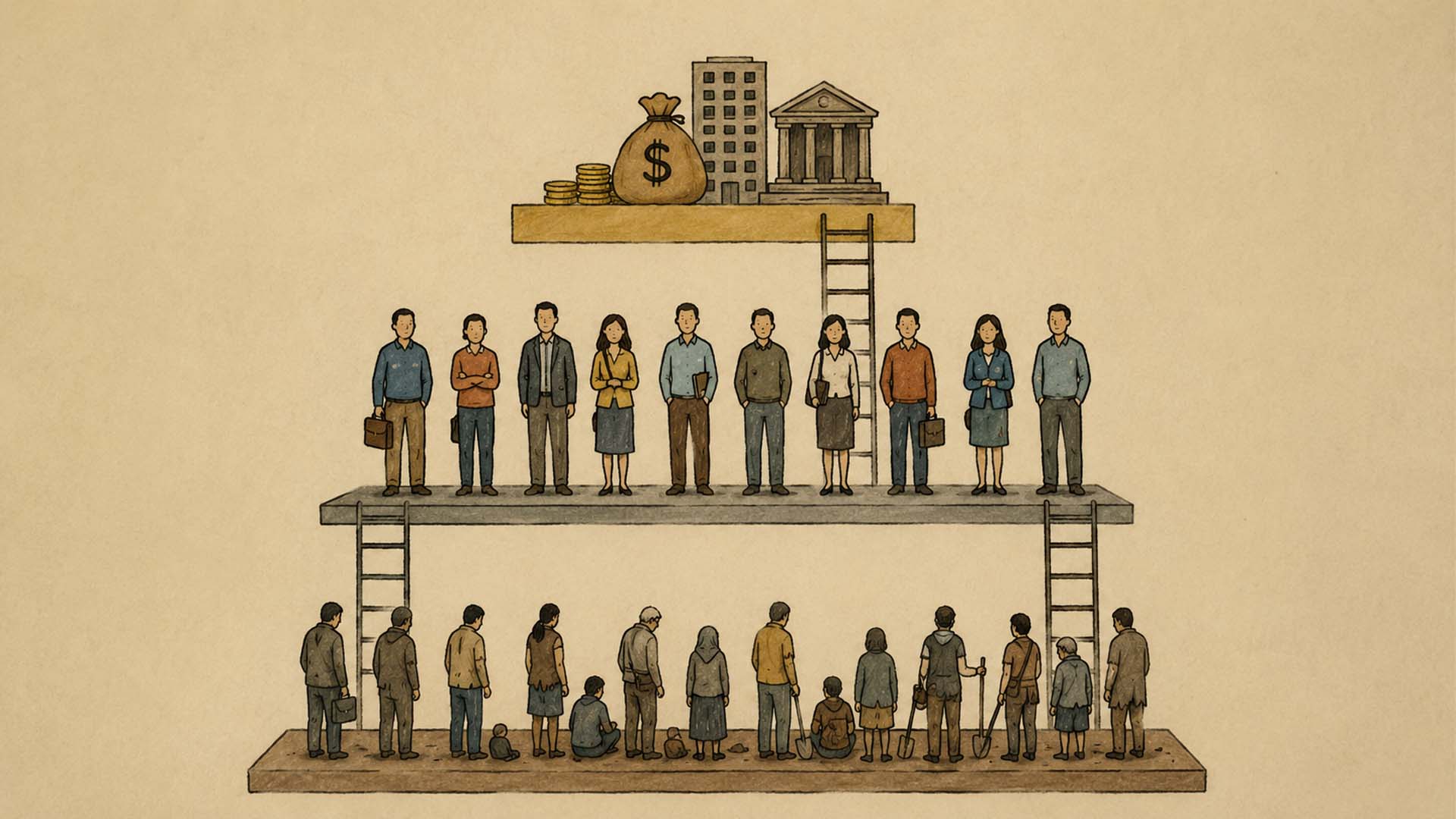
The middle class is an intermediate class. It is an infiltration that developed between the oppressed and the post-caste aristocracy. Through commerce, crafts and usury, it buys from the aristocracy and sells to those at the bottom, buys from those below and markets to those above; it takes artificiality rather than originality as its basis. It defeats aristocracy with money. Initially, money facilitated life or exchange. It was an instrument with exchange value. At first, “seashells, gold, salt and obsidian” were used instead of money. One buys what one needs with money. The moment it is said, “so many sheep, so much wheat, wool or eggs in exchange for this object,” money has entered the picture. Today, in the financial age, trillions of dollars in virtual money with no equivalent are in circulation. Money is also made without producing anything, through games involving the stock market, interest and foreign exchange. The state is the product of the marriage between the secular god and the heavenly god. The state is the illegitimate child of this marriage. The union of money and Yahweh led to the state.
The Jews are the best example of this class. The later Mosaic and monotheistic religions are also versions of it. At first the middle class was a minority, but with the capitalist process it reached an enormous size—so large that it became a population that consumes and devours the social structure. The disappearance of society has now become the most fundamental problem. Hitler and Stalin are products of this class. There appears to be no sphere on which this class has not left its mark. Rather than class analysis, it is necessary to focus on caste and aristocracy. Throughout history, statist class civilization was built by three mercantile sections: priest-ruler, bureaucrat and soldier.
History has seen three great middle-class revolutionaries: first Abraham and his successor, the Prophet Muhammad; second Robespierre; and third Lenin. Even when undertaken in the name of socialism, the middle-class outlook was not overcome and socialism was used as a mask. The Right of Nations to Self-Determination was used as a tactic, a temporary outlook intended to prevent disintegration. It fully reflects a middle-class outlook. Excessive use of violence, spreading terror and essentially crushing those at the bottom are fundamental characteristics of middle-class leaders. This is why socialist revolutionaries, the Kharijites and the barefoot were massacred. It is also why today’s crisis is taking place. It is the middle class’s greatest crisis. Those at the bottom can resist throughout history and even win their freedom, but ultimately they cannot go beyond resembling the master. They do not know what to build.
The first uprising and ideological leadership of the middle class were carried out by the Jews. Moses’ exodus from Egypt may be regarded as the middle class’s first revolutionary step. The second step was for this ideology to rest on a certain mass base, exceed the limits of Jewish tribalism, spread in a more general and universal sense, and extend to a particular social base. This may be regarded as its period of socialization, and the Islamic Revolution as the process of its politicization. This struggle lies at the root of the Muawiya-Ali conflict. It was carried to Western Europe by the French Revolution and to the East by the Bolshevik-Chinese Revolution. These were middle-class revolutions. Because Stalin killed six million peasants, he was able to find slaves to work in the industrial drive; otherwise he could not have achieved industrialism. Through the force and violence of the state, he dispossessed people and procured and employed slaves and the unemployed to work in industry. This is also what happened in China: under the mask of socialism-communism, bourgeois elements are created, the middle class is produced, and working sections are turned into cheap labor and instruments of exploitation.
The middle class is opposed to democracy. It rejects monism mentally and practically. One class means the Russian class; one nation means Hitler’s nationalism. A monistic religion, sect and patterns of thought lead to fascism. The ideas of both class and nation are products of the German structure of thought. Judaism is the first form of this mode of thinking.
Today the middle class is a scourge upon humanity. The existing system rests on the middle class. This structure that has arisen is now chiefly responsible for collapse, depression and crisis.
NOTE: COMPILED FROM THE MANIFESTO.