


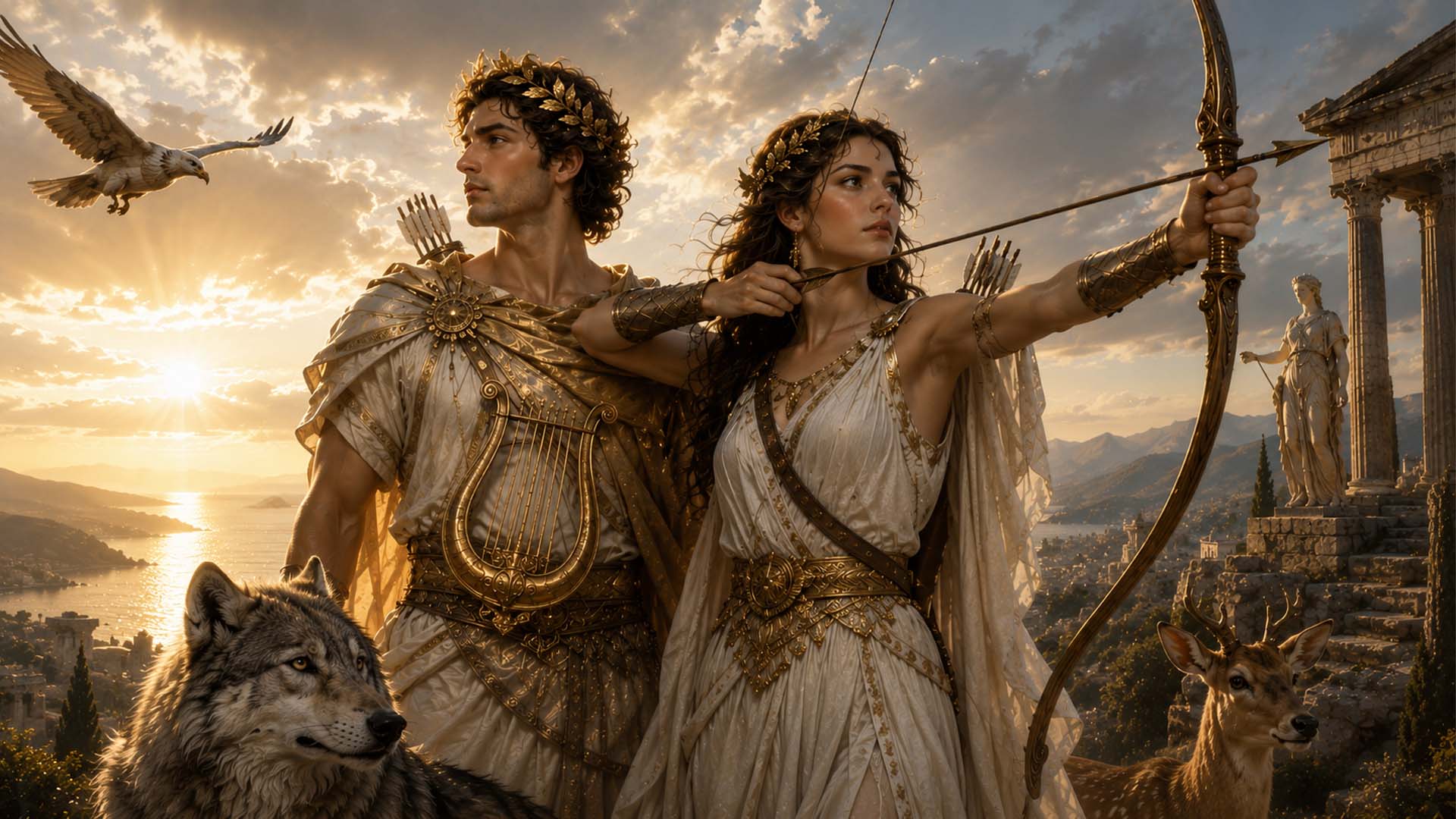
Apollo is known as the god of the sun, light, and the guide of truth. He is also defined as the god of music, but he is known most of all as the god of light. His name is not Greek.
Like Dionysus, his roots are from Anatolia. He too, as an Olympian god and like Dionysus, is different. His roots are from Anatolia. His mother is the Goddess Leto. “Leto” comes from “Lat.” Leto is in the Greek language, and its essential root is Lat. In fact, Lat is the goddess of Lycia. In mythology too, it passes in this way: Apollo’s origin comes from Lycia, that is, from Anatolia. They say that in the Trojan War he took Hector’s side; in other words, he took his place on the side of Anatolia and protected the people. They say Zeus fears Apollo greatly, and when Apollo is mentioned among the Olympian gods of Greece, their hearts tremble with fear. They fear the god Apollo most of all. Because he is the god of protection, and his warrior aspects are very prominent. He is known as the “god of arrows.” Apollo has divine qualities. He is the god of righteousness and truth; he never lies. This is also the continuation of Zoroastrian culture. He takes truth, enlightenment, and the sun as his basis. At the same time, these are the characteristics of the Leadership. The Leadership says:
“Can you find even a speck of trickery in my intelligence?”
But when Greece and patriarchal culture are mentioned, what immediately comes to mind is trickery, lies, and conspiracy. Apollo, however, is the opposite of this. In this sense, Apollo is important. There is a striking point here. When Apollo is discussed, Artemis must also be discussed. She exists in Anatolian mythology and later passed into Greece. It is said that Apollo and Artemis are brother and sister. Artemis is Apollo’s sister, and their mother is the Goddess Lat. Artemis is also known as the goddess of fertility, earth, and the moon. Artemis was accepted most of all in Lydia, in Anatolia. Artemis is a great goddess. They say that the statue of Artemis has now been found near Ephesus, İzmir, and the temples of Artemis are already there. Likewise, Artemis is the symbol representing virginity. When she went to Europe, Rome, and Greece, Artemis’s aspect of virginity was also strong. In the time of Christianity too, virginity is seen as sacred; it takes its foundation from Artemis. Artemis is known in Europe more as a virgin. But on the Anatolian side, she is known more through her aspect of fertility. In the statue of Artemis, she has forty breasts; this too is a symbol of fertility. But it is a striking point: when Artemis goes to Europe, she is known as the symbol of virginity. They say that in Christianity, the foundation of virginity and sainthood developed on this basis. For thousands of years, a culture was formed on this basis.
The name Artemis is not Greek. It is an Anatolian name, because “Art” carries the meaning of “earth and sun.” In fact, Artemis is the Goddess of the earth. Another striking matter is this: Artemis emerges in Ephesus. In the same place, the Amazons also emerge; they accepted Artemis as their own goddess. Likewise, philosophy also emerged in the same place. The first philosophy, before emerging in Greece, emerged in Ephesus, Anatolia, Ionia. They say that Heraclitus is one of the greatest philosophers; this philosopher emerged in the years around 500 BCE in Ephesus. They say he wrote his most important book on nature and dedicated that book to the Temple of Artemis. Heraclitus took his inspiration from Artemis. Artemis is known as the “Goddess of the Arrow and Bow.” The characteristics of Artemis and Apollo resemble one another. Artemis is the goddess of protection and protects young girls. In mythology, three kinds of archer gods and goddesses are mentioned. One is the archery of Apollo, the second is the archery of Artemis, and the third is the archery of Ares or Athena. The qualities of all of them are warrior-like. But what is the difference between them? They say Apollo and Artemis are the god and goddess of protection. But Ares and Athena are the god and goddess of war. It is said that Ares and Athena represent patriarchal culture, while Apollo and Artemis represent Neolithic culture. As was said, Apollo is the son of the Goddess Lat. He and Artemis are brother and sister. The Greeks feared Apollo and Artemis most of all. Because they are very strong in the field of war.
It is striking that Athena was created from Zeus’s brain; she has a shield and is seen like a man. It is said that the word Ares also comes from attack. Because he always attacks. But this attack is for protecting his own land. There is a difference between the two wars. Ares and Athena represent Greek patriarchal culture; they represent the Achaeans and Achilles. In the Trojan War, they came in the name of Achilles with the aim of occupying Anatolia. Behind Achilles are the god and goddess Ares and Athena. But behind Hector — Hector defends Anatolia — are Apollo and Artemis. Even Aphrodite is there as well; likewise, all the Neolithic goddesses and the Amazons took the side of Troy. But the others took the side of patriarchal culture.
In mythology, Ares is said to be a raging god; his arrow and bow were made of iron and bronze. He throws his arrow and bow randomly, attacks everywhere, and for this reason no one likes him. In the same sense, he is the god of theft, war, and plunder. Athena is also like this; she was created from the brain of a man, fights according to man, and protects Athena. Apollo and Artemis also have the arrow and bow, but this arrow and bow is for protecting the people. Hector represents heroism, and on this basis they stand behind Hector. In mythology, it is said that the arrow and bow of Ares and Athena were made of iron and bronze. But the arrow and bow of Apollo and Artemis are more different. They say Apollo’s arrow and bow are silver, and Artemis’s are gold. For this reason, it is said that gold and silver represent the technique of Neolithic culture. But iron and bronze represent the state and civilization. There is a difference between the styles of the two wars.
Today, the Kurdistan Freedom Movement also wages a war of defense. The aim of the Kurdistan Freedom Movement’s war is not like that of Ares: theft, seizure, plunder, and power. The aim of the Freedom Movement’s war is defense and self-defense. That is why the Leadership said, “Apollo.” Kurdish women today also protect women and society. They are warrior women. Artemis expresses the same thing. That is why the Amazon warrior women said, “We are the priestesses of Artemis.” In the Trojan War, they waged a very strong war and gave great assistance.
How was Hector defeated? Athena created trickery and conspiracy. Under different appearances, she spread Hector’s weakening and told lies. On these bases, Artemis and Apollo are important. Especially Artemis passes into history as a warrior woman. She fought against patriarchal culture in order to protect her city.