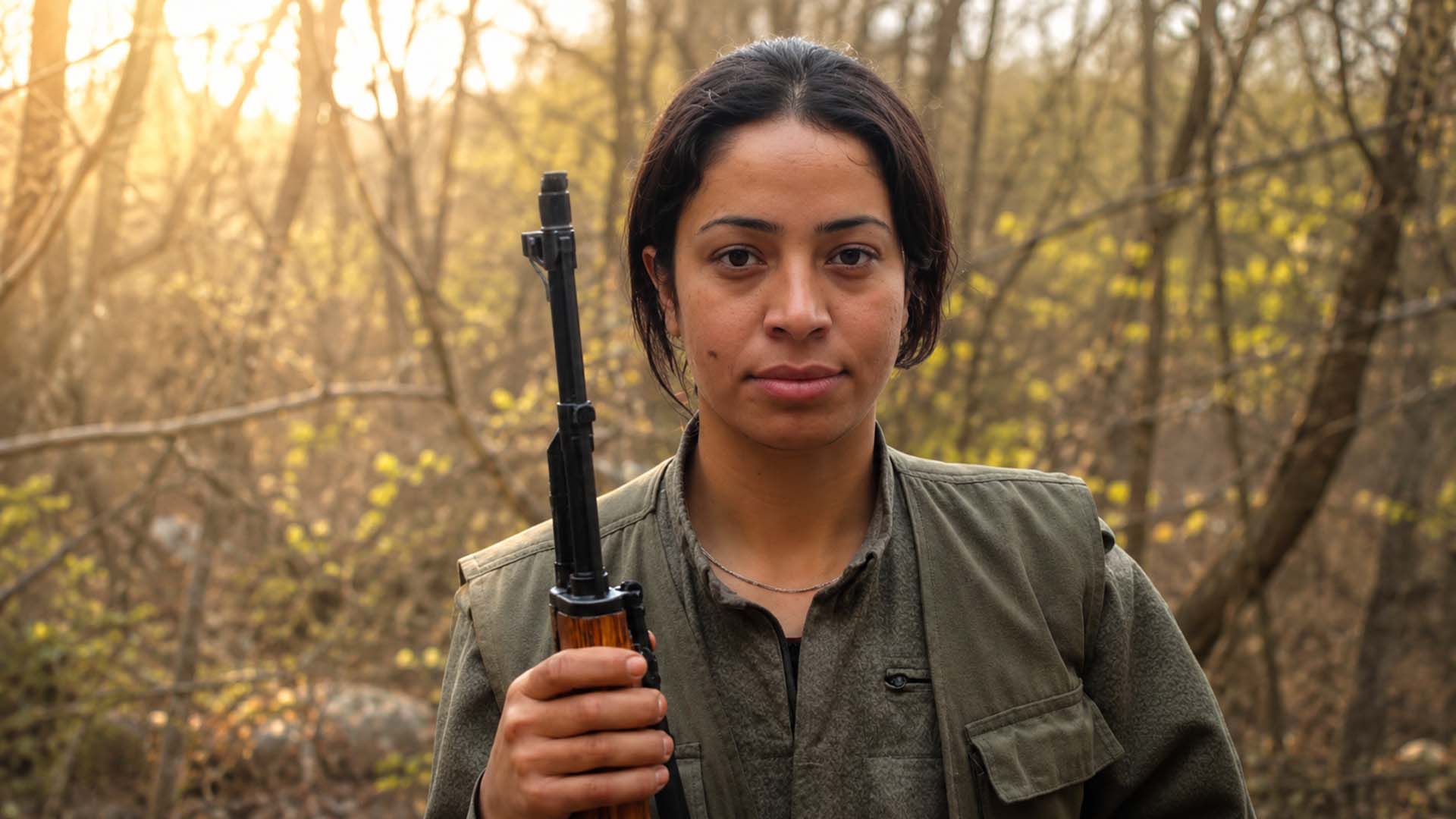
SHE NEVER EXCHANGED HER LOVE OF THE HOMELAND FOR ANYTHING
“Our martyrs: those who made life truly life; those with whom we laughed in the face of pain; those who added joy to our happiness; those who multiplied our hope and carried roses into our future…”
Kobani is the name of the center in Southwestern Kurdistan best known for its hardworking character. Whenever Kobani is mentioned, two things come to mind: first, labor and diligence; second, feudalism. Feudalism, as is well known, means narrow-mindedness, pride, arrogance, and, of course, vindictiveness and tribalism. Labor and diligence, however, mean becoming more beautiful, contributing to life, and recognizing no limits in self-sacrifice.
With the war for freedom, Kobani acquired yet another characteristic: patriotism and militancy. It also came to mean fighting on the foremost front of the freedom struggle.
Although Kobani has a feudal social environment, hundreds of young people from Kobani made their way to the mountain peaks and contributed significantly to the struggle for freedom. The first woman martyr from Southwestern Kurdistan was from Kobani. Her name was Dicle. The most prominent woman revolutionary raised in Southwestern Kurdistan was also from Kobani. Her name was Şilan—Şilan Kobani, namely Meysa Baki.
Thus, with the war for freedom, another Kobani reality emerged. What matters now is a Kobani made even more beautiful through the freedom struggle.
Beritan Welat was from Kobani. She came to the mountains of freedom in 2008 and quickly adapted to guerrilla life. Beritan was a woman guerrilla. A comrade who joined the guerrilla ranks during the same period describes her in these words:
“When I was among the new fighters, Comrade Beritan once came to visit us. We met at a time when we had only just begun guerrilla life. Comrade Beritan had left the group of new fighters for that battalion one week before me. Yet while I was on my way there, everyone I met would say, ‘Give our greetings to Comrade Beritan.’ They never forgot to add that she had only recently joined and that she had a very beautiful smile.
When I arrived at the battalion, my eyes searched for Beritan. I wanted to see the smile everyone had spoken about. When I looked at the faces of the comrades there, I recognized that smile on their faces. Beritan was present in those smiles. There was warmth in them—the warmth of comradeship. It was a sincere, endless, and warm friendship. This was how she participated in life. In every conversation, every discussion, and every word she used, she conveyed that warmth. Her search was always centered on this. Whenever things were not like this, she struggled, because all her thoughts and beliefs were rooted in friendship. She had heard of the comradeship of the PKK and had grown up with it. She had turned toward the mountains for the sake of that comradeship.
Comrade Beritan and I spent one period of practical activity together—one winter and one summer. We were supposed to remain together for another period, but unfortunately we were confronted with her martyrdom. During the winter we shared, although she had not yet completed even one year, she was the one showing us the way. We admired her curiosity, enthusiasm, desire, and stance. We wanted to be like her. Sometimes I was astonished and wondered how someone so new could unite with the mountains so quickly and guide comrades who had been there longer than she had.
She lived according to her dreams. Comrade Beritan greatly wished to go to the Zagros. I told her many times, ‘How can a person fall in love with a place she has never seen?’ The Zagros was the birthplace of humanity, and that was why she wanted to go there. She wanted to live as a guerrilla in those mountains. For her, this was a deep longing. She always kept her hope alive by saying, ‘One day I will certainly go to the Zagros.’ She did not speak of it very often, but whenever the Zagros was mentioned, her eyes revealed everything. When you looked into her eyes, you could see that love, that devotion to the Zagros, and that deep enchantment.
Her love for her land and her country was one of her defining characteristics. As the Leadership says, ‘A woman’s attachment to the land and her patriotism are very strong.’ In the personality of Comrade Beritan, we could clearly see love for the homeland and the soil. Indeed, Comrade Beritan was betrothed to the land of her country.
Beritan came from a feudal family. Kobani is a feudal place, and women there are therefore raised within a feudal culture. Comrade Beritan, too, had been engaged at a young age in accordance with these feudal traditions. But she did not sacrifice her covenant with her land for a covenant with a man. She had pledged herself to the Zagros. On the basis of that pledge, she carried in her heart the hope that one day she would reach those mountains. Comrade Beritan had come to the peaks for the sake of this longing.
It was April 2010. In that spring, only a few days remained before she would complete her first year. It was such a spring. Like everyone else, Comrade Beritan was waiting impatiently for the technical training we were receiving to end so that we could go to the practical areas where we would apply what we had learned. As she herself used to say, she was good at marksmanship, and everyone wanted to hit the target as she did. She had received good sniper training and would have become a skilled sniper.
Before Beritan Welat could fulfill her pledge, she suddenly left us, becoming wedded to the land to which she had been betrothed. On 6 April, as a result of a howitzer attack, Comrade Beritan and two of her comrades joined the caravan of martyrs. She lived the year she was about to complete to the fullest, with her devotion to the Leadership, her guerrilla spirit, and her comradeship. What remains to us from her is to run toward the love she carried for the mountains…
How fortunate we were to know you. How fortunate that, as we walked the paths of life, sharing a morsel of bread and drinking a sip of water together, we also lived, divided, and shared with you!
How fortunate that we traveled these paths with a comrade like you, whose smile was so beautiful.
Your path will always be our path.”
Code Name: Beritan Welat
Full Name: Zeynep Xelil
Date and Place of Birth: 1986, Kobani
Mother’s Name: Sewli
Father’s Name: Xelil
Date and Place of Joining: 2008, Kobani
Areas Where She Served: Zap
Date and Place of Martyrdom: 6 April 2010, Zap
Comrades in Struggle