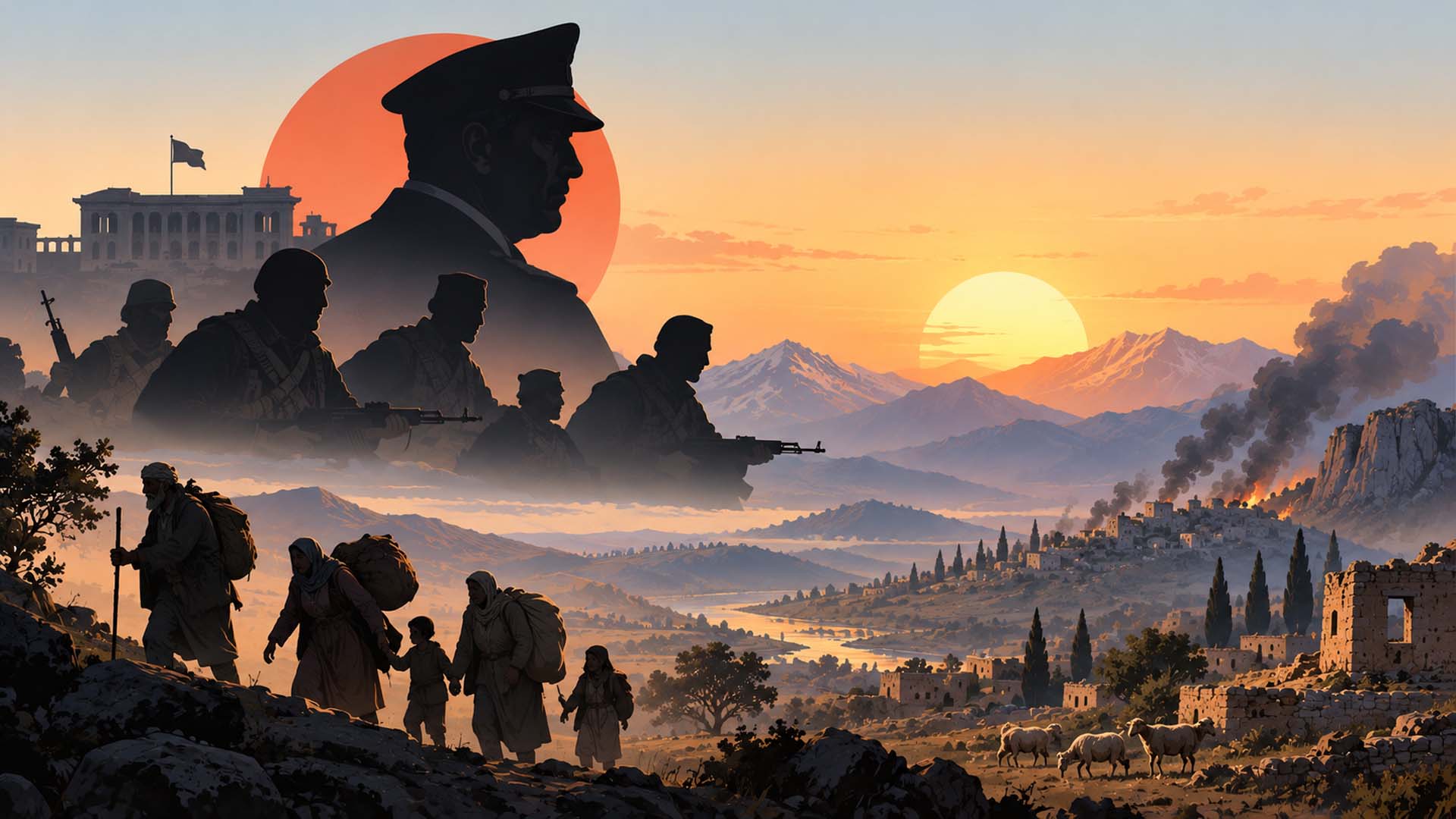
Those who carry out the massacres perpetrated by the system within the special-warfare order are not just any ordinary force in the army.
They are companies formed specifically within the army. There are also gangs that join the army as a group. Topal Osman, for example, has this characteristic. He is from the Black Sea region; he is a gang member. He commits robberies, blocks roads, launches raids, and establishes his own rule through that gang organization, that gang mentality, and those gang attacks. Gradually he becomes a force. In such a process, there are the relations M. Kemal establishes with these people. This time they join the army collectively and become a special unit within it. There is someone called Sakallı Nurettin Pasha, who takes command of the army. Topal Osman is with him too. These are also the people who carry out the Koçgiri massacre in Kurdistan. These are also the people who carry out the massacres against Hontus and the Pontians. In other words, special forces are used in these massacres. And these special forces enjoy freedom of action and the authority to kill, rob, torture, and seize property. They are given the authority to rape, and they do so without restraint. In other words, giving them free rein to commit every kind of war crime and leaving them untouched is implemented as part of the thrust of its organizational and warfare methods. These too must be considered within special warfare. There are other things as well. The Committee of Union and Progress has disbanded, but the Special Organization, Teşkilat-ı Mahsusa, maintains its organization. This Teşkilat-ı Mahsusa is not a structure organized only in Istanbul. It is organized in Damascus, Baghdad, and the Caucasus more than in the cities of Anatolia. These people also have an ideological outlook. The Turanists have a mindset imbued with Turkism and racism. Whether in the Caucasus, Baghdad, or Damascus, they have special organizations in such places where they organize, form special action units, and pursue special and underground organization. Of course, in the process of the Ottoman state's transformation into the Republic of Turkey, these become a foundation inherited by those who establish the Republic; they not only inherit it but also continue its existing policies. In these respects, the formation of the Republic of Turkey is characterized by its organizing itself as a force that brings itself to power through top-down conspiracies and massacres, relying predominantly on the military bureaucracy. Indeed, internal conspiracies continue even after they establish their rule. Kazım Karabekir is sidelined. There are also people such as Rauf Orbay and Fethi Okyar, known as M. Kemal's comrades-in-arms; they too are neutralized. So much so that an assembly has been established in Ankara, yet even members of parliament are killed through conspiracies. The state structures itself on that basis. In such a structure, once a certain result has been reached and the national borders have been imposed, they turn against whoever remains within those political borders. They target the Kurds, Islamic circles, and socialists alike. They target whoever stands against them. They also target the Alevis specifically. They see all these groups as obstacles in their path, as distinct centers of power. They want to establish their own existence by eliminating those obstacles. Nor do they stop there; they also want to consolidate their dominant ideology, and they do not stop there either: they begin implementing the nation-state strategy in the harshest and most conspiratorial way. For that reason, these are turned into areas where the state's nation-building is created and developed. Accordingly, the aim is to Turkify the Kurds, the Laz, and communities of other ethnicities known as Muslim communities. The aim is to Sunnify the Alevis and further diminish them. Thus, in terms of culture and identity as well as belief, the nation-state model being developed, or being sought to be developed, on the Turkish Anatolian lands of the Republic of Turkey, the nation-state's nation-building, begins to be imposed throughout the Republic's existing borders. All this happens within the framework of special plans. In other words, it does not arise on the basis of a problem occurring and an immediate decision to eliminate these problems. For example, there is the Eastern Reform Plan. Before that, there are decisions to establish the Independence Tribunals. There are texts setting out the grounds for establishing the Independence Tribunals. There are the objectives of the Eastern Reform Plan. All of these are plans aimed at bringing about Turkish state nation-building. All of them are developed through special practices and laws. Does special warfare not mean a system constructed through laws, practices, and courses of action? It does. All of these are characteristics present in the formation of the Republic of Turkey. It describes the ground on which military occupation, annexation, and assimilation policies are developed in Kurdistan. Let us pay attention: up to the 1950s, most of the courses of action we consider within special-warfare strategies are already being implemented across Anatolia and Kurdistan. If it is a coup, a coup is carried out; if it is genocide, genocide is carried out; if it is assimilation, steps to advance it are taken and implemented. If it is the denial of existence, that is achieved through these measures. People always speak of social engineering; the Republic of Turkey's reality of formation takes the shape of such engineering plans. These also become the solid foundations for the formation of a special-warfare system and regime. On these foundations, a renewed campaign of occupation is conducted in Kurdistan. But this occupation develops within a new plan. It is true that all of Kurdistan is targeted, but they do not move against all of it at once; they proceed piece by piece. First they identify the most strategic areas, identify the weakest points in the most strategic areas, develop provocations at the weakest points, treat those provocations as a pretext, and launch attacks to bring that place under military control; they pursue a policy of genocide and displace people from their homes and homelands. Once they have done this in one region, they go to another and put a similar strategy into practice there too. From there they go to another. That is why it is said that the Genç-Palu uprising is the beginning. It is also described as the Sheikh Said Uprising; the process extending to the 1940s is what is meant. What is called the Kurdish uprising is always, there, the attacks launched to bring Kurdistan under supervision and control piece by piece. The uprisings that take place are the people's legitimate self-defense against attacks. Legitimate self-defense becomes an uprising. But legitimate self-defense there is a war to protect oneself; against whom? Against occupation and genocide. Now, when these occupation attacks begin in Kurdistan, there are also decisions taken at the same time, and these are expressed very clearly in the Eastern Reform Plan. There is the displacement of Kurds from where they live, and the settlement of Muslim Turkish migrants brought from the Caucasus and the Balkans in places from which Kurds have been displaced. They are settled in the regions from which Kurds have been removed. Or they are settled in the most strategic areas of Kurdistan's geography. They subject the Kurds to genocide and exile, and outposts are built in the most strategic places, while road construction begins.
(B): There are also special units, and these are set in motion. These describe their continuous attacks from one part of Kurdistan to another. They take the form of practices that show how Kurdistan was occupied anew. Now there is the Kurdish plan İsmet İnönü prepared during that process. According to that Kurdish plan, for example, Turkifying the area west of the Euphrates is taken as the basis. It is said that if the west of the Euphrates is Turkified, the Kurdish question will be resolved. Once the Kurds are confined to a particular area, they will be Turkified through special policies, and opportunities to subject them to genocide will emerge there. In other words, military occupation and annexation in Kurdistan are implemented alongside policies of assimilation, that is, the advancement of cultural genocide. It is true that some come to the fore at certain times, but even when some come to the fore, the forms through which colonialism is realized are being implemented in Kurdistan. It has this characteristic. When the military occupation process is completed on its own terms, the groundwork for assimilation has already been prepared, laws have been enacted, and efforts have been made to steer people toward that point in certain respects; assimilationist policies can then come into operation on that basis. The Republic of Turkey's political institutions can be transferred, one by one, to every part of Kurdistan. All of this takes place within a particular planning framework. Finally, there is also Kurdistan's economic plunder. Not only its underground wealth is seized: with the seizure of its wealth above ground as well, Kurdistan becomes a market. It does not merely become a market area; in Kurdistan, which has been turned into a market area, Kurdistan's society is also placed in a position where it is to be transformed into a Turkified society. In these respects, Kurdistan's society is brought under domination. If we pay attention, all these policies put into practice are carried out as an engineering project. The decisions taken are special, the planning carried out is special, and their implementation is special too. They are planned at desks, discussed at desks, and decisions on how they are to be implemented are taken at desks. The years in which all this takes place in Kurdistan are those from 1925 to the 1940s. There is also the legacy inherited before that. Now the 1940s represent a period when the Second World War has just begun. Germany's role in the Second World War is also known. In those years, Hitler is in power in Germany. Hitler too, while building his own system, carries out special planning, takes special decisions, and forms special forces. In a sense, he reorganizes Germany's form of government and social sociology according to his own designs. In doing this, Hitler has people who inspire him. Hitler himself says, “I took Mustafa Kemal as my model; M. Kemal is my teacher.” Now the policies Hitler puts forward in the Second World War are also special policies. These plans, devised and implemented as a kind of engineering project, are an important example. This is how the genocidal attacks against the Jews begin. Following these attacks, attacks against socialist and communist sectors also begin as a result of this planning. Ultimately, special-warfare practices extending throughout society are put into operation. The German army is reorganized. The German army's official troop numbers are reduced, while the number of forces loyal to Hitler exceeds the size of the regular army many times over. An arrangement is established accordingly, and the same arrangement is made in politics. Action is taken on that basis. When he goes on the offensive, he attacks Czechoslovakia first. Because, while organizing his war economy, he needs to bring the war industry developing in Czechoslovakia under his control. A year after that, the occupation of Poland begins. Germany emerged defeated from the First World War; Europe's other imperialists and the United States revive it and put it back on its feet. Hitler's target is to attack the Soviet Union, but he does not attack the Soviets first; instead, he attacks Poland. He attacks the Soviets later. All of this is developed in line with a strategy and a plan. But Hitler is at the head of those developing the plan, and Hitler has taken M. Kemal as his model. What is implemented in Turkey, what M. Kemal implements, is not taken as a model by Hitler alone. After the Second World War, when the United States develops its neocolonial policy and the special-warfare policies directed toward it, it also draws on practices around the world. When determining a strategy to put special warfare into practice, it draws more heavily on the Republic of Turkey, the Committee of Union and Progress, and Teşkilat-ı Mahsusa. At that time there are diaries kept by leading figures of Teşkilat-ı Mahsusa, and documents held by the Republic of Turkey. They take these documents and study them. They then draw conclusions for themselves. Kurdistan is also a principal place where these practices take place. Special warfare in Kurdistan or Turkey, the special-warfare policies developed within the Republic of Turkey's borders, should not be seen merely as a practice occurring in that geography, or one whose results remain confined to what occurs there. In these respects, it acquires significance as a practical field from which fundamental data are obtained for developing special-warfare strategy and its tactics. When addressing special warfare in Turkey and Kurdistan, we must first correctly see that implemented process and the meaning of that process in the international arena, so that we can correctly understand and see how US strategy acquires concrete meaning in Turkey in the subsequent period. The Second World War ends, and the United States inherits the colonial legacy. When it inherits that colonial legacy, it also begins searching, within the system for which it has assumed the role of gendarme, for how to make counterrevolution permanent, how to make the system of capitalist modernity permanent; policies are developed accordingly. These policies have various names. They are called the Marshall Plan, the Truman Doctrine, neocolonialism, special-warfare strategy. All of them mean policies that acquire concrete expression in the United States during the Second World War period, but whose effects are felt throughout the world. This must be connected to neocolonialism, to US world domination, to the extensions of the colonial legacy it inherited, and to changing world policies; and it must be understood that special warfare is carried out on this basis. Now, when special warfare is developed, it has objectives. To reach those objectives, certain mechanisms are created, and action is taken through those mechanisms. We stated this at the beginning. Its pillars are Unconventional Warfare, Stabilization Operations, and Psychological Warfare. It is built on these three pillars. In being built on these three pillars, it also has strategic objectives. Unconventional warfare becomes the name for the frontal attacks launched against the guerrilla struggle developing in countries fighting for independence and national liberation against colonialism, for the methods employed, and for the strategy put into practice. What does this mean? Guerrillas operate in small groups, but until then the war against guerrillas is conducted by the regular army; therefore, forms of operations other than regular-army operations are also brought into play against guerrillas. To put such operations into practice, special forces are formed, special-operations forces are formed. These special-operations forces receive training other than normal army training. Outside the normal army structure, smaller units are organized, units able to act with greater initiative. Training is determined accordingly. These become forces that develop special operations against guerrillas. They see unconventional warfare as the activity developed by these forces. But this constitutes only one part of unconventional warfare, and these take various names. They do not limit themselves to forming official militarist forces within the army and the police. At the same time, organizations made up of underground elements that they can use in this unconventional warfare are also created. These are given names such as proletarian units, local defense units, and other names. So much so that individuals within society who have completed their military service can also be organized as part of that underground structure. What does it target? The Soviet Union has been formed, the Soviet Union is seen as the enemy, and there are nearby countries where the Soviets are expected to intervene; in these nearby countries where intervention is presumed, preparations are made as though a Soviet intervention could happen at any moment. These preparations have two dimensions:
1- Organizing the army accordingly
2- Organizing underground activities accordingly
Underground activities are not legal; they are conducted illegally. Both the militarist forces and the forces within the population are positioned accordingly. Accordingly, within the framework of political organization, organizations are also established under the name of “Civil Society.” In Turkey too, steps to put the special-warfare strategy determined by the United States into practice are taken on this basis. The Republic of Turkey becomes a NATO member, and the armies of countries affiliated with NATO are regarded as a NATO army. From that army's military organization to its food, drink, clothing, and weaponry, it is constituted from materials registered on the NATO list. Direct relations are maintained within such an army, but there is also a secret, deep relationship maintained within it. These are given various names. The organization called Gladio is established on that basis. There are such organizations in the United States and Britain. The countries where these organizations emerge are primarily Britain, France, Germany, Spain, Italy, Greece, and Turkey. In other words, in whichever states are NATO members, the Gladio organization occupies an important place within their military organization. These are units that use special methods to conduct covert operations through individuals designated by secret organizations. This is also established within the Turkish army. The people who will lead this organization within the Turkish army are taken to America. These individuals receive special training in America. They become officers trained for special operations and warfare. The first Gladio organization within the armies is established by the Directorate of American Relations. The officers who head that department are also trained in America. One of the first to head that department is Alparslan Türkeş. In such activities, a new organization established under the name of the Mobilization Investigation Board enables influence over a broader area. These organize within the army and police forces, and from there begin activities within society. Local proletarian units are formed, and they organize within them. There is such an organizational scheme. But alongside this organization, an organization responsible for directing special operations is also established within the army. There are commando units in the Turkish army. The commandos' task is to conduct special operations. Later, special-operations units are formed under the names Blue Berets and Maroon Berets. Their task is to conduct strategic special operations. Within the framework of similar organizations, there are the Marines in America. They too assume such a role. There are paratrooper units in France; they too assume the same role. In other words, in all NATO member countries, both an illegal core is established and a military organization arranged for special operations and given an appearance of legitimacy is developed. That is, the army is affiliated with NATO, now takes orders from it, and is organized accordingly; but the relationship is not limited to that, and takes shape according to this structuring. Accordingly, its positioning is against a Soviet intervention, a positioning against an internal uprising. Now, in this positioning against an internal uprising, it establishes organizational networks within society that can sustain such an operation. Associations and parties are founded, all on the basis of serving this purpose. Associations for the struggle against communism are founded in Turkey; this is their task. The Republican Peasants' Nation Party is also founded. An illegal organization is established within society under the name of patriots. Those patriots are in the position of troops on standby in a possible civil war or a possible external intervention. Strategic regions have been established within Turkey's state borders; arms depots are established in those regions, and secret bases are set up. All of these are preparations for special warfare. These are preparations made on the basis of special warfare. Society is organized; religionism and nationalism are used. Through religionism and nationalism, an ideological infrastructure for special warfare is created. This ideological infrastructure plays a role capable of drawing society into itself and putting society at its service as well. Accordingly, through an intense propaganda war and psychological warfare, society is molded into a religionist, nationalist, statist mindset and made ready at any moment for an attack in whatever form is desired. There has been the Cyprus war, problems have occurred in Cyprus, and the Republic of Turkey has intervened in Cyprus; when the Republic's intervention in Cyprus takes place, intense hostility is fostered in both Turkey and Kurdistan. Hostility toward the Greeks is built on racism, nationalism, and religionism. Other Muslim communities, such as Kurds, Turks, Arabs, and Georgians, are also drawn into it. All of these manifest themselves as special-warfare planning. While these are being organized, Kurdistan has already been colonized and brought under domination. It has been made a market for Turkish colonial capitalism. Alongside this, assimilation has also been brought to a certain stage. Kurdistan has been made the direct center of special-warfare practices implemented within the Republic of Turkey's state borders, and made part of an integrated policy. But while this policy is implemented, it also has aspects specific to Kurdistan. What are these aspects specific to Kurdistan? Although the Republic of Turkey implements policies on the assumption that it has turned Kurdistan into an extension of itself, it has always seen Kurdishness as a scourge hanging over its head. It has seen it as something capable of rising up at any moment and as a potential danger to itself. That is why, alongside policies implemented on the basis of the Republic of Turkey's state borders, it has also put policies specific to Kurdistan into operation. For example, let us say that in the implementation of various plans, a policy of genocide against the Kurds is very widespread. There are those military organizations that take Kurdistan as their basis, there is the gendarmerie, there are outposts. They have come to exercise control over society through oppression in the full sense. In Kurdistan, the people have come to think of the gendarmerie whenever the state is mentioned. The gendarmerie and the state have become synonymous. The people have been made to groan in agony under the gendarmerie's tyranny. This situation shows the special policy there. Schools have been opened, a widespread policy of Turkification has been pursued in those schools, and schools have been turned into places of assimilation. Kurds have been subjected to compulsory education and placed in dormitories. These too are forms of special warfare's implementation in Kurdistan. Religious orders have been made very widespread in Kurdistan; these orders spread in Kurdistan are not orders or tendencies arising from differences in interpreting religion within Islam's denominations, or from differences in fulfilling religious matters and procedures. They are entirely policies implemented on the basis of religionism and nationalism to advance national denial, assimilation, and Turkification in Kurdistan. On the one hand there is military oppression, the gendarmerie, and the colonial situation, while on the other religionism is used effectively, assimilation is used effectively. These are implemented in Kurdistan as special-warfare policies. Alongside this, other policies are also implemented. When Kurdishness is seen as a danger, anything that can revive Kurdishness is also attacked and acted against. What are these attacks? For example, certain developments occur after the 1960s to prevent the use of the Kurdish language. At that time, Kurdish-language radio stations are broadcasting in Iraq; before that, there are radio stations broadcasting in Kurdish in Armenia, in Yerevan. As an alternative to these broadcasting stations, radio broadcasts begin in Diyarbakır and Erzurum. In these places, efforts are made to prevent people from listening to Kurdish-language radio stations. These are methods used to prevent the people from speaking their own language and listening to their own music. They are intended to break the influence in Northern Kurdistan of radio stations that have begun broadcasting in Kurdish; they are based on serving assimilation. Kurdish songs are Turkified. The names of settlements in Kurdistan are completely Turkified. In other words, policies are put into operation that allow nothing to exist that could evoke the Kurd. This is a special-warfare policy. Also, when policies toward Kurdistan are determined, the four colonial states act in concert in their policy toward Kurdistan because they see the Kurds as a common enemy. In other words, Iran, Iraq, Syria, and Turkey cannot act on their own toward Kurdistan. These states act jointly. They take decisions together and implement them together. The others do not permit action contrary to the interests of any of them. The Kurds have been designated as a common enemy. Against this common enemy, the enemies join together and become the common enemy of the Kurds.