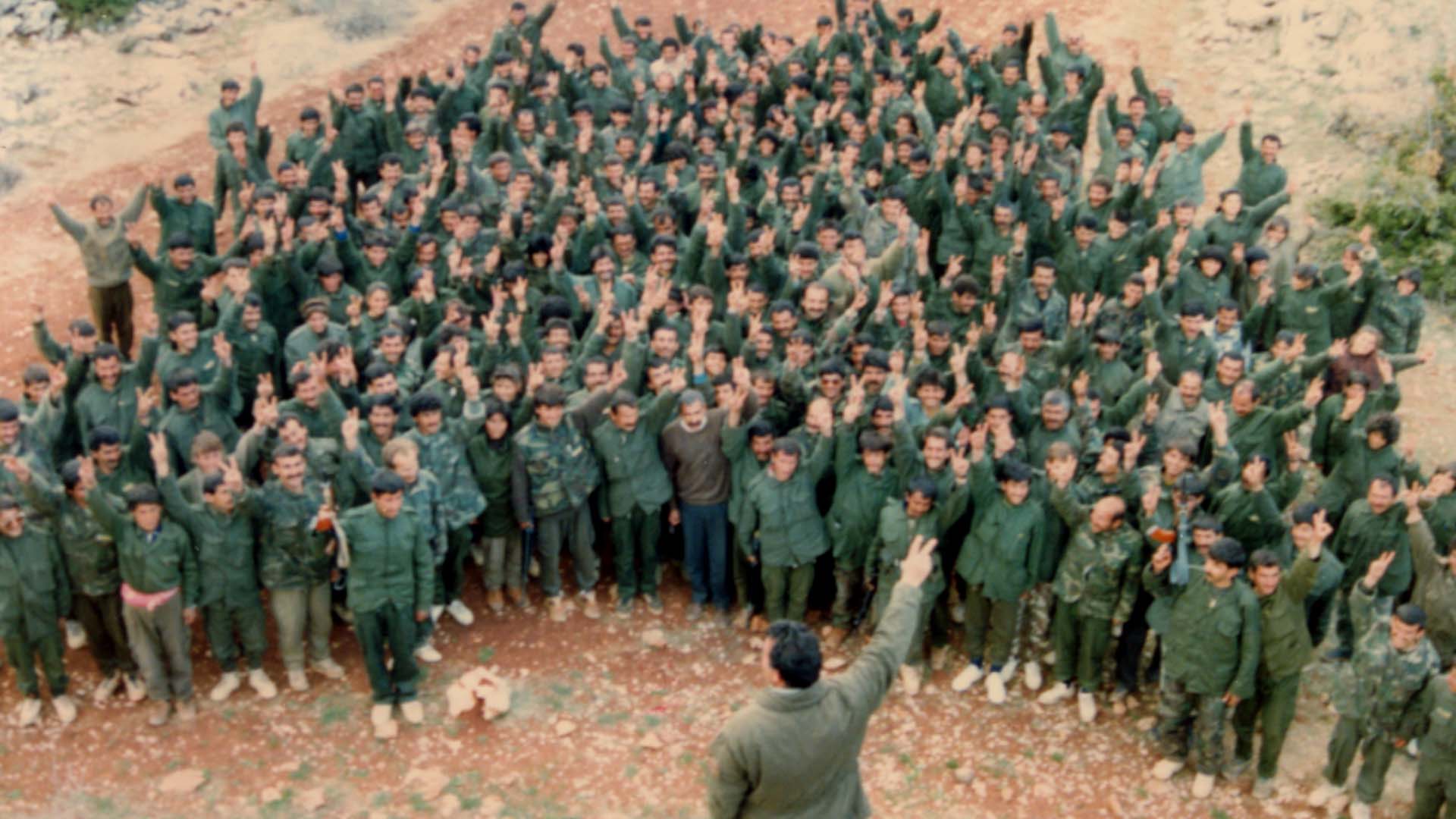
(From Leader Apo's Defenses on Self Defense)
In the general, collective sense, without social morality and politics, which gain texture as factors of existence for carrying out society's common affairs, societies cannot sustain their own existence.
The normal state of society, its existence, cannot be without morality and politics. If a society's own moral and political fabric is undeveloped or has been crippled, diverted, and paralyzed, it is possible to say that this society is experiencing the occupation and colonialism of various monopolies as capital, power, and state. But to sustain existence in this form is self-betrayal and alienation against its own existence; it is to exist under the sovereignty of monopolies as herd, object, and property. In this condition society has lost its own nature, has either lost the abilities of natural society or had them atrophied. It has been colonized; worse still, it has abandoned itself, with everything it has, as an object of ownership to decay and nonexistence. Many societies fitting this definition have been observed in history and today. Those decayed and destroyed are many times more numerous than those still standing.
When society falls into the condition of being unable to form, operate, and make functional the moral and political institutions necessary for sustaining itself, it means it has been taken into the vise of oppression and exploitation. This condition is the ‘state of war.’ History can also be defined as the ‘state of war’ of civilizations against society. When morality and politics do not function, the only task society can perform remains: self defense. The state of war is the state in which peace is absent. Therefore peace can gain meaning only on the basis of self defense. A peace without self defense may be an expression of surrender and slavery. The defenseless peace imposed today by liberalism on peoples and societies, especially the game called democratic stability and compromise, means nothing other than the covering up of bourgeois class domination carried out by a force on one side armed to the teeth, that is, the covert continuation of the state of war. Defining peace in this way appears before us as the greatest effort of ideological capital hegemony. In history, however, it expresses itself in a different form under the name of ‘sanctified concepts.’ Religions are loaded with concepts in this direction. This is especially true of civilized religions.
The realization of peace can attain its true meaning only if societies' self defense, and therefore the character of moral and political society, is protected and secured. In particular, the definition of peace that also required Michel Foucault's great effort can gain an acceptable social expression only in this way. The meanings imposed outside this do not produce, in the name of all communities and peoples, any expression beyond being a trap and the continuation of the state of war in covert forms. The word peace, under the conditions of capitalist modernity, is a word loaded with traps. Its use without correct definition is very dangerous. If we define it once more, peace is neither the total elimination of the state of war nor a condition of stability and absence of war under the superiority of one side. There are sides in peace. There is no decisive superiority of one side, and there must not be. Third, arms are silenced on the basis of consent to society's own moral and political institutional functioning. These three conditions are the foundation of principled peace. Unless a real peace rests on these principled conditions, it expresses no meaning.
If we open these three conditions a little, first, the complete disarmament of the parties is not foreseen. Whatever their claims may be, they pledge only not to attack one another with arms. Armed superiority is not pursued. They accept respecting the rights and possibilities of keeping themselves secure. Second, there is no ultimate superiority of one side. Perhaps a stability or calm secured under the superiority of arms may exist, but this condition cannot be called peace. Peace can come onto the agenda when the sides, whichever side may be right or wrong, mutually accept stopping the war without securing superiority. Third, in solving problems, the sides accept respecting the moral, that is, conscientious, and political institutional functioning of societies, again whatever their positions may be, whether two sides, society, or power. The condition called ‘political solution’ is defined within this framework. A ceasefire that does not contain a political and moral solution cannot be interpreted as peace.
Under these principled peace conditions, democratic politics enters the agenda by gaining indispensable importance. When society's moral and political institutions function, the process that naturally emerges is the process of democratic politics. Circles hoping for peace must know that this can achieve success only if politics plays its role on a moral basis. In peace, at least one side must be in the position of democratic politics. Otherwise what is done does not go beyond being a ‘peace game’ on behalf of monopolies. Democratic politics plays a vital role in this situation. A meaningful peace process with the opposing power or state forces can be lived only under dialogue by the forces of democratic politics. The rest is the continuation of war-making, that is, monopolies, through mutual temporary suspension. There is fatigue from war and there are logistical and economic difficulties. If these are overcome, war continues until the superiority of one side is fully secured. These forms are not called a peace process; they can be called ceasefires made for more violent wars. For a ceasefire to be peaceful, it is of principled importance that it lead to peace and be tied to the three conditions we have counted.
As is sometimes seen in war, there may also be situations in which the self-defending side, the side in the right position, gains final superiority. Even in this situation, the three conditions for peace do not change. As seen in actually existing socialism and in many justified national liberation wars, immediately running to one's own power and state and securing stability under this power and state cannot be peace. This time what is at issue is the replacement of the foreign power by a monopolist local power, the section called state capitalism or national bourgeoisie. Even if it is called socialist power, the sociological reality does not change. Peace, as a principle, is not a phenomenon secured by the superiority of power and state. Whatever name power and state may have, bourgeois, socialist, national, non-national, it makes no difference; unless they share their superiority with democratic forces, peace does not enter the agenda. In the final analysis, peace is the conditional reconciliation of democracy and the state. Throughout history, the stories of this reconciliation have occupied great space and time. They have been tried in many times and places. There is the principled and long-term one. There is also the one broken before its ink has dried. Societies do not live merely as the establishment of the forces of power and state. However much their fields are narrowed, unless they are totally destroyed, they know how to continue living under their own moral and political identities. Perhaps this is the reality that was not written in history, but is the essential state of life.
Not seeing society as consisting merely of stories of state and power, but rather assuming it as determining nature, can contribute to the formation of a more realistic social science. However great and rich powers, states, and capital monopolies may be, Pharaoh and Qarun, or however monstrous they may become, like those today, enough to swallow society, the new Leviathan, they can never eliminate society. Because in the final analysis, society is what determines them. The determined can never take the place of the determiners. Even the most dazzling, media-propaganda power of authority, as in our day, is not enough to cover up this truth. They are the most miserable and pitiable powers dressed in the guise of giants. Against this, human society, since its formation, will not be deprived of finding meaning as nature's most wonderful creation.