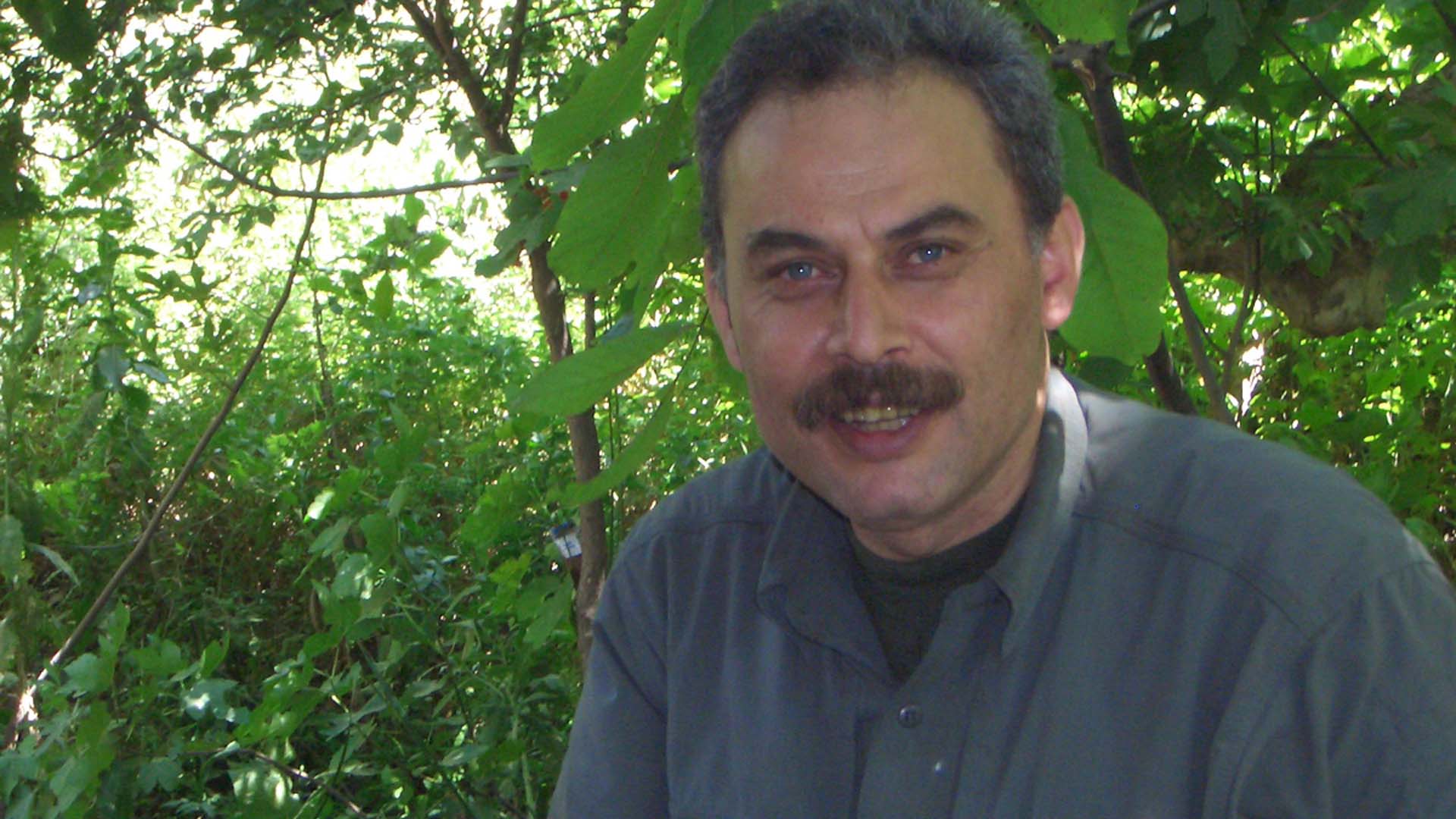
Comrade Ferzende suffered a heart attack in Heftenîn in 2017. The comrades could not find an opportunity to take him to our doctors, and as a result he fell a martyr.
At first, when I heard, I truly did not believe it. I kept telling myself there must be a mistake. It had never crossed our minds that one day Comrade Ferzende would attain martyrdom in this way. But later the comrades made enquiries and told us, “It is true; Comrade Ferzende has fallen a martyr as a result of a heart attack.” I am sure all the comrades were deeply pained by his martyrdom.
Our revolution and our lives are interwoven with martyrdom. The reality of martyrdom is not far from us. We are not strangers to it, and we all walk the path of martyrdom. Yet Comrade Ferzende’s martyrdom had a particular effect on us. Within our party, he was a personality with distinctive characteristics of his own. In the party, we say that all militants are one in thought and spirit. That is true. Wherever we are, these are our shared characteristics. But each militant also has distinctive qualities of their own. How so? These different qualities strengthen and enrich commitment to the party. Each of our comrades has individual qualities that add something too. Of course, we are not all identical or copies of one another. Like different colours, each comrade has left and continues to leave their own mark on the revolution and revolutionary life.
Comrade Ferzende too was truly a distinctive personality in this respect. Through his life, his participation, his work and his qualities, he too was a colour. Comrade Ferzende was not someone who would remain in the shadows. No! He had distinctive qualities, and with these he remained in our ranks for nearly 27 years.
Some comrades may have come to know Comrade Ferzende only recently. But as far as I know, he was originally from Efrîn. In his youth, Comrade Ferzende first studied in the schools of religious congregations. These congregations therefore had a religious influence on him. But after the work of the Leadership and the party developed in Rojava, the war in Northern Kurdistan grew. The effects of the expanding war were felt most strongly in Rojava. In Efrîn in particular, this influence increased after the martyrdom of Comrade Selîm (Rahman Korkmaz).
Initially, Efrîn was a place distant from the Kurdish movement. Kurdish movements existed in the South and the North, influencing the Cizîrê region. But Efrîn was geographically distant. The influence of Aleppo—the culture of the regime—largely prevailed in Efrîn. Yet the PKK’s accumulation of work over the years led to an eruption there. The party’s work in Efrîn raised patriotism to its highest level. This means that a very deep patriotic spirit existed in Efrîn, but work had not been carried out there. Through the intervention of the Leadership and the party, very strong patriotism developed in Efrîn, resulting in very strong participation from there. It is now said that we have 5,000 martyrs from Rojava in the party’s revolution. I believe a large proportion of them are from Efrîn. Joining had become a mass phenomenon. The people of Efrîn all became supporters of the PKK.
Comrade Ferzende joined during that period too. He joined in those days when patriotic and revolutionary spirit was rising. Upon joining, he came to the mountains. Comrade Ferzende’s life in the mountains was truly a distinctive life. How so? He had a personality of his own and was stubborn in his personal characteristics. He continued his life in that way.
Comrade Ferzende is known as a doctor, a physician. He worked as a dentist. Yet becoming a doctor did not come so easily either… He had distinctive characteristics. For example, he fasted every Ramadan. He fasted with great discipline. His fundamental concern was not fasting itself; he had gone beyond that. His concern was self-discipline, the training of the self. In this way, Comrade Ferzende had established a discipline for himself.
In 1998, we went to Botan together. In 1999, a report arrived from Kelareş. I read in it that the comrades had imprisoned Dr. Ferzende. At first, they had told him, “You will practise medicine here.” From time to time, he would go towards Iran to bring medicines. The comrades said of him, “This man is already a Muslim; he has dealings with Iran.” On that basis, the comrades immediately convened a forum there and arrested him. In reality, however, he had no connection with the matter of dealings. In the spring of 1999, Comrade Ferzende discussed the matter with the administration in Kelareş and put forward a proposal in his report, saying, “I can carry out medical treatment work. But the comrades have imprisoned me and say I am an Iranian spy.”
We can thus say that Comrade Ferzende first began his medical work in Kelareş, amid a lack of resources and problems of this kind. During the period of the international conspiracy, all the comrades coming and going from the North and the South received treatment there. Afterwards, he continued his work in several places in the South. Because of Comrade Ferzende’s independent qualities, during the leadership of Botan and his associates they almost declared him a spy or agent. Comrade Ferzende did not readily bow his head. If he saw mistakes in some people and believed they were not acting in accordance with the party, he would never bow before them. Even at the cost of his head, he would accept nothing from them and would not submit to them. For example, Comrade Ferzende would not accept Botan at all. We can say he had personal qualities marked by this kind of stubbornness.
In 2000, he was in Xiner; I went there and saw him. Once again, they had put Comrade Ferzende under great pressure. They had even forbidden him to practise medicine. In 2005, Comrade Ferzende opened a dental hospital in Zap. From that year until now, all comrades being assigned to the North would go to him, just as they first went to central headquarters for their assignments. Comrade Ferzende examined and treated all their teeth, and afterwards they were sent North. One can say that, since 2005, Comrade Ferzende has contributed his labour to every comrade who has gone North.
Comrade Ferzende took his medical work very seriously. No comrade has complained about his treatment. There is no such person. Whichever comrade came to him, he carried out his work with great seriousness. There are many comrades like this. For example, Comrade Xelîl DAG was such an example in the mountain press. He too took up his camera and built a distinctive revolutionary identity with it. He showed how much renewal and varied beauty PKK militants could create within themselves. Comrade Ferzende was an example of this kind too.
He had other qualities besides these. For example, Comrade Ferzende was very sensitive and deeply feeling. He was stubborn and did not accept everything. If he saw a mistake in something, he would react and take a stand. In brief, all the comrades know Comrade Ferzende. But he had a history of his own. Had another comrade encountered so many mistaken approaches, they might not have been able to hold themselves together. For example, I personally witnessed several times how he was subjected to very many wrong approaches. Mistaken interpretations were made of him; even accusations were brought against him. But when it came to the fundamental point, he was a party militant. He was committed to the Leadership and the party. In critical times, this fundamental quality of his came to the fore. I know personally that, in the time of the liquidationists, Comrade Ferzende took part in the PYD’s work and went to Rojava. At that time liquidationism was to the fore, and splits and dispersal were taking place within the PYD. But Comrade Ferzende took a stand and came to the mountains. In those days, many people wanted to leave the mountains, but Comrade Ferzende did the opposite and came to them. He had taken a stand. He said, “The right place is the PKK, and I will be of the PKK.” He insisted greatly and said he would go to Gabar. In those difficult stages, when the party’s line was being questioned, Comrade Ferzende’s essence came to the fore.
One of Comrade Ferzende’s foremost characteristics was his great desire to go to Gabar. He was deeply attached to Gabar. His medical work may have brought him considerable prominence, but he was truly a guerrilla of difficult times. At one time, being a guerrilla in Botan was not easy. Leave war aside: it was not easy even to keep yourself alive for 24 hours. In those conditions, he lived as a guerrilla there, fought and practised medicine… Comrade Ferzende was not merely a doctor in Gabar. He was everything. He was everything to the wounded comrades. One can say that he loved hard and difficult conditions. I know very well that, for a time, he insisted on going to Gabar. Apart from its spiritual significance in the history of our struggle, Gabar was the most difficult area in Botan, with the fewest resources and the most frequent enemy targeting. He was a lover of Gabar. He took comradeship in those difficult conditions as his foundation. His guerrilla experience was far from slight. In the hardest and most difficult stages of our struggle, he was in the most challenging places. He was a party militant of substance.
Comrade Ferzende was very open in his words. He said everything plainly. He was not someone who sought publicity. His essence emerged in hard and difficult times. His comradeship, commitment and awareness of the party’s line were strong. In every critical period, these qualities of his were always to the fore. Besides this, he was very warm and sincere in life. For example, despite being such a veteran comrade, he never once asked for authority or a post.
Comrade Ferzende spent nearly 27 full years in our ranks, always on the foremost fronts. Two years ago, the comrades at headquarters elected him a Member of the HPG Council, in recognition of his many years of revolutionary labour and particularly his strong and steadfast stance. For the last two years, as a council member, he participated in our meetings of the HPG Council Leadership. Last year, too, we held a meeting of the HPG Council Leadership. In the meeting, when Comrade Ferzende gave his pledge, he said, “I have not earned this authority.” He was that humble a comrade. In fact, Comrade Ferzende’s experience was more longstanding than that of many of our comrades in leadership. But because of his humility, he always said, “I have done nothing that would entitle me to give this pledge.” He was so genuine that he took such a stance.
He attended our meeting this year too. In recent days, the comrades had discussed with him going either to Ocaxa PKK or to Rojava Kurdistan. He had prepared himself to go. But sadly, news of Comrade Ferzende’s martyrdom arrived. At such a time and in such a manner, we had never expected a martyrdom like this. We were truly deeply pained. One thinks that the enemy might attack our comrades in Amed, Dêrsim or Botan and that adverse situations might arise. But we did not expect this martyrdom of Comrade Ferzende. The news arrived suddenly… This also shows that, in our revolutionary lives, it is not known when or how martyrdom may occur. Comrade Ferzende had a colourful life in his revolutionary history. His life must be written about and must not be allowed to fall into oblivion.
In conclusion, one can say that Comrade Ferzende was a comrade who was a doctor and a militant of our party. He gave great labour to the revolution and the guerrilla, and his service is sacred. He was a worker. He was a militant who gave his labour without calculation or recompense. He worked without asking for anything in return for his labour. This is one of the fundamental measures of militancy. We must take it as our foundation, uphold comradeship on this basis and be worthy of one another. We must first be worthy of these comrades and fulfil their hopes. On these foundations, we once again remember Comrade Ferzende and, in his person, all the martyred comrades, and we will be worthy of them.
DR. BAHOZ ERDAL