

Capitalist modernity is a global system that has profoundly and multidimensionally influenced human history from its emergence in the sixteenth century to the present.
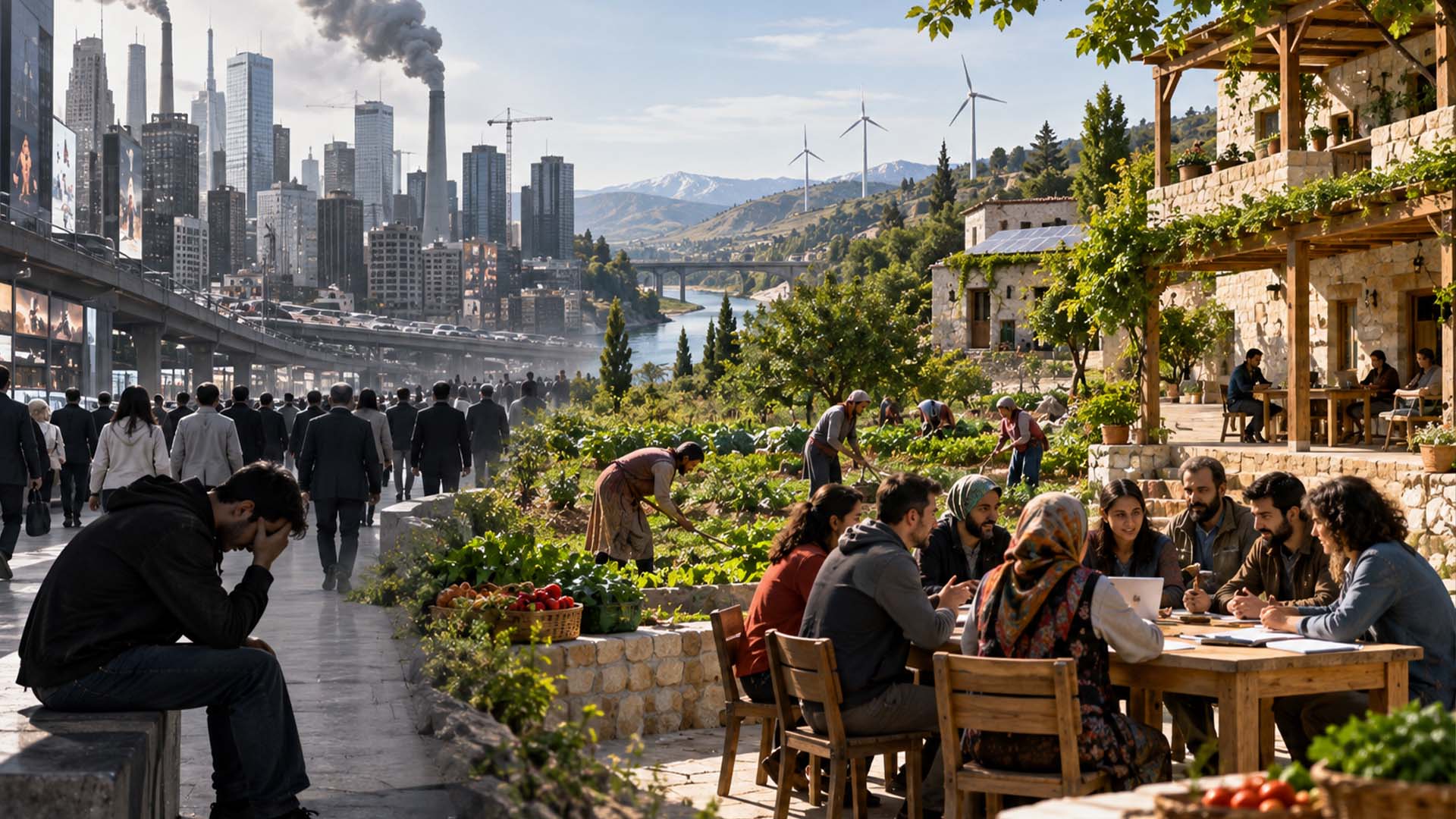
Although this system has globally enabled important gains such as economic growth, technological progress, and improved living standards, it has also produced serious sociological harms in the social sphere. Examining this dark social face of capitalist modernity under the main headings of alienation, inequality, environmental destruction, and cultural homogenization is an important threshold for understanding and deeply analyzing the human and social model modernity has created in today’s world, and for overcoming ambiguity regarding possible solutions.
1- Alienation: The Human Being’s Separation from the Self:
Alienation, central to Karl Marx’s critique of capitalism, is one of modern society’s fundamental problems. Capitalist relations of production separate workers from the products they create, their labor, their colleagues, and even themselves. As the worker becomes merely a component of production, the worker ceases to be the product’s creator. This causes loss of meaning, lack of motivation, and psychological crisis. Today, alienation extends beyond the exploited worker to the loss of identity created by consumer culture and the individual’s inability to realize the self. The social and integrated production relations of the past have thus given way to a completely individualized plane of production, severed from society and marked by extreme class inequality. By monopolizing production, the system continually drives society as a whole into a psychology based on consumption. It accomplishes this by fundamentally directing human needs and making people choose what the system itself desires. This severely disrupts the balance between production and consumption, making basic foodstuffs increasingly scarce and creating a situation in which not everyone can reach them.
2- Inequality: An Enriched Minority, an Impoverished Majority:
Capitalist modernity has concentrated wealth in the hands of ever fewer people. Injustice in the distribution of income and wealth increases social unrest while perpetuating and intensifying the cycle of poverty. Inequality in access to basic rights such as education, health care, and housing restricts opportunity and obstructs social mobility. With globalization, these inequalities have assumed an international dimension and deepened the gulf between developed and developing countries. Basic human rights—the common values of every person, every society, and all humanity—have become something granted to some and potentially denied to the majority. This separates the foundation from the structure built upon it and leaves the foundation to decay over time. Deprivation of values to which everyone is entitled has been made the fate of most humanity. Its chain effects produce individuals suffering psychological problems and rapidly damage social unity.
3- Environmental Destruction: Exceeding the Planet’s Limits:
One of capitalist modernity’s most destructive consequences is environmental devastation. A growth-centered economic model has led to limitless exploitation of natural resources and rising pollution. Global problems such as climate change, biodiversity loss, water scarcity, and soil erosion clearly show that capitalist modes of production and consumption are unsustainable. Exceeding the planet’s carrying capacity poses grave risks to the future. Drinking-water reserves are rapidly depleted; prime agricultural land is increasingly allocated to construction, mining exploration, and industrial facilities, while disruptions in the natural food chain grow. To put it this way: irrigation creates a cycle in an agricultural area. This cycle protects the food chain, makes elements in the soil available for human life, and seeks to preserve the atmospheric balance in nature. These processes must, of course, take place within a natural system. Today, however, agricultural chemicals have begun to destroy this balance. Worse still, such lands are removed entirely from the natural cycle and replaced with factors that disturb equilibrium. It is clear that this will create chain reactions of major devastation throughout human life. Human life expectancy is also shortening as this balance deteriorates, while diseases increase substantially. All of these are consequences of intervention in nature and the negative effects exposed by the savage production regime carried out through capitalist modernity. Because of this destruction, our world is increasingly losing its role in preserving the universe’s balance, and natural disasters are arising ever more rapidly.
4- Cultural Homogenization: The Loss of Local Values:
Alongside globalization, capitalist modernity has accelerated cultural homogenization. The multidimensional domination established by Western culture over social elements threatens local values, traditions, and linguistic diversity elsewhere in the world. The rapid spread of consumer culture greatly weakens individuals’ identities and sense of belonging while reducing cultural differences. This can diminish social vitality and create cultural poverty. What is meant by cultural poverty? Briefly, it is the lack of access by individuals or communities to essential cultural resources and skills they should possess. Like economic poverty, this concept emphasizes disadvantages in nonmaterial fields. Cultural poverty does not mean only an absence of knowledge or artistic ability; it also encompasses deficiencies in cultural identity, social values, traditions, and social capital that sustains society. It gives rise to a homogenized human type whose feelings have gradually been blunted.
5- Individualization and the Weakening of Social Bonds:
With the rise of individualism, capitalist modernity has greatly weakened social bonds. In a competitive environment, people tend to compete rather than cooperate. Instead of embracing the values through which they bring one another into being and creating wholeness, they prefer a life that prioritizes individual identities and affiliations. The phenomenon called society thereby grows weaker, leaving the individual to a private sociality. The clearest example is the communal cooperative method of production, widespread in many parts of society only five or ten years ago but now rarely encountered. Changes in the family institution, declining neighborly relations, and reduced effectiveness of civil society organizations diminish social solidarity and estrange members of society from one another. This creates loneliness and social isolation—the death of society and the impaired birth of the individual.
In conclusion, although capitalist modernity has produced important gains for humanity, it has also caused serious negative effects in the social sphere. Problems such as alienation, inequality, environmental destruction, cultural homogenization, and individualization pose major threats to the sustainability of modern society. Capitalist modernity must therefore be critically evaluated, and fairer, more egalitarian, and environmentally conscious alternatives must be developed. To leave a livable world to future generations, we must move away from a growth-centered economic model and embrace human-centered, sustainable development. The concrete alternative is solely the system of democratic modernity based on the democratic nation. Leader Apo presents this system in its most concrete form and explains in every respect why it is the sole remedy for saving society from death. Against the effects listed above, democratic modernity offers a more livable, sustainable, and inclusive system and a way to eliminate the devastation caused by capitalist modernity. Cultural poverty has already almost erased the concept of identity, leaving a single identity: liberal identity. The way out will be painful, and the existing damage cannot simply be removed at once; nevertheless, with determined effort and social unity, this alternative system is the only one that can be implemented.