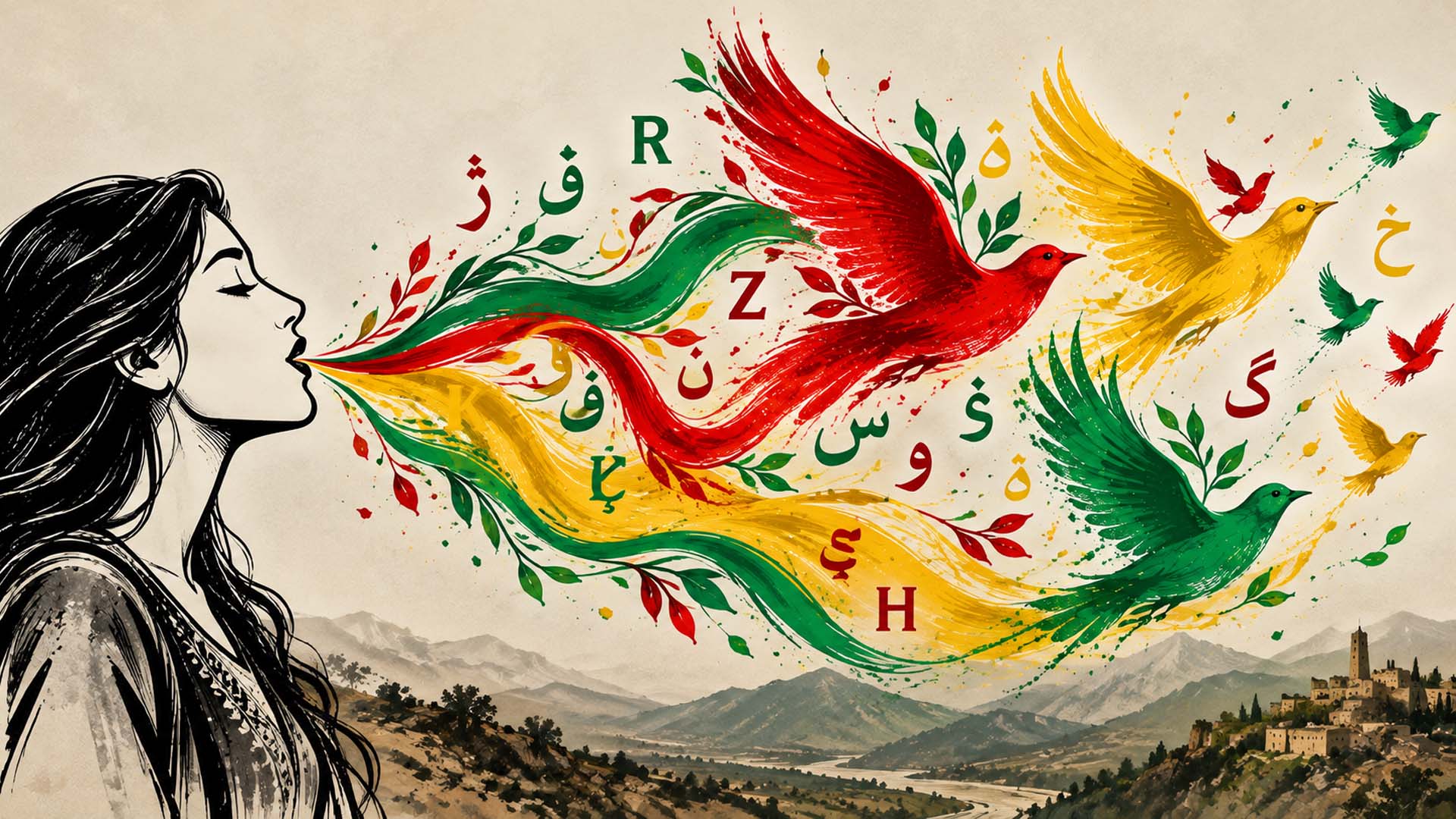
Language Is The Life Of Humanity
One of the most ancient peoples, rich through its language, is the Kurdish people. Because their language was banned, they were forced to preserve and adorn it through the style of dengbej singing, stories, and writings, which are at the same time among the oldest cultures of the Kurdish people. It is a language with many dialects and ancient words filled with meaning. Many words still used today have histories of thousands of years and carry very deep meanings. It is so rich that sometimes three or four words are used for one thing. Unlike many other languages, it has an ancient and well-founded root. It may not be the first language, but one of the first languages used by humanity is Kurdish.
Literature And Pain
The daggers of literature in the hands of Kurdish scholars and poets are sharper and stronger than all daggers. That is because they lived in their hearts the pain of everything they wrote and said. In short, one can say that they spoke their pains with their golden voices and melodies. Figures such as Ehmede Xani, Melaye Ciziri, Seydaye Tirej, Baba Tahire Uryan, Piremerd, Ebdullah Pesew, and hundreds of figures whose names we have not mentioned became, through their pens, a source of strength for the children of this people. But unfortunately this language has never become an official language and has always remained under the shadow of some other nations, that is, other languages. For years a struggle has been waged for this. Many people sacrificed their lives so that the mother tongue would become official and the Kurds would be known in the world.
The Greatest Oppression Is Against Language
Official history has always been written by the hand of power, and one language has always been accepted. One of the oldest languages on the face of the earth is Kurdish. Yet because Kurdish has never been an official language, many precious diwans and writings have also faced disappearance. All our writers and artists were aware of this oppression. But unfortunately, because the Kurdish people were not united, our writers and artists too could not prevent this tyranny. For example, the great Xani said in the sixteenth and seventeenth centuries: "The Kurds now need a leader." But unfortunately he himself could not lead this. When one looks at the diwans and works of Kurdish scholars, it is easily seen how aware they were of the oppression and subjugation of the Kurds. That is why Seydaye Cigerxwin also says: "If we do not become one, we will go one by one." The oppression against language is like a dagger constantly in a person's back; it does not kill, but it does not allow life to be lived in peace either.
After a period, and especially after the Turkish, Iranian, Iraqi, and Syrian republics were established, pressure and attacks on Kurdish culture and language appeared clearly. The higher the level of literature and culture was, the greater and harsher the attack and pressure became. Let us pay attention: much Kurdish music of the twenty-first century was stolen by people who had moved away from their own culture, such as Ibrahim Tatlises and Mahsum Kirmizigul, and was spread as if this music were their own. This was because opportunities for recording and distribution among Kurds were few, and because they could not easily distribute their art under the name of Kurdishness. Much music was stolen from the Kurds; sometimes with different words, sometimes the same words were used in another language.
I Fly Toward You
I fly, I braid the rings of hair of children with frightened eyes.
I see you in everyone's mouth,
Pure and sweet.
I fly, in an endless dance
I meet girls and young men
Adorned in green, red, and yellow.
I fly, before the door,
In every street I meet the ancestors,
Those who are proud of you.
I fly, I tumble on the mountain
I tremble with the majesty of the guerrilla,
In their eyes and lips and chests
I see you with all beauties.
I fly over plains, mountains, and highlands
And in every encounter of mine
With nightingale, waterfall, rose, and daisies
I see you.
With beautiful melodies I enter the sleep of death.
With you I sing, with you I become joyful
And with you I become a lover in the fortress of my country.
The Struggle Of The APOist Movement Is The Struggle Of Culture And Language
The struggle for language and culture is the most fundamental struggle that every nation must wage in the strongest way. Today the war is the war of language and culture. If today the Kurds are in struggle with all their strength, this is the struggle for language and culture. Let us pay attention: in earlier years Kurdish culture and language were almost moving toward nonexistence. It had reached the point where people were ashamed to speak Kurdish and listen to songs. It was the influence of the culture and language of neighboring countries that had put the Kurdish people into such a wretched situation. At the same time, in many parts of Kurdistan the language had been banned. But through the incomparable struggle of Leader APO, this has today reached a decisive level. Instead of being ashamed of the language, a run toward the language has begun. Alongside this, throughout the world it drew the attention of many people and imposed on them the study of the Kurdish language. After many studies, it is easily seen that many words now used in many languages also take their roots from Kurdish, even if there are changes in pronunciation.
Mother's Milk; Language
I say this to those who envy you, to those who do not know you. They do not know what they have encountered. They want to crush you, but they do not know that you are beloved by millions. They do not know how many brave ones rose for you, adorned their mouths and hearts with golden letters, and sacrificed themselves for you. They washed water, killed death, burned the sun, and suffocated the air with their dialects. They brought withered flowers to life, froze snow, and longed for beautiful days through your beauty.
Those Who Give Their Lives For Language
After long years in which this situation continued harshly, a historical change began. This was the emergence of the APOist movement after many uprisings, when no one any longer expected a Kurd to raise his head. One of the movement's main aims was for the Kurdish language to be recognized and become a language of education. Undoubtedly there were many famous and valuable figures who until then had devoted their entire lives to the service of the Kurdish language. But with the APOist movement this rose to the summit. With great revolutionaries such as Qasim Engin and Helmet Diyar Xerib, a great spark of Kurdish language and history rose, and stopping it became an ache in the enemy's heart. Today too, if we look carefully, the leader of the Kurdish people speaks in all his writings and conversations about the culture, language, and art of the Kurds. However much we may have reached a great level of struggle today, this is not enough for liberation. Assimilation and attacks on our culture and language continue harshly every day. This makes the waging of a strong struggle even more obligatory for us.
I am your lover beside all pains and sufferings
From you I learned the sweetness of mouth and lips
Forbidden everywhere
Yet you killed no one with your weapon
You are never forgotten
You certainly do not allow forgetting
Do you not have lovers
The color and voice of the oppressed
Your lovers will kill death
They will make you living, living, living