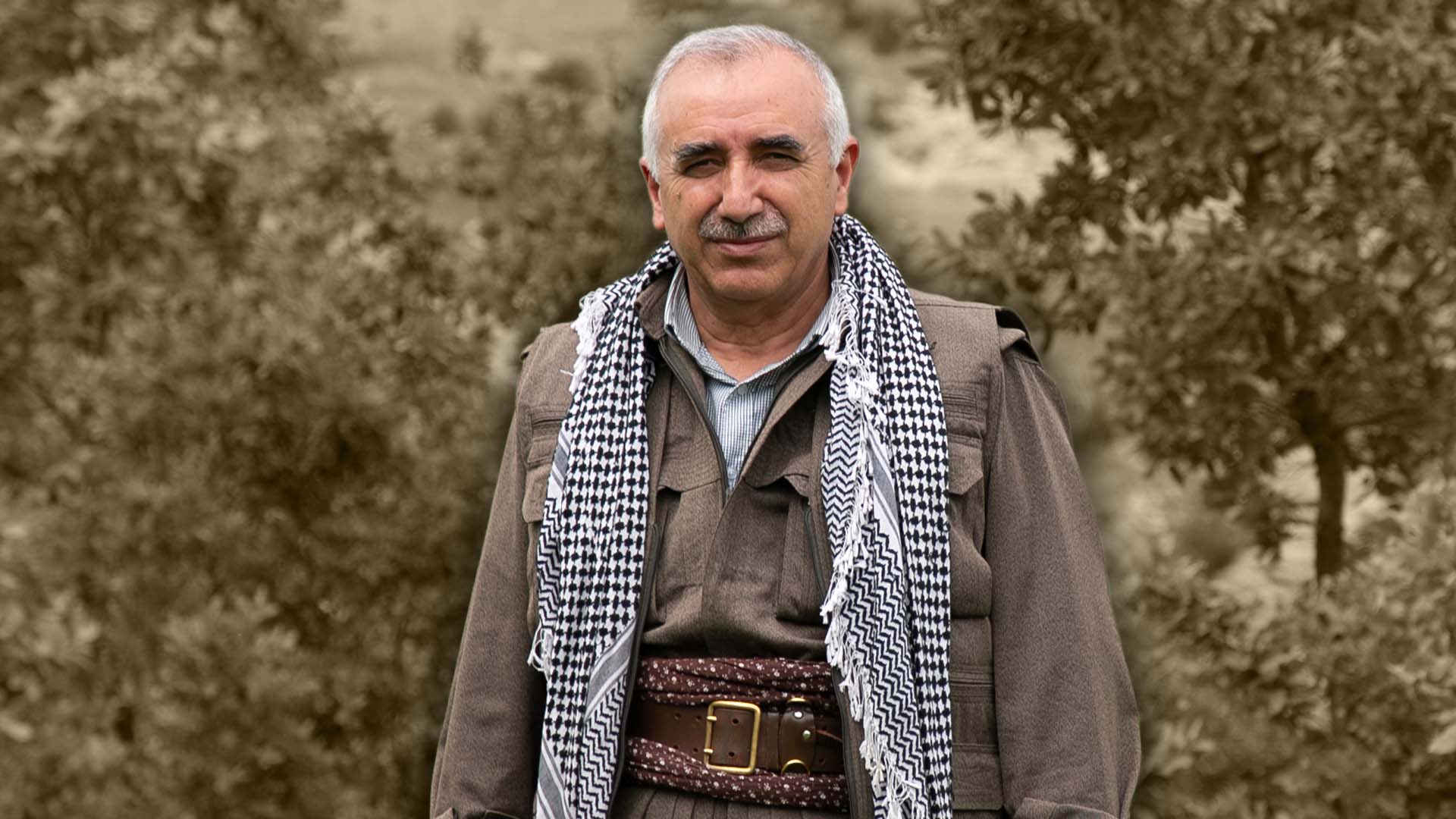
Murat Karayılan commented on the legal reforms being debated in Turkey as part of the current process, saying that concrete confidence-building measures must be taken to achieve a lasting solution.
Murat Karayılan, a member of the Command Council of the People's Defense Center (HSM), commented on the legal reforms being debated in Turkey as part of the current process, saying that concrete confidence-building measures must be taken to achieve a lasting solution. He also asked, "Will this law cover everything?"
Speaking during a special broadcast on Stêrk TV, Karayılan responded to questions from journalist Delîl Ronahî. The People's Defense Center (HSM) Command Council member addressed a wide range of issues, including the significance of July in the history of the PKK, the Peace and Democratic Society Process, the isolation imposed on Kurdish leader Abdullah Öcalan, and the legal reforms currently under discussion in Turkey.
A symbolic weapon-burning ceremony took place in July. This phase began with Abdullah Öcalan's 27 February call. Your movement then held its congress and adopted important and historic decisions. Yet despite nearly a year and a half having passed, there has been no visible progress. How do you assess the current state of the process?
The process initiated by Mr. Öcalan on 27 February 2025 is a highly significant and historic one. It is as important for us as it is for the Republic of Turkey and the Turkish state, because the Kurdish question is Turkey's oldest and most fundamental issue. That initiative was a very important step. As a movement, we believe that the struggle from this point forward must be carried out through democratic and social means. We took those steps out of conviction. We believed in the Democratic Society Struggle Strategy, and we acted on that basis. We remain committed to it. We have already demonstrated this commitment through the steps we have taken. Over the past year and a half, the position adopted by our movement, the decisions we have made and the measures we have taken all show how determined both our movement and its leadership are. We acted in accordance with our own rules and adopted decisions from which there is no turning back.
The Turkish state, however, has not taken any legal steps so far. That does not mean it has done nothing. There have been visits to and from Imralı, a parliamentary commission has been established, and after some time the ceasefire became reciprocal, bringing the fighting to a halt. These are, of course, certain positive developments. However, the measures necessary to move the process forward and prevent it from being dragged out have still not been implemented. It appears that the Turkish state has yet to make a clear decision on this issue. They continue to place many matters on the agenda, but they seem to leave them suspended between yes and no.
Another issue is the profound lack of trust. So far, the state has not taken a single step capable of building confidence. There has been no gesture of reconciliation. We disbanded the Kurdistan Workers' Party (PKK) and ended the strategy of armed struggle. In other words, we brought hostility to an end. We said, "We are opening a new chapter; we no longer want hostility but friendship." It is true that Turkish President Recep Tayyip Erdoğan and Devlet Bahçeli speak about Kurdish-Turkish-Arab brotherhood. State officials occasionally make statements along those lines. Yet in practice there has been no reconciliation. No legal measures reflecting that discourse have been taken. Naturally, such a delay is open to criticism, and there are reasons for it.
The problem begins with the state's approach. They continue to speak of a "Terror-Free Turkey." The Kurdish question is a historical and social issue. It is one of Turkey's fundamental problems. How can a solution-oriented approach emerge if the entire issue is reduced to one of "terror"? That is the core of the problem, the mentality. It is clear that there is a problem in the state's mindset; it has not reached a clear position. We decided that from now on we want to resolve this issue through dialogue. We changed our own paradigm regarding the solution. The state, however, must also change its paradigm. If it continues to operate according to the old logic of destruction and annihilation, that mentality will continue to dominate. They still view the Kurds as a threat. Yet we want friendship now. How can brotherhood exist? Friendship must come first before brotherhood can follow. You cannot call someone a brother while treating them as a threat. You cannot speak of brotherhood while denying their rights. It is as though you want a brother who has surrendered. How can that work? That is the real issue.
We want to reconcile with the state, transform the Republic into a democratic republic and become part of that democratic republic. We do not want to stand against the Republic. This has always been the fundamental approach of our leadership and our movement. But we do not see the same approach from the other side. Instead, we see hesitation, anxiety and suspicion. We have made our decision and remain committed to the Congress decisions. These are not ordinary decisions.
Yet we still see an approach dominated by doubt and concern. As long as the Republic continues to regard us as a threat, trust cannot develop on our side either. The problem exists, but there is still no confidence that it will be resolved. In my view, this stems from the state's own approach.
Over the past few days, statements have been made saying that a decision has been taken to bring the framework law before parliament this month. That would be very important. If the content of this framework law is not one-sided and instead is comprehensive and inclusive, it would represent a historic opportunity for Turkey.
It has often been said that the Kurdish question has existed since the very beginning of the Republic. In fact, it also existed during the final century of the Ottoman Empire. Before that there had been a peaceful coexistence, but for the past 220 years, from the uprising led by Abdullah Babanzade in Koy Sanjaq (Silêmanî-Koye) in 1806, there has been an unresolved issue between the Kurdish people and the Ottoman state, and later the Republic of Turkey. I should add that the Ottoman period was somewhat more flexible. At times there was peace, at times conflict, and at times agreements. The Ottoman state was more capable of producing solutions. It generally adopted a softer approach, often pardoning those who rebelled and giving them a place within the system. That was the case with Bedirxan Bey and Sheikh Ubaydullah, for example. The Republic, however, approached the issue through violence and executions. During the Republican era the problem became much more severe, and it has continued throughout the Republic's 102-year history.
The Republic of Turkey is capable of resolving this issue. How? When the Republic was first founded, conservatives were excluded, and the Kurds became a target. Over time, conservatives struggled and eventually became part of the Republic. Who remains excluded today? The Kurds. The Kurds are one of the oldest peoples of Mesopotamia, and a significant part of Kurdistan lies within Turkey. They live both inside and outside Turkey's borders. Today they seek to become equal and free citizens within a democratic republic. The Republic must embrace them as well. That requires a fundamental change in approach. If the Turkish parliament, or those drafting this framework law, proceed on that basis, it will open an entirely new era for Turkey. It will provide an important opportunity for Turkey to become a center of democracy in the Middle East and to strengthen its standing in the region. We are waiting to see what this law will look like. Will it be comprehensive, or will it not?
In your recent assessments, you also referred to the legal framework currently being discussed in Turkey. There are claims that this framework has been presented to Abdullah Öcalan and that he has approved it. Yet Mr. Öcalan remains under a regime of isolation. How do you assess this apparent contradiction?
For the past 42 days, no one other than the state delegation has been allowed to see Mr. Abdullah Öcalan. It is clear that he remains under a regime of isolation. This is not an ordinary form of isolation; it is political isolation. It serves a specific purpose. We know that the state delegation has been traveling to Imralı and holding meetings with Mr. Öcalan, and that at times his fellow prisoners may also be participating. It appears that, because no agreement has yet been reached, the isolation continues.
There was a similar period of isolation before, from 27 March to 15 May. Now, for 42 days, no delegation from outside has been permitted to visit Mr. Öcalan. In fact, this is precisely the period when visits should have increased. Mr. Öcalan wants the isolation to end, and so do we, along with many people in the public. We want visits to become more frequent. Yet before this, there was a 49-day period of isolation, and now another 42 days have passed. At the same time, we know that state delegations continue to travel to Imralı and meet with Mr. Öcalan. His fellow prisoners may also be taking part in these discussions. There is clearly an ongoing dialogue. But because those discussions have not produced a result, the isolation continues.
Now, some people close to the government have claimed through the media that Mr. Öcalan has approved the framework law. These claims are false. They are part of psychological warfare designed to create expectations and false hope.
If an agreement had actually been reached, they would have opened the way immediately, and the Peoples' Equality and Democracy Party (DEM Party) delegation would have gone to Imralı the very same day. Why are they preventing anyone from going now? Because the discussions have not produced a clear outcome. They do not want Mr. Öcalan's views and assessments to reach either us or the public while the negotiations remain deadlocked. That is the precaution they are taking. They know that if a meeting takes place, Mr. Öcalan will assess the current situation, offer his views and voice his criticisms. This indicates that no agreement has yet been reached, and that is why the current situation continues. That is how we understand it.
Another thing that appears evident is that, at Imralı, the state is trying to impose its own approach on Mr. Öcalan. Through discussions and unilateral efforts, it seeks to force its own position and have it accepted. That is what seems to be happening. The state should not proceed in this way. It is wrong to impose demands on Mr. Öcalan or insist on certain positions. The continued isolation is also wrong. It deserves criticism and gives rise to concern. That is how the situation appears at present.
Mr. Öcalan is the chief negotiator. He has the authority to make decisions on every issue. We, our comrades and our organization have already made that clear. However, the decision concerning Mr. Öcalan belongs to us. In other words, it is the guerrilla that makes that decision. The Congress entrusted that responsibility to the guerrillas. What decision did the PKK 12th Congress, the Dissolution Congress, adopt? It decided, in particular, that the process of laying down arms should be directed by Mr. Öcalan. That means Mr. Öcalan must enjoy his physical freedom in order to implement those decisions. This responsibility was entrusted to the guerrilla. Therefore, the position of our Movement and the guerrillas regarding Mr. Öcalan is clear.
Nothing can move forward without Mr. Öcalan. There should be no insistence on proceeding without him. Persisting in such an approach would only make the process more difficult and prevent any meaningful outcome. As I said earlier, there must be a comprehensive law capable of resolving this century-old historical issue. The solution must be developed with that understanding. If the leader of the Kurdish people remains imprisoned, the Kurdish people cannot become free. Our people expressed this truth as a slogan during their most recent rallies, and their representatives voiced the same demand. We have been saying this for a long time. This is the position of our people, our guerrillas and our Movement.
Brotherhood develops through mutual recognition, not through denial. That is the first reality that must be acknowledged. Secondly, they say, "The Kurds exist, and Kurds and Turks are brothers." If the Kurds exist, then they must also be recognized in law and included within the legal framework. They must not remain outside the law. Only then can they become democratic and free citizens. Without this, presenting us with a narrow law that applies only to the guerrilla, and even then only to certain categories, will not produce a solution; it will deepen the deadlock. This is a historical issue that requires a historic sense of responsibility. We are approaching it responsibly from our side. We want a fundamental solution to the problem. We genuinely want to see a democratic republic develop in Turkey, with the Kurds participating wholeheartedly and no longer being regarded as enemies. That is why we have taken such far-reaching decisions. But those on the other side must adopt the same approach. The state must do the same. Only then can a solution emerge.