“Forty-one souls amid this endless whiteness…”
In the morning, I want to step outside the shelter. I open the door and look out; the outdoors is in no condition to be ventured into.
The snow has reached halfway up the waist. I go back inside and try to write something. The snow covering the top of the shelter does not allow the light to enter. I put down the pen and go outside. The mountains are intertwined, and all the heights are pure white.
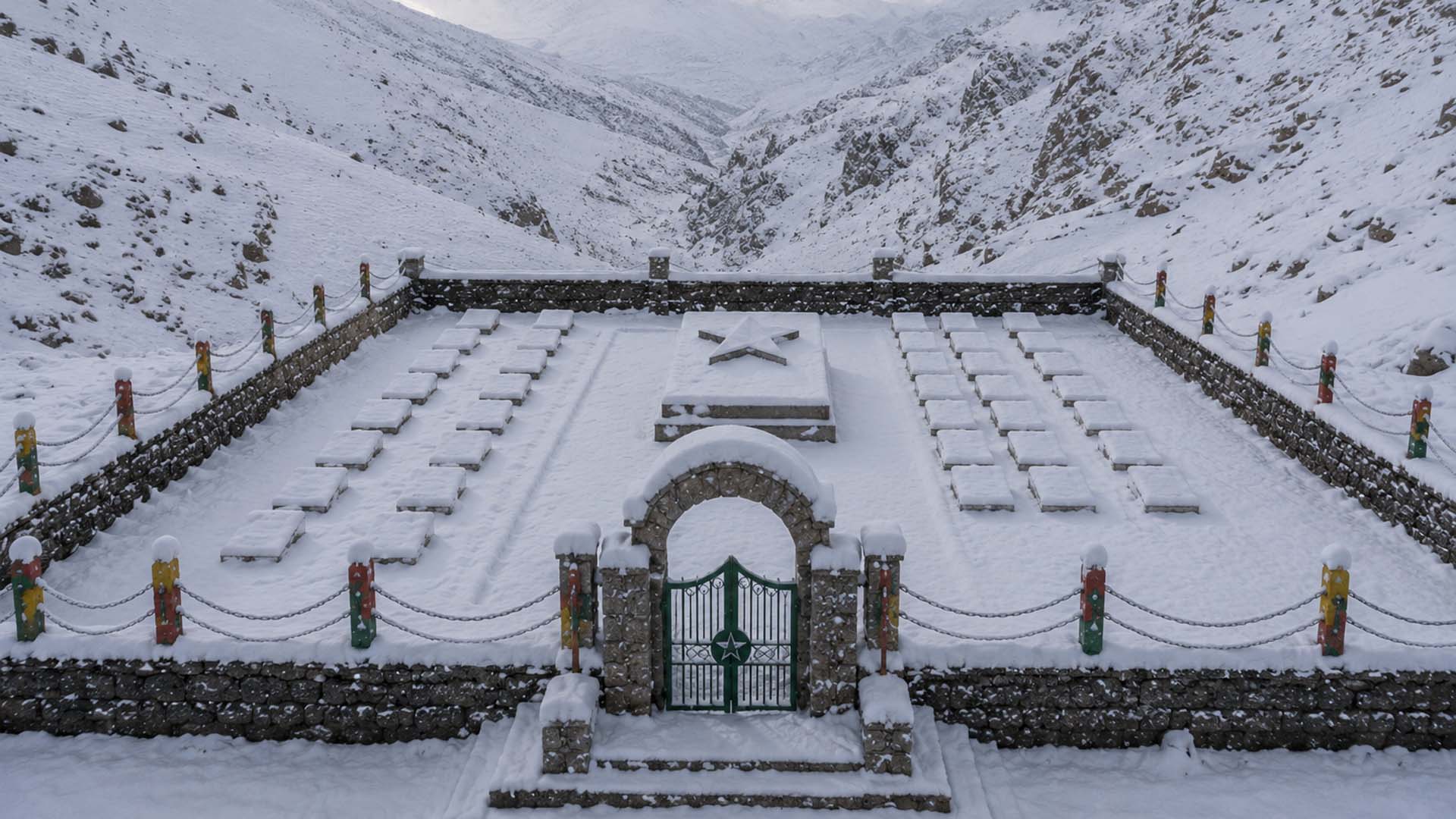
Our camp is immersed in silence. Most of the comrades are in training, while some comrades, like me, are trying to write something. I move forward and climb onto the ridge. A deep silence also prevails in the camps visible in the distance. On the height of the ridge, the howling of the wind and its cold are more distinct. I look at the valley once again, and my eyes settle on the structure standing on the flat ground beside the water flowing through the valley. It appears to lean slightly against the slope; it is surrounded by a wall like a rampart, and snow has covered the space above its gate. Yet the structure has not disappeared beneath the snow; the snow has not been enough to conceal it.
I know this structure.
Our martyrs’ cemetery!…
And I know who lies there.
Even when the weather was fine, I did not have the courage to approach it. I had not dared to go inside, nor even to stand before it and gaze upon it. A mystery surrounded it. I had fallen under its spell, and I did not want that spell to be broken. I thought that if I went there, its magic would disappear. Even before the snow had fallen, even when I passed nearby, I had not been able to go there. Something had always held me back.
Now, on this ridge, beneath the thickly falling snow, my eyes remained fixed upon it. Those who were there, those inside the open-topped walls—did they not feel cold? Did they not sleep? Did they not grow hungry?
We used to dance in a line so as not to feel the cold. Were they dancing too? Or were they warming themselves by embracing one another? Or had they now come to warm themselves with the earth and grow cold with the earth? I wondered whether there was bread in their bags…
I look again; there is no movement inside the walls.
Are they keeping watch? Or are those who no longer grow cold, hungry, or thirsty standing in ceremony?
As I think of these things somewhere between reality and dream, it is as though a cry rises:
“We are the ones who judge the evils of the world. We are the judges of night and day, the protectors of the mountains and the people. We judge according to the laws created through the philosophy of the great human being. We are in the heart and mind of every Kurd. There is no escape from us, nor can there ever be.”
A feeling, an unbearable desire to judge oneself, calls me to reckon with myself.
The world has become a geography of mist. As though torn from the earth and suspended within an empty space in the fog, I will reckon with my sins. I leave the ridge behind and move toward the structure. I stop on the broad steps before the front wall, upon which the image of a weapon and a flag is placed. Along the wide stone walls surrounding the cemetery stand iron rods painted yellow, red, and green. Fine chains extend from rod to rod, circling in from both sides and meeting at the front gate. Between two small square pillars, the gate bearing the military banner has been painted green.
On a stone arch that looks like a moon half-submerged in the earth, the name of our martyrs’ cemetery is written:
“Martyr Şerîf”
I climb the snow-covered steps. On the grave standing at the center is a star. Upon it is written: “Martyr Şerîf.” Forty-one of my comrades are lined up with discipline, as though waiting. On each of their marble stones, a star and a name have been engraved.
I look at the front rows: Berîvan, Botan, Nugîhan, Cemal, Karker, Rezan, Zîlan…
I remember Martyr Şerîf from the banks of Avaşîn. Leaning on the walking stick he sometimes used, he would look on with a sorrowful, innocent expression.
Martyr Şerîf was from the village of Hilal in Botan. He had joined the guerrilla in 1989. Although he was a young villager, he rose to the command of a battalion because of his powerful effort to understand and apply the revolutionary line. He took part in many actions and was wounded many times. The last bullet that struck him had left his mouth tilted slightly to one side, and the effect of that wound gave him a strange innocence.
Once, while we were catching fish together with the comrades, we saw his body. His body was like our wounded geography, pierced through and through.
In 1994, he underwent training in the Leadership field. When the Party Leadership said to him, “Şerîf, you have been worn down greatly. Let us send you to Europe or to Makhmur; you may struggle in practice,” Comrade Şerîf did not accept this. He insisted before the Party Leadership on his desire to return to the homeland, and so he returned.
He was known for his seriousness and his determination in applying the Party line. At the breaking of every dawn, he would take the binoculars and go to the guard position; he would never begin his day without conducting reconnaissance for at least an hour. For him, it was like a morning prayer. In his presence, everyone felt the need to act according to rules and with seriousness. The consistency, clarity, and seriousness in his life naturally spread this atmosphere around him.
I stand before the martyrs’ cemetery, and suddenly it is as though a loud, cheerful voice cries out:
“Comraaade!”
I imagine the highland pastures on the heights of Zagros. From near Kanî Xeskê, Martyr Botan calls out: “Come, come!” I answer him: “Wait, I am coming.” After saying farewell to the comrades, I take the horse and set out. We approach the shepherd settlements and the comrades’ tents on the other slope of the mountain. When Botan sees children playing football on the flat ground ahead, he immediately takes off his vest and weapon and places them on the stones. Before I can even say, “Stop, where are you going?” he has already started playing football with the children.
I call out:
“Comrade, let us go!”
He answers:
“Sit down, sit down. Let us play a little, then we will go.”
And he keeps playing until he is drenched in sweat, running around with the children like a child himself.
When he returns, his yellow locks are stuck to his face with sweat, and he looks at me mischievously from behind them. Just as I say, “Look, Botan, we are late,” one of the children scores a goal.
He says:
“Look at that rule-breaker! He scored against our team. If I had been there, he could never have scored.”
He tries to leave, but I do not allow it. We set out again.
A mine had exploded beneath Comrade Botan’s foot while he was going to a hill in Avaşîn. Because the mine was small, his foot had been broken near the ankle. For this reason, he walked with a slight limp. And the way he limped gave him an endearing air. Especially when he played football with that foot, he would leave us overcome with laughter.
Even in that condition, he insisted on going to the combat battalion. Once he said to me:
“I will go to Comrade Karasu. He has a tender heart; if I speak with him a little, he will send me.”
I answered:
“You will get nothing. Because of your foot, they will not send you anywhere. Besides, the battalion is on the border for now, and it is not even as mobile as we are.”
He replied:
“But sometimes they go on actions. We can go too and take part in a few actions. We have stayed here too long.”
Because Botan said everything with a smile, I took it all as a joke. Yet he did everything he had said and achieved what he wanted. Once, when I went to the battalion, I saw Comrade Botan there. He had become a unit commander. He was still smiling. He was still joking with the comrades and filling the atmosphere with laughter.
It was summertime, and the weather was very hot. He saw that I was sweating and kept insisting that we should go and plunge into the water.
The snow continues to fall. Standing before the martyrs’ cemetery, I move back and forth along the boundary between imagination and reality. Snow covers the cemetery, and my eyes become fixed upon another name written on one of the marble stones:
Martyr Cemal…
I remember Comrade Cemal from his first days, from the training of new fighters. Filled with the excitement of becoming acquainted with the mountains and the guerrilla, he stood there shyly. His eagerness and impulsiveness in military training had drawn my attention. He was enthusiastic and emotional. He had no concerns for himself; he acted without calculation…
When the training ended and he was setting out for practical work, I said to him:
“Comrade Cemal, you act with a little too much heat and impulsiveness. Be more composed; protect yourself. If you continue this way, you will fall as a martyr early.”
With a respectful expression, he answered:
“You tell me, ‘Develop yourself,’ and then you tell me, ‘Protect yourself.’ Can that be? We will go and settle accounts with them.”
Then we parted.
Everything is pure white. The slopes lie beneath the snow. Amid this endless whiteness, forty-one souls…
As though in defiance of the world’s dirty, discriminatory system, they lie in the same row, without any distinction: women and men, without division between any parts, and without rank. Each one of these brave people, who knew no distinction of gender, region, nation, language, or religion, had displayed an act of heroism.
I had come here to reckon with myself before our judges, those who question us.
The weather had turned into a storm, and the snow was falling.
I knew that spring was near…