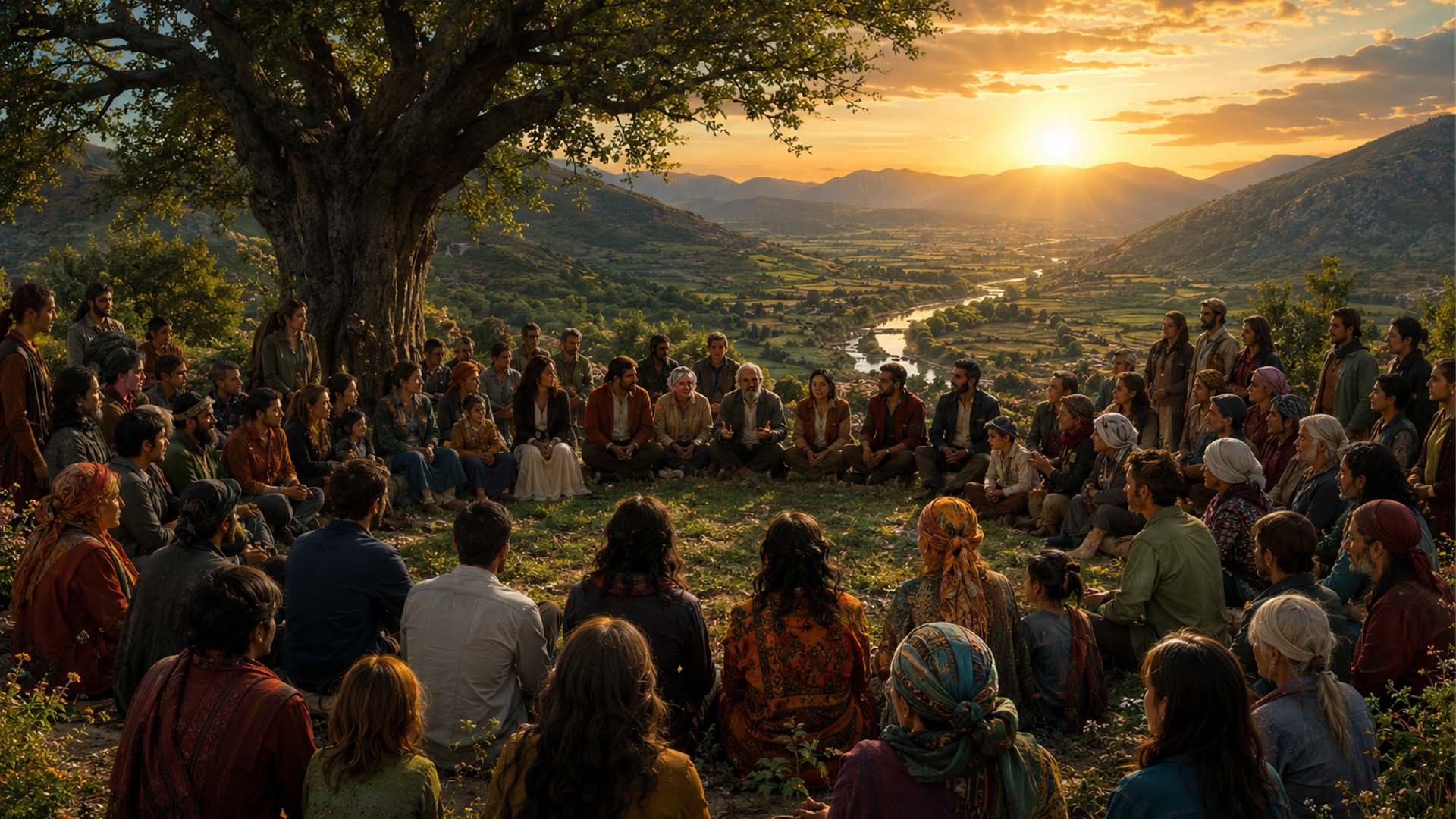
The construction of the democratic nation, as a remedy against the idea of the nation-state, means society reclaiming its own essence and, in its simplest form, rebuilding sociality in a renewed and living way.
When Leader Apo sought to create a place for the Kurdish people on the stage of history, he was in fact striving to revive the sociality rooted in the origins, and to do so in a stronger form. The human model produced by the system, which standardizes people and submerges them in liberalism, leaves society almost breathless and blind. Even the most fundamental phenomena that should be lived on the basis of sociality and togetherness are obscured and wasted through the hand of the nation-state. Therefore, the idea of the democratic nation is a system in which society can live within its own reality, on the basis of coexistence with all societies. This, in fact, constitutes the essence of being human. As Leader Apo also states, while the nation-state is power-oriented, the democratic nation is based on the solidarity and self-administration of communities. And this togetherness is also the mortar of the ethical-political society. The identity of the democratic nation serves a common ethical structure, common principles, political reason, and common social interests. Beyond racial, national, and religious identities, it prioritizes sharing and solidarity.
Leader Apo states the following on this matter in the Manifesto:
“The nation-state is an organization of power, whereas the democratic nation is an organization of social administration. While the nation-state is based on the engineering of creating a uniform, homogeneous society, the democratic nation is based on the nature of a multi-identity, multicultural, heterogeneous society. While the nation-state relies on turning identities into instruments of power, setting them against one another and making them destroy each other, the democratic nation is based on democratic relations and solidarity among different identities and cultures. It removes identities from being instruments of power.”
Leader Apo states that the concept of the democratic nation is a concept that allows for freedom. Based on this determination, we can say that within the concept of the democratic nation, all communities and differences can freely express their ideas, thoughts, demands, and measures of rejection and acceptance. In other words, they can make them common.
From this standpoint, the Leader makes the following assessments in the Manifesto:
“The solution perspective of Democratic Modernity is the Democratic Nation. We have put forward the concept of the democratic nation by relying on the dialectic of nature and thought. This concept is one that enables freedom. Differences can express themselves freely. Against problematic concepts such as secularism in religion, nationalism, and the national question, the theory and concept of the democratic nation possess a content capable of developing a new solution. This concept has carried both me and all concerned circles to today’s solution process. This is very important. What is called the fundamental contradiction is this.”
“All nation-states are the nationalization of the modern age. But through force, violence, and power. That is, these nations are formed by the hand of the state. When power enters into the nation, it becomes the nation-state. But when democracy enters into it, it becomes the democratic nation. Can there be a democratic nation? Of course there can. The whole of society can be within it. Democratic modernity has formed within contemporaneity. From this contemporaneity, both a capitalist nation and a democratic nation are born. For example, Switzerland is close to the democratic nation, while the Germans are a nation-state from head to toe. So these also have degrees. In my view, Scotland is a democratic nation. But England is a nation-state; there is both the nation-state and the democratic nation. These will be vital for us as well.”
“The democratic nation will, to a significant extent, be defined as the ‘commune of communes.’ It may also be called the socialist nation; there is no harm in that. The people becoming a national society, the nation becoming socialist, can also be expressed as the democratic nation.”
“In the past, we used to say, ‘tribalism is bad.’ We used to say, ‘let us immediately eliminate it.’ Yet it is a culture of thousands of years. It also has positive aspects. It must be democratized and modernized. The concept of the democratic nation is also related to these matters. It has a depth and breadth capable of encompassing all these ethnicities, tariqas, sects, and even religions.”
“Kurdistan is the geography where both Judaism and Christianity were born. It is the place where Islam was achieved. Instead of denying these, it is necessary to open the way for them to express themselves and unite within democracy and peace. When they unite, an immense energy of the democratic nation emerges.”
“The great strength of the democratic nation comes from here. Within it there are all kinds of sects and religions. They live, in a sense, in a confederal form. This is what we call democratic confederalism.”
“If the mentality of democratic modernity is the democratic nation, its embodiment is its political goals. We can call this the commune of communes, communality, the union of communes, or the community of communes. This should not be confused with the concept of the state. Communes are a fundamental need of society; they are self-administrative. The commune is the root cell of the democratic nation.”
“Democratic modernity develops the model of the democratic nation against the nation-state. The fact that the nation-state contradicts the historical and social realities of the Middle East provides a ground for the development of the democratic nation. The democratic nation is a flexible model of social organization that is open to differences. The mentality of the democratic nation, which rejects the nationalist, religious, positivist, and sexist mentality of the nation-state, is a model for keeping society alive together with all its differences; it is holistic. On this basis, it rejects every kind of ideology that seeks to unify, homogenize, and impose sameness. In a multicultural and multi-identity geography such as the Middle East, there is no other option for a solution, nor can there be.”
In light of all these assessments made by Leader Apo, the sole solution to the most fundamental social problems of our day lies in the construction of the idea of the democratic nation. To embark on the construction of the democratic nation, in order to liberate the social mind—ever more dulled and numbed by capitalism and its ideology, liberalism—from the power of a particular clique or segment, is the most fundamental duty of every individual in society. This is not a utopia. On the contrary, it is the greatest idea that can be realized.