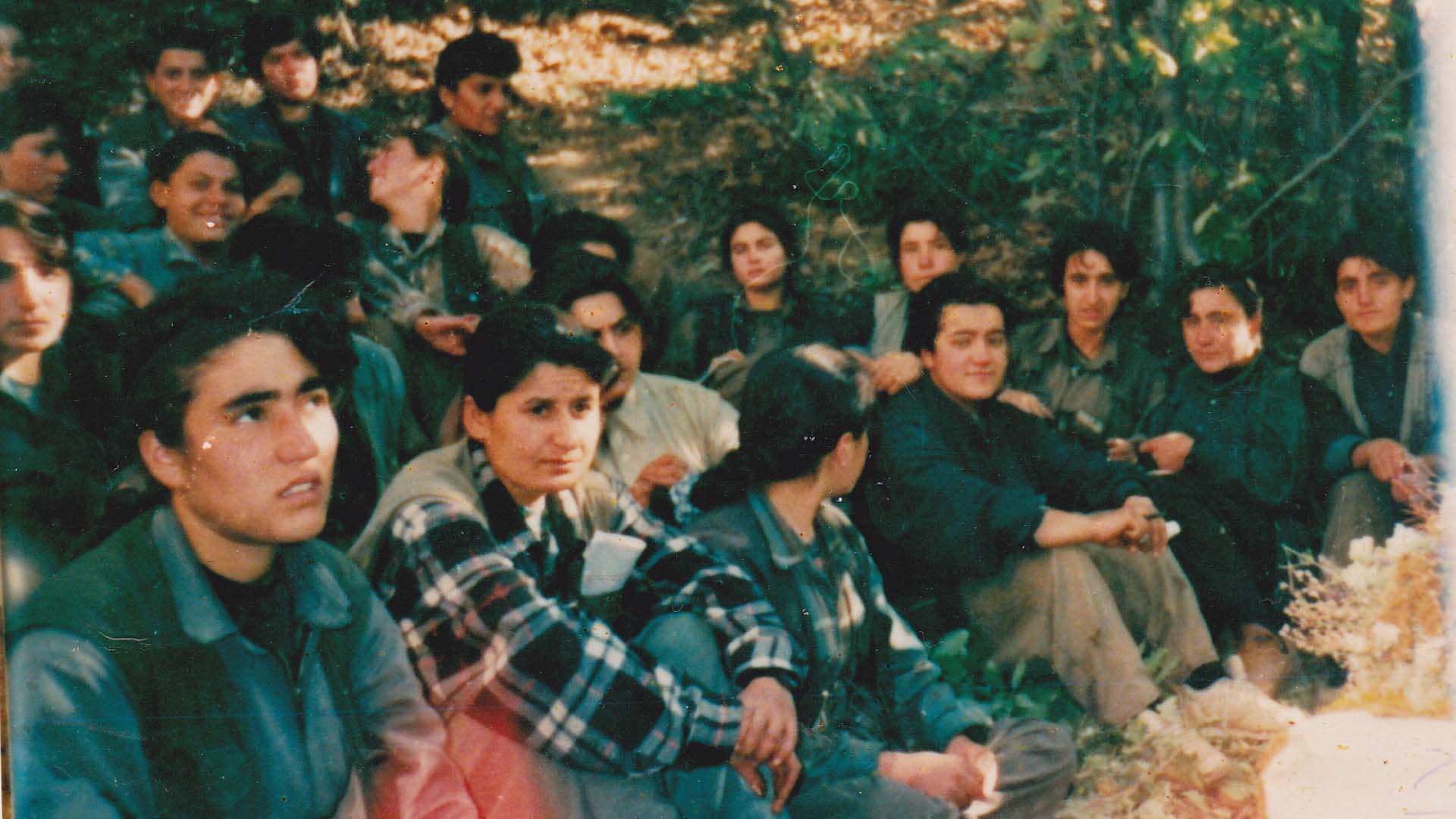
The Dînar Resistance Stretching from 1938 to 1999!
Berçem, whose given name was Nuray Oran, was born in 1980 in the hamlet of Axpar — Akpınar — attached to the village of Türktaner in the Xozat district of Dêrsim. She completed her primary education there. Until she joined the PKK, she was constantly moving back and forth between Axpar and Xozat.
Xozat is a small district located in the western part of Dêrsim. Its geography is mountainous, forested, and in places pastoral highland. Its nature is very beautiful. It was one of the important centers of resistance in the uprising of 1938. Even today, some areas of Xozat remain within restricted zones. The Karamuk stream, also known as the Xozat creek, which passes just below Xozat and flows into the Keban Dam, adds a distinct beauty to the district. Yet alongside its beauty, Karamuk also carries within it a great sorrow and pain. Karamuk is almost like the historical memory of the people of Xozat. In the massacre of 1938, hundreds of people were gathered at this stream and killed. After the massacre, in order to hide its savage face, the state brought the Karamuk stream within the borders of the newly established military garrison. The Karamuk stream became a graveyard for countless people whose bones were mixed together. The nearby valleys of Alî Boğazî and Çaxpar, close to Axpar, shared the same fate as Karamuk.
Berçem was one of the youngest children of Geyik and Hasan, two insurgents who had survived the massacre. They had nine children. She was the twin of her brother Çayan. In the chain of children, these two siblings formed the ninth and final link. Berçem was born an hour or two before Çayan. Çayan’s birth was somewhat painful and difficult. Berçem treated her earlier birth as a good omen and turned it into a kind of advantage over Çayan. She would say, “I am older than you, and therefore I am your elder sister; you will listen to me and take me into account.” Deliberately putting on the airs of an elder sister, she would annoy Çayan and pull him into a quarrel. The shows of strength they developed against each other usually ended in wrestling matches. In wrestling, Berçem was usually the winner. Each time, amid loud cheers, she succeeded in putting Çayan’s back to the ground. Çayan would try to suppress the psychology of defeat by pulling Berçem’s hair; he would turn red with anger, say that Berçem had cheated, and declare that he did not accept the result. Berçem, as the winning side, would then pass from lap to lap, showered with intense attention and affection.
When the occupation began in Dêrsim and the uprising broke out, Berçem’s father was a young man who had married only a short time before and had become the father of a child. In that massacre, her father lost his newborn child, his wife, and many members of his family and kin. Her father was a brave and deeply valiant young man who fought on the front of resistance during the uprising. Her mother, meanwhile, was still a small child during the uprising. Until the uprising was suppressed, she protected herself by hiding in the areas of resistance; she was a rebellious and courageous woman, deeply devoted to her honor. In the uprising of 1938, Berçem’s father and mother witnessed many massacres. Berçem grew up with the memories of uprising and massacre told by her father, her mother, and her close surroundings.
Berçem turned into places of visitation the broad-leaved willow tree where her grandmother had escaped from the soldiers’ hands and hidden during the 1938 uprising; the cave where her father, coming to the village at night from the battle on the hill, had taken and hidden the seven children he rescued from the ruins of the burned village; and the cliffs of Karaburun and Çaxpar, from which young girls threw themselves in order not to fall into the hands of the enemy. The 1938 uprising and resistance became, in Berçem’s mind and heart, a wound that never formed a scab; it shaped her character and her searches for life.
The resistant tradition of Dêrsim found its clearest expression in Berçem’s personality. She had a very resistant, stubborn, determined, militant personality, reactive against the state. The most distinct features of her personality were her rebelliousness, her fierceness, her courage, her devotion to freedom, and her great anger toward the dominant system.
No matter who it was, she would never remain beneath any word or any wrong behavior; she would always have a reply. She would not submit to pressure or domination, and she would never bow her head before oppression. I remember how many times she beat male comrades because they had shouted at her or approached her wrongly. If something did not make sense to her, she would not take into account the words of those older than her, including her mother and father; she would do what she knew to be right. She would also face the consequences that might arise with courage. In this sense, Berçem never committed the sin of resembling the elders.
Dêrsim’s spirit of resistance found its most beautiful and striking expression in Berçem’s personality. Berçem had a great interest in stories of resistance. She was a Dev-Sol sympathizer. She knew very well which revolutionary had resisted where and how. Each time she would narrate it with excitement, as if she had just heard it and had been there herself; then her laughing eyes would ignite like fire. When she spoke of the resistance of revolutionaries, she would lose herself and live that moment with her entire being. She had identified me as one of her best listeners. Whenever she found an opportunity, she would immediately come to my side and, without tiring or growing bored, would tell for hours of the actions and resistance of revolutionaries: revolutionaries had been surrounded in a narrow valley; then they broke the encirclement by fighting; two of their comrades were heavily wounded; they took their wounded comrades on their backs and withdrew while fighting. Another group, meanwhile, encircled the enemy from behind and annihilated them… Again, a group of revolutionaries had fallen into an enemy ambush; after taking wounds, they threw themselves into a stream, entered the reeds in the water and hid there, waiting for hours in the ice-cold water, hungry, thirsty, exhausted, and wounded…
In Berçem’s stories, revolutionaries were always extraordinary people who fought and resisted bravely and courageously, and who struck great blows against the enemy. When she told of those who had fallen as martyrs in clashes and actions, she created an unbelievably mystical atmosphere; she made her voice mysterious, as though speaking of a divine power full of secrets, sometimes raising her tone and sometimes lowering it to a barely audible level. She would overflow with enthusiasm, longing, admiration, love, and grief. At that moment I would forget myself, dissolve in the power of her narration, and become lost, as if in a boundless sea of imagination.
One day the two of us had gone to the field to cut vetch. The place where Berçem was working was a little far from me. She was speaking loudly, trying to make her voice reach me. After speaking from afar for a while and watching me, she could not bear it and came to my side. Again, her large beautiful eyes were smiling. As always, her childlike smile spread across her beautiful face. She came close to me and began to tell of the resistance of revolutionaries. Once more, defenseless, I surrendered myself to her magical power.
For some reason, my resistance was very weak before the force of Berçem’s narration. Just as she did with many people, she would quickly subdue me too with the power of words and storytelling. When she spoke, the fire in her soul spread from her tongue into her surroundings, broke the human being’s defensive resistance, and drew one inside. Berçem transformed her spiritual world into speech and body language in a very striking way, and from it she created a tremendous power of meaning. Whenever she spoke, I would move away from the time and place I was in. This time, too, the same thing happened to me; while cutting vetch, I let myself go into the corridors of time and space that she created with the power of her narration. I did not notice that the sickle had cut my finger. Minutes later, when I saw the blood from my cut finger spreading onto the bundle of vetch in my hand and dripping onto the soil, I came back to myself and realized that my finger had been cut.
She was energetic. Her ability to organize was highly developed. When she was little, she would organize children within a few minutes, lead them behind her, and go off to play. She was interested in sports. In mixed games she always made her influence felt and invented new games. Often, together with her friends, she would take on the roles of soldiers and revolutionaries and perform theatrical games. Neighbors would often complain of Berçem, saying that she led their children astray. As much as she played, she also worked; she did not refrain from doing the work that fell to her. Yet she would plan and carry out the order between the work she had to do and the games she wanted to play according to how she herself wished and found appropriate. She would not accept or apply contrary approaches and impositions. Because of this trait, we often had quarrels and tense discussions, but in the end I was the one who gave in.
Her comprehension was highly developed, and she was very intelligent. She read left-socialist sources and Turkish left publications, and she entered into discussions with everyone, women and men alike. In discussions, in order to bring the person to the point she aimed for, she would change many languages and produce many words. She would not let go until she had brought the discussion to a satisfying level. She took great care not to be hurtful; she used a language that was almost capable of drawing a snake out of its hole, and she rendered the other side ineffective. People often said, “This girl has a devil’s charm.” Truly, a person both wanted very much to be angry with Berçem and yet could not be angry with her in any way. With her natural, simple, frank style, she awakened in a person both anger and an intense feeling of love and tolerance at the same time, neutralizing the other side’s reflex.
She was very interested in poetry and literature. She wrote poems. She read literary sources, drifted into the distance, thought for hours and dreamed. She had a very rich world of imagination. Sometimes she told stories that astonished a person. These stories were not things she had read somewhere or heard from others; they were her own constructions. The heroes of the stories possessed such extraordinary qualities that it was hard to find them among ordinary human communities. Berçem had completely clarified in her mind the life she longed for and the human typologies she desired. These people, products of her world of imagination and ornaments of that world, were so free, simple, clear, and ideal that one hesitated to touch them. Her dreams were delicate and tender, like herself. When she spoke, the energy that flowed from her soul into mine pulled me like a magnet into her own depth. The characters in whom the extraordinary people of her imagination became concrete were revolutionaries.
When revolutionaries were mentioned, the entire flow of Berçem’s life changed. According to Berçem, these people possessed wholly extraordinary qualities; they were perfect human beings. Revolutionaries could not have weaknesses or flaws. They possessed virtues that existed in no other human being. They were brave, valiant people, with unmatched talents and beauty, who stood up to the capitalist system and the Turkish state. To stand beside such people was an honor. She was a very fanatical sympathizer of Dev-Sol. She had read and heard of the prison resistances of Dev-Sol militants and had been deeply affected. The fact that she had constantly lived in close contact with Dev-Sol militants since childhood also largely shaped the development of this interest.
We had intense discussions and quarrels about Turkish left organizations, especially about Dev-Sol. In Berçem’s family, the women generally sympathized with Dev-Sol, while the men sympathized with TİKKO. As for me, I had always maintained a cautious and distant approach toward all factions. Though in a general sense I defined myself as revolutionary-socialist, I had not developed any serious interest in any faction. In later processes, when I read the publications of the PKK, my preference would become clear. While I was trying to draw Berçem and her circle of friends toward the PKK, she was trying to draw me toward Dev-Sol. Our intense discussions sometimes went as far as small resentments and short periods of not speaking. When I heard of their decision to join Dev-Sol as a group, my anger increased further, and a very tense discussion took place between Berçem and me. In order to prevent their joining Dev-Sol, I accelerated my own joining of the PKK. Although normally I had planned to join two months later, I brought it forward and went out to the guerrilla one week later. My early joining disrupted the plan of the group led by Berçem to join Dev-Sol.
Berçem’s research and deepening on the PKK essentially developed after my joining. Our relationship with Berçem, as much as it was quarrelsome and conflictual, also held a deep love within it. On 12 July 1995, Berçem joined the PKK from Xozat. She did not know the PKK very well. She was heavily influenced by the prejudices developed by the Turkish left. She thought of the PKK as a nationalist movement, Sunni-fanatical, organized against Alevis and revolutionary movements, and under the state’s guidance. Although before joining she had read a little and tried to understand, her concerns were far from resolved. Yet my joining had added different doubts to the doubts in her mind from another angle. According to her, if the PKK was an organization as she thought, what did it mean that I had chosen such an organization? Could there not be different things she did not know? She planned to come and see the PKK, and if it was as she thought, to convince me as well and take me away.
The period in which Berçem joined the PKK was a very difficult process for the Dêrsim province. Şemdin’s liquidationism had caused very great damage to the province. Desertions and losses were very intense. Demoralization was the general mood. In the approach to people, a pragmatic and repressive style was very dominant. The failure in war tactics was leading every day to new losses and moral collapse. This picture did not correspond in any way to the phenomenon of revolutionism in Berçem’s mind. On the contrary, it became a factor that fed her prejudices and concerns. She had not warmed to the environment. She was experiencing serious problems of integration. Neither did she want to stay, nor did she want me to stay. In that period, very intense discussions developed between us. At every opportunity, I tried to explain that this situation was temporary, that it was the result of individuals’ weaknesses, and that the real PKK was not this. She, however, was not convinced and struggled to take me away; she constantly argued with the provincial commander and demanded that he convince me to return. This process of discussion and wavering lasted for months. Over time, through discussions and meetings, through the analysis and evaluation of the processes we were living through, through Leader Apo’s criticisms and perspectives directed at the province, and through the short ideological trainings she saw, a positive process of concentration and questioning developed in Berçem. As the province entered a process of correction, as warmth and sharing in comradely relations strengthened, as the guerrilla’s resistance against the enemy, its successful actions, martyrdoms, wounds, and its endurance before the difficulties of life and nature emerged, Berçem’s prejudices were shattered. She had now entirely abandoned her plans to take me back and had made the decision to participate fully.
Until she fell as a martyr, Berçem always remained in the Dêrsim province. She carried out guerrilla work there. She took on duties at the level of squad and platoon commander. She was always a successful guerrilla and commander. Berçem was always known, and always remembered, for her honesty, laboring spirit, emotional depth, simplicity, intelligence, courage, stubbornness, rebelliousness, persuasive ability, and capacity for empathy.
Berçem’s enthusiasm within life never diminished. She had a very contagious enthusiasm. She was highly sensitive and attentive toward people, life, and nature. If she had upset someone unnecessarily, she could not free herself from its effect for days; she would experience a deep discomfort, be unable to endure it, and go to discuss with the person concerned, trying to understand and to explain herself.
Toward the enemy, however, she was very radical and harsh. In every action she went to, she necessarily played a very decisive role. In actions she was very agile, brave, and fearless. Her self-confidence and courage created great interest and admiration among comrades. In one action she went to, she was in the defense. When the assault group failed to play its role, showed itself, and withdrew, Berçem left the defensive position and went on the attack. The other comrades had to follow behind her, and by pressing insistently against the enemy hill, they brought down the positions.
Her resistance before the difficulties of life was strong, and her will was sharp. She never made her physical illnesses or difficulties into an obstacle. She was an exemplary personality in her claim to overcome difficulties and barriers.
She loved riding horses very much. Once Berçem mounted a horse, it was impossible to restrain her. When Berçem rode, one felt as though she had grown wings and was flying. One day, she again mounted a horse as rebellious as herself and galloped at full speed. For a moment she could not keep her balance and fell from the horse. Her ankle was sprained; her arm and ribs were bruised. Even in that condition, she got up and went after the horse, thinking of catching it and mounting it again. Her foot swelled and could no longer fit into her shoe; tying a keffiyeh around her foot, she walked for days within the operation.
She was very intolerant of wrong, inappropriate, unjust discussions, evaluations, and criticisms. She had a very deep sense of justice. She strongly opposed people being accused and judged unnecessarily and unjustly, and she would do everything in her power to defend that person. One day, in a meeting, some problems and mentalities were being discussed. Certain unjust accusations and claims were being developed. Although she criticized and evaluated them, not much changed. This time she took her weapon and left the meeting. She ran away from the meeting place and, somewhere ahead, began firing into the air. Everyone was astonished and panicked. Thinking that she had harmed herself, the comrades went to her in worry. When they reached her, they saw Berçem sitting and thinking deeply. They asked, “What are you doing?” She replied, “I am firing bullets at mentalities.”
In the winter that connected 1996 to 1997, I was with Berçem in Alî Boğazî. We spent the winter training process together. We prepared for spring together. She had grown further, matured, developed, and become more beautiful. Toward spring, we entered three clashes in Alî Boğazî. She played a very effective role in the clashes. She knew very well the necessity of war. She fought very well, but she did not love war. Because she believed she had to fight, she also experienced no hesitation. Berçem was not unfamiliar with the consciousness of war and the enemy. The occupation of Dêrsim and the uprising of 1938 had shaped the consciousness of the enemy in her deeply. She knew very well that it was impossible to build a free life without fighting. Some discussions developed between us on the necessity, futility, and cruelty of war. Between every conversation, with the air of a wise woman, she would say that the life she dreamed of could not be without war, and with her bittersweet yet affectionate smile, steeped in hope and sorrow, she would try to pull me away from the heavy atmosphere of the discussion.
In March 1997, when a force the size of a battalion fell into a tank ambush in the Bozanlar area of Alî Boğazî, Berçem, amid snow several meters deep, amid bullets raining down on them and bombs exploding beside them, was breaking through the snow and trying to lead her comrades out of the encirclement. On that difficult day, Berçem’s command of the terrain, her endurance, and her sound judgment became a guide for her comrades and played a decisive role in the rescue of 19 comrades.
The year was 1999. Leader Apo was captured as a result of the international conspiracy and handed over to Turkey. Everywhere, intense actions were developing under the slogan “You Cannot Darken Our Sun.” Many people set themselves on fire, made bombs and detonated them. Proposals for self-sacrificial actions came from hundreds of guerrillas. Across the country, revenge actions were carried out one after another. The Dêrsim Çiçekli outpost action was planned precisely in such a period and for this purpose. The action was a response to the international conspiracy.
Çiçekli outpost was a very strong and well-equipped outpost established beside Çiçekli village, attached to the center of Dêrsim. The outpost took its name from Çiçekli village. In operations directed toward the area, the first reinforcement of forces was made to this outpost. Along with controlling a significant part of the area, the outpost also played the role of a central place where operation forces gathered and dispersed. The plan of the action was directed at the military convoy that would come to the outpost. A guerrilla force the size of a company participated in the action.
An ambush would be laid on the road coming from Dêrsim to the outpost; the military convoy that would arrive in the later hours of the night would be struck, and the guerrilla force would withdraw quickly and leave the area. On this basis, the guerrilla company reached the ambush site at night and took positions. The military convoy did not arrive at the expected time; it came when dawn was about to break. Although the convoy did not come at the planned hour, they waited until dawn and struck the convoy. The enemy suffered many losses. Many vehicles were completely destroyed by the guerrillas. The guerrillas withdrew safely without losses. But after the action, the enemy, taking advantage of the daylight, landed troops by helicopter on all the nearby hills. With thousands of soldiers sent out from the center of Dêrsim, it held the area. Cobras heavily strafed the withdrawal line from the air. In the Cobra attack, several guerrillas fell as martyrs; Berçem and Faik, the West Dêrsim regional commander who was leading the action, were wounded. Faik suffered internal bleeding. With the help of their comrades, the two were moved under a rock resembling a cave. Cobra and mortar attacks continued without interruption. From the ground as well, the enemy tightened the encirclement and struck the area violently.
The group that had withdrawn under the rock fought and resisted where it was until evening. Their ammunition, too, was nearly exhausted. Martyrdoms and wounds occurred within the group. With darkness falling, Faik said that he would certainly fall as a martyr and that the group should leave him a bomb and quickly leave the area. After intense discussions and insistence, he convinced the group, but he could not convince Berçem. Berçem insisted. “Either we all go together, or I stay too,” she said, and she stayed. Despite great efforts, no one could convince Berçem to leave. After the group departed, the clash continued. In the later hours, the enemy completely surrounded the cave and attacked violently. In order not to be captured wounded, Berçem and Faik detonated the bombs on themselves.
On 16 April 1999, in the Dînar valley attached to the center of Dêrsim, Berçem joined the caravan of martyrs together with 14 of her comrades.
Dînar is one of the fundamental places of resistance in the 1938 uprising. In this valley, hundreds of people fought against the enemy, resisted, and reached martyrdom with honor. Dînar is the symbol of the honor of the people of Dêrsim. The resistance of Berçem and her comrades was a new graft onto Dêrsim’s tradition of resistance.
Every April, involuntarily, I speak with Berçem. Berçem and April are two truths united in my heart. When April comes, my emotional world changes completely. In April I see Berçem, I embrace Berçem, and I share the great longings of my heart with Berçem. In my heart, my mind, and my eyes, April becomes entirely Berçem, and Berçem becomes April. In the bursting buds, I feel Berçem! In the green sprouting from the soil, I feel Berçem! In the flower raising its head tenderly, I feel Berçem! In the wind scented with April, I feel Berçem! In the waters flowing foam upon foam, I feel Berçem! In the intensifying chirping of birds, I feel the reflection of Berçem’s sweet voice! In April, in everything that touches my eyes and my heart, I follow the traces of a greeting that might come from Berçem!
April lives, without limit, the joy and enthusiasm of awakening nature from its sleep and reviving it anew. Just like Berçem, who overflowed with the enthusiasm of free life! April gently awakens the earth from its sleep and drowns it in green, yellow, red, purple, pink, lilac, and a thousand other colors. Just like Berçem’s endless, colorful world of imagination! April is nature’s most living face, flowing with freedom. Just like Berçem’s heart, which flowed freedom into Dêrsim!
In the depths of my consciousness and my heart, April and Berçem form such a perfect unity that I cannot keep myself from merging with this metaphor.
Berçem is one of the flowers of resistance of Dêrsim. Berçem is one of the flowers of resistance of Kurdistan. With the resistance of Berçem and her comrades, Dêrsim came one step closer to its essence. It came one step closer to freedom. Berçem and her comrades became bridges of honor stretching from 1999 to the resistant truth of 1938. Saying, “You Cannot Darken Our Sun,” they went smiling toward death in the light of Leader Apo and became immortal. In the light of the immortals, Dêrsim began to cry out resistance and freedom more strongly.
Code Name: Berçem Xozat
Name and Surname: Nuray Oran
Date and Place of Birth: 1980, Dêrsim, Xozat, Türktaner Village, Axpar — Akpınar hamlet
Mother’s Name: Geyik
Father’s Name: Hasan
Date and Place of Joining: 1995, Dêrsim
Areas Where She Stayed: Dêrsim
Date and Place of Martyrdom: 16 April, in the Çiçekli outpost action in Dêrsim
Besê Şîmal