Garisa is the witness to the story of armed struggle. The mother of all events and experiences. Beside every high hill, or behind every tree, there is an event that has not been known, heard, or interpreted.
The meaning of Garisa has a special place for guerrilla war. The word Botan became a sweet word in the history of armed struggle, spoken on the lips and sweetening everyone's mouth.
Garisa possesses strength and majesty; it is an incomparable subject. For that reason enemy forces cannot easily pass into every part of this region. It has high, rugged, and difficult mountains. On one side is Cace, on the other Mount Piro; as for Herekol, it is already the mother of all guerrillas. Not only today, but in history too, it has a great name and fame. On one side its height and ruggedness, and on the other the wars and clashes that had taken place in Herekol, had become like a barrier in the eyes of the enemy. For this reason the fear of all mountains existed in the enemy's mind, but the fear of Garisa, and especially of Herekol, was different. The struggle that the guerrilla developed in this region and the meaning it gave to this place had been carved like a map into the history of armed struggle.
Since the war began, in Garisa the meaning of life had changed for the people of this region. The life that once groaned under the enemy's oppression and force lost its old meaning with armed struggle. After 1989, Garisa became a guerrilla camp, as if it had been freed from the cold and frost of winter and rejoiced at the coming of spring.
The tenth anniversary of the armed struggle had been celebrated, but that year the war had become more difficult than in all previous years. The enemy had set out with all its savagery and was coming against the guerrilla with large cleansing operations. The enemy's slogan, "either we will finish them, or we will finish them," was being repeated everywhere. The guerrilla, however, acted on its own slogan: "either victory, or victory." In every part of the region, great resistances and epics of war were being staged. In this way the confrontation that had begun in the first months of that year continued with all its difficulty.
Days passed and months came. The year was now moving toward its end. The guerrilla, as every year, was again making preparations for camps. But that year, in order to cut the people and the guerrilla apart, the enemy had left almost no village in the Garisa district that helped the guerrilla. In other words, they too had taken their share of the enemy's savagery. They had either been completely burned or destroyed. As a result, the villagers had migrated and left their homes behind. Those villages, built over thousands of years, now remained like ruins. Only owls hooted on the witness walls. Only a few guard villages that the enemy had made into its support and backing remained in the region. They too stayed there for the enemy's security. In other words, a few villages where the enemy had stationed its forces remained in the region. But on the high mountains the guardians of these mountains, those who struggled for the freedom of this land and people, still remained. Although they had passed that year in the heat of war, the season was still not like previous seasons. In other words, naturally, in wintertime the war would pause a little.
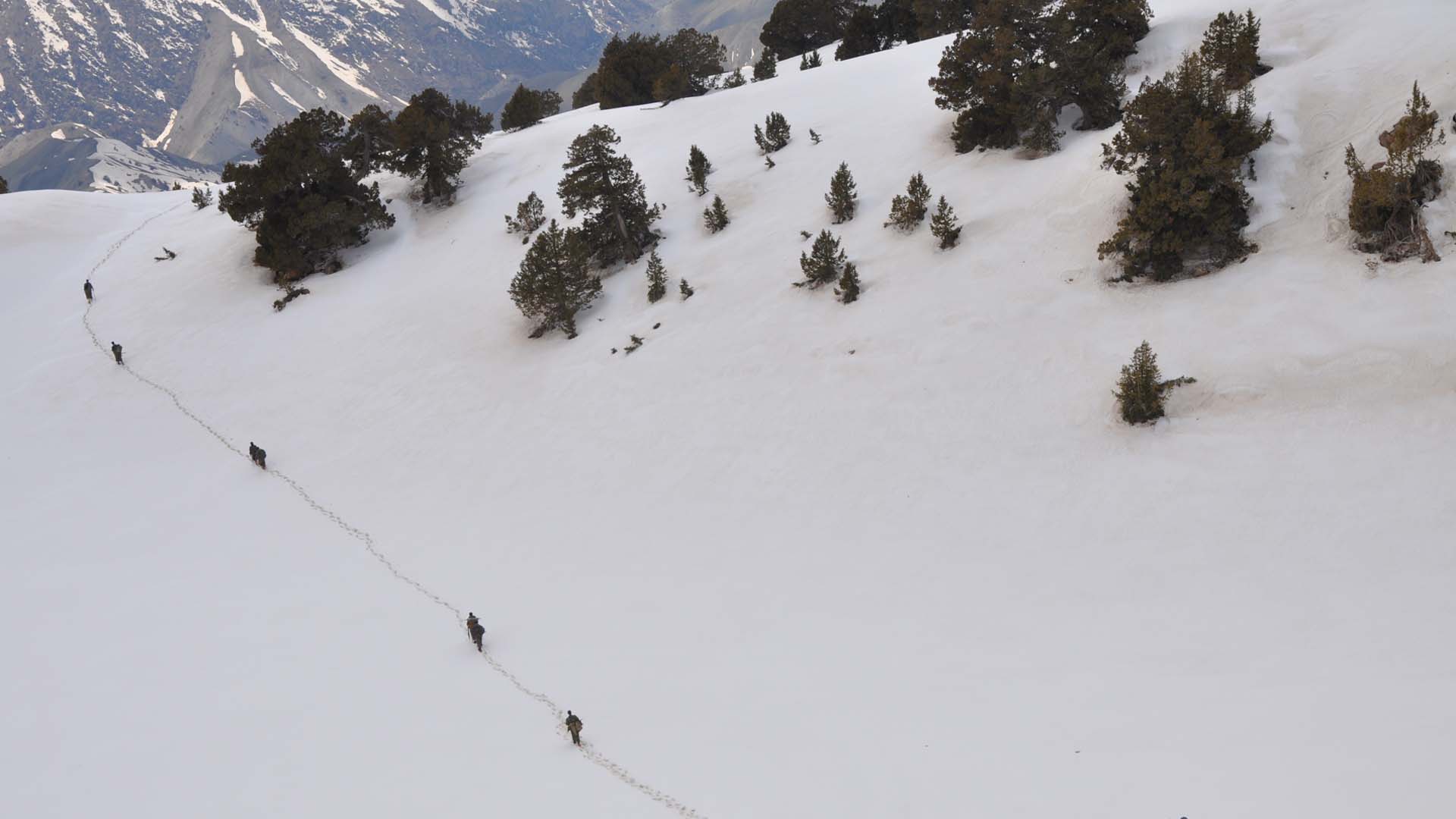
Fog had reached the summits of the high mountains; they no longer remained without fog and cloud. Winter was showing its adornment to everyone. White snow had spread its dress over everywhere like a bride's veil. Garisa, with all its majesty, had become one color. The color of snow had hidden all of Garisa's beauty beneath itself. The guerrilla too had become guests of this land. They had made this place their homeland, and to fulfill their hope they endured every cold and frost. Therefore a group of comrades had to go to the village of Ers for food supplies, to take out the provisions they had hidden there earlier and bring them to their unit.
After a long time we reached the place where we had hidden our provisions. All the comrades prepared their loads and we set back on our way. But before leaving the village of Ers, we sat under an oak and caught our breath. After smoking a cigarette, it was approaching seven in the evening. The world was slowly growing dark. We walked for a while, but such a storm rose that we could no longer open our eyes. Snow and rain were falling so hard that everywhere had turned white. After we had walked a little, we understood that we had lost the way. From the place where we entered the road until six in the morning, we went back and forth in the snow. As time passed, the wind and storm, snow and blizzard, grew stronger. It reached the point where weapons stuck to our shoulders from the cold. Almost all of our knees had weakened and we could barely push our way forward. The road we used to be able to cross in half an hour, from exhaustion we could not finish even in three hours. Although every comrade used all the strength in his body so that we might quickly get out of this situation, the weight of the load on one side and the storm on the other weakened this strength and will. We were weakening, and we could not move forward as we had hoped.
Suddenly news came from behind: "Comrade Aras and comrade Xerib can no longer walk." We moved their bodies a little so that they would rise and walk with us. But these comrades, like birds whose nests had fallen into the snow, said: "Get yourselves to the comrades, otherwise you too will become like us."
Whenever I looked at them and at the condition they were in, our comradeship of long days came before my eyes like that snow and storm. All those days when we wandered, walked, and laughed together fell before my eyes like an old picture.
The snow kept falling more harshly and ruining our path. After we had moved a little away from our two comrades Aras and Xerib, another comrade also said: "You go!" We tried to raise him to his feet, but his body had become like a block of ice; he could barely hold himself standing.
Again we were forced to leave that comrade behind. On one side, our hands would not detach from those comrades; on the other, in order to save the other comrades, we were forced to continue our way. When the road became very difficult, each time a comrade opened the way in the snow in turn. Each time a comrade went ahead and tore through the snow. Whenever we walked a little, we fired a bullet and ran our hands over the barrel of our weapon so that it would become a little warm.
After a long march, the light of morning slowly began to show itself. The world opened, and the snow and storm withdrew to the high places. We wanted to reach quickly the spring above the village of Sukal. Near the spring there was a cave. After an hour we reached near the cave. The comrades had already heard the sound of our weapons, and they too were coming to our aid like the speed of the wind. We all went together into the cave. The doctor and all the comrades rubbed our bodies so that the blood would circulate...
Note: After the snow melted, the bodies of those comrades were found by the comrades and buried with a military ceremony.
Bahoz KOCER