



History is the origin of everything, the point of departure, and the beginning of the journey of formation. Especially in terms of social phenomena, having roots in history expresses the significance of social values in determining whether a phenomenon is beneficial or harmful to society.
If the emergence of a phenomenon on the stage of history has contributed something to humanity, then that phenomenon is positive and equally legitimate. However, if it has harmed humanity, fragmented sociality, and led to exploitation, then no matter how positively it may be presented today, it is fundamentally harmful from its very roots and should therefore be rejected.
At the dawn of history, before the emergence of dominant civilizations, everything was created on the basis of humanity’s needs. Concepts such as morality, politics, and economy were always phenomena that contributed to society and served its interests. Although morality has now been eroded, politics reduced to the demagogy through which states deceive society, and the economy transformed into an instrument for exploiting society, these concepts in their essence belong to society. They serve society’s interests and must be stripped of the distorted forms that have turned them into instruments for legitimizing the system, and once again be returned to society.
On the other hand, concepts such as the state and power emerged from the very beginning as tools against society, as mechanisms of exploitation, and can never truly serve the interests of society. Therefore, to become a free society, it is first necessary to free oneself from them.
Within social nature, history reveals the true face of phenomena, while on the universal level, formations represent the simplest and most natural form of truth. The universe itself is truth. There is no place in the universe for anything unnecessary, meaningless, or untimely. Even formations that were meaningful in their own time are surpassed by the universe once their role is completed and their time has expired, evolving into new formations.
Phenomena that are in harmony with the characteristics of the universe and do not stand in contradiction to it are likewise beneficial to social nature and express legitimacy in the strongest sense.
From this perspective, we will seek to understand self-defense first in the universe and then in society. By briefly examining its universal and historical foundations, we will arrive at the present-day condition of women’s self-defense.
The dominant system, from the very formation of society, declared self-defense—the most indispensable characteristic of society—to be an illegitimate and unjust right. At the same time, it legitimized armies as instruments of exploitation and proclaimed the spoils obtained through war to be the rightful property of the system.
Yet the truth is precisely the opposite. Whoever has been deprived of their rights or subjected to attack always possesses the right to defend themselves. In contrast, the system’s seizure of social values and achievements through military force, plunder, massacres, and conquest is nothing more than theft. It has no legitimate aspect whatsoever and is, moreover, an act of profound disgrace.
Self-Defense Is a Universal Characteristic
When we first look at nature, we see that self-protection is a fundamental principle in all forms of existence. This principle applies not only to living beings that have reached the stage of biological life but also, as a universal principle, to subatomic particles themselves.
One of the most concrete examples of this can be observed in Einstein’s struggle during the discovery of the subatomic world. Einstein indeed discovered many characteristics of atoms and subatomic particles, yet fundamentally he remained committed to Newtonian physics, whose laws he regarded as clear and absolute. For this reason, he was determined and persistent in trying to understand the subatomic world according to those laws.
With all the ingenuity of analytical intelligence, Einstein conducted numerous experiments to comprehend the properties of particles. Yet particles refused to behave as he wished. Each time they acted differently, frustrating his plans, misleading him, and leaving him astonished.
The nature of the particle is remarkably rich and multifaceted. Despite countless experiments and discoveries, it continues to fascinate humanity and remains full of mysteries.
The universe is the most living of all beings, and it is its intelligence that created and sustains the cosmos. We humans are, in fact, the latest stage reached through its evolution. Consequently, all of our characteristics have their origins in the universe itself.
And what about self-protection? Self-defense!
Since self-defense is a fundamental characteristic of all existence, it is a feeling of universal origin. The universe preserves its vitality by constantly expanding and by transforming beings whose lifespan has ended or whose energy has been exhausted into new forms of existence. In this way, it maintains its living and dynamic character and continually renews itself. All of this means that the universe protects itself through perpetual renewal.
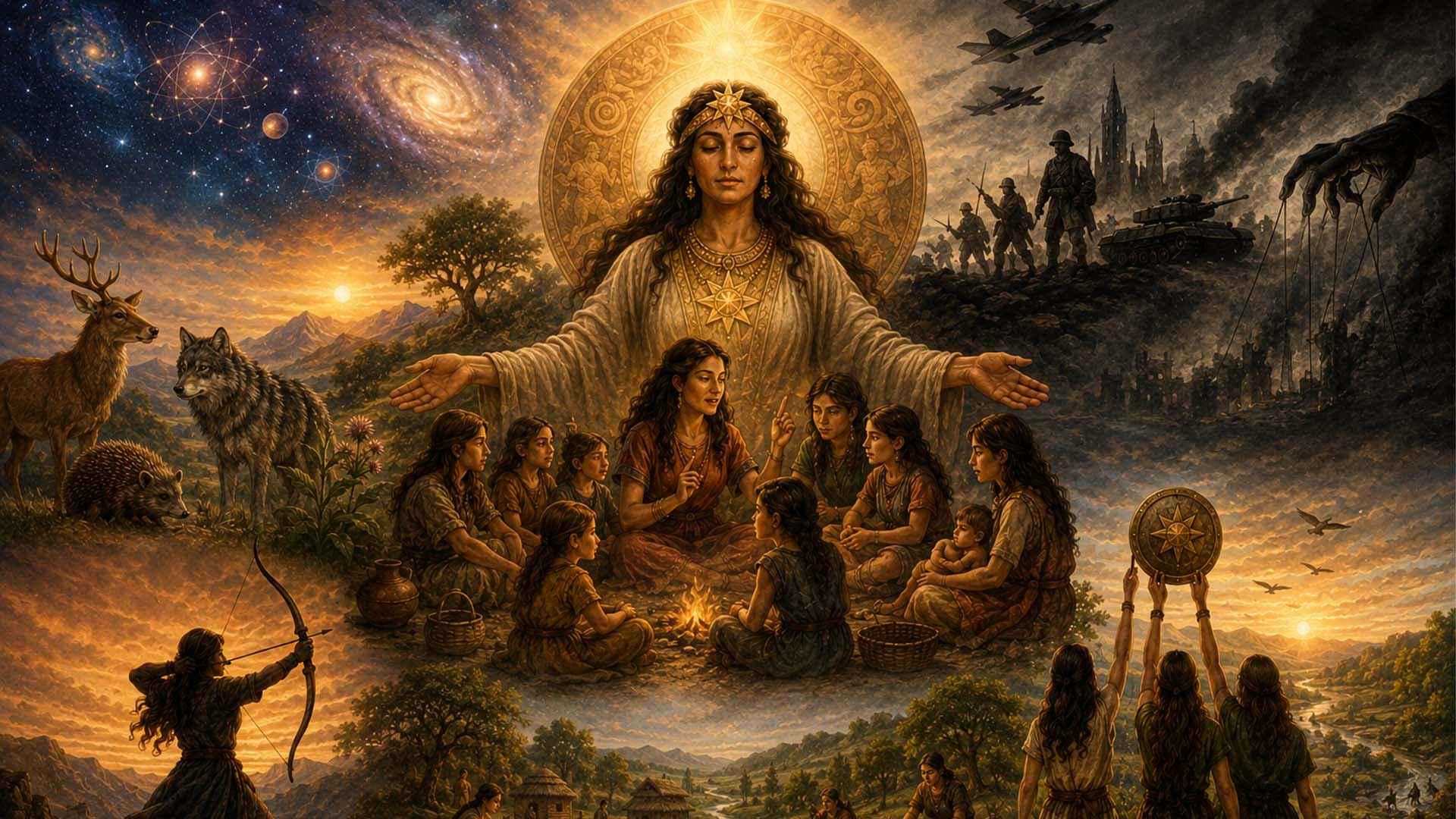
When we search for the origins of self-defense within social nature, we encounter the leadership of women. Woman is the pioneer of socialization. She is the one who founded society, developed social memory through her wisdom, and constructed the entire material and spiritual cultural structure of society.
To regard the sacredness of women in the first stages of socialization merely as a function of ensuring the continuation of the human species would be a deeply mistaken perspective. Woman did not simply give birth to the child; she nourished, clothed, protected, and taught the child everything she knew.
Since the very beginning of humanity, every child born into the world has been welcomed as sacred for the continuation of society. Yet transforming that child into a human being was the task of woman. This was the true sacredness.
Feeding the child, clothing them, protecting them from heat and cold and from the dangers of wild nature, and raising them as a thinking human being were woman’s greatest services to society. The most essential pillar of protecting society was transmitting social memory to the new generation. In every new individual joining society, culture itself was being reconstructed.
Securing the conditions of existence was the first step in protecting society. The use of reason, culture, language, and social life—the very qualities that distinguish human beings—were all taught by woman. Society could not exist without these. Even if it did, the distinctive qualities that make humans human would never emerge.
These characteristics are not only what distinguish humanity but are also the means through which woman defended society. By teaching those gathered around her how to use their minds, she protected them. She protected society through dialogue, explanation, sharing, mobilization, and the transmission of knowledge.
Woman’s wisdom became the fundamental condition for ensuring the continuity of life and preserving the social essence. Everything woman created and invented was recorded in social memory, became part of social culture, carried humanity toward what was better and more beautiful, and through these achievements humanity was protected.
The clan of the Goddess was the first form of society. Unlike today’s family and society, which both commodify the individual and render them dependent, it was a sociality based on sharing, nurturing through teaching, and giving human beings their human qualities. It was the environment in which society’s moral structure and politics were shaped.
The first society was the clan, and the first leader was the mother. The society formed around the Mother Goddess was egalitarian and communal, and everything that was done was carried out for the benefit of society and on the basis of defending society.
To be continued…