

Why did the Goddess of Love also become the Goddess of War? How did war and love come together? How did these two opposing concepts coexist within her identity at the same time? Could war and love exist side by side?
Here we arrive at the period in which male-dominated mentality began to develop and attacks against the fundamental values of society commenced. Man attacks the production of woman. He disrupts the law of the household (economy) and, as a cunning man and a thief of the home, steals the values produced by society. He turns the family into property; the first dominant figure becomes the father, and the first institution of exploitation becomes the patriarchal family developed under the monopoly of the father figure. He also attributes to the father the qualities of protection and guardianship that belonged to woman.
Society ceases to be the foundation of culture, morality, and politics, and is transformed into a sphere of exploitation for the state, where individuals deprived of will and reduced to slavery are raised.
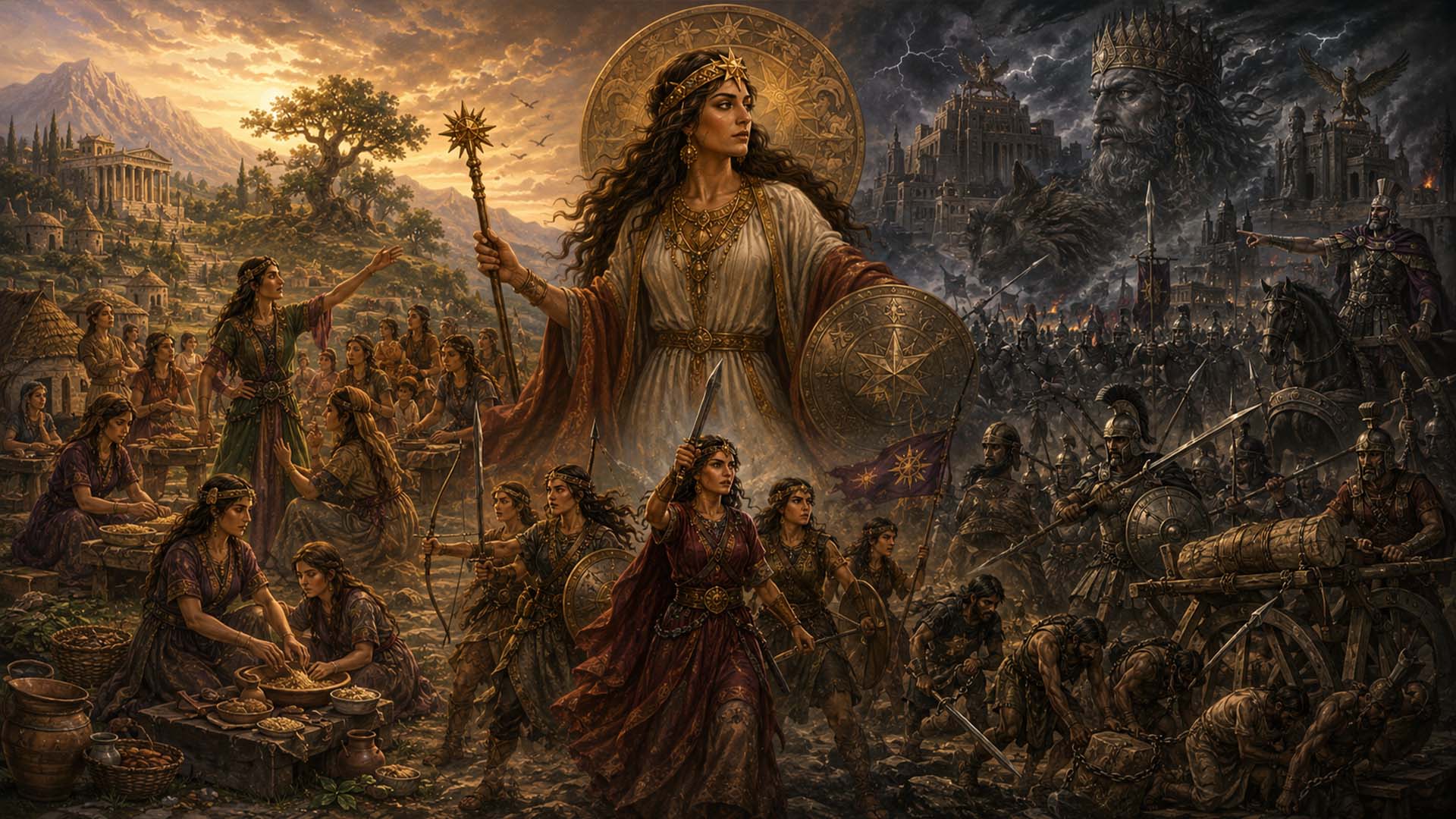
The first war of the Mother Woman was against this reality. The Goddess Star earned the title of Goddess of War, alongside that of Goddess of Love, through her struggle to defend society.
Today, the word Star is used in many languages to mean “star.” This is a continuation of the ancient reverence for the universal works of this primordial goddess and of the identification of the goddess with the stars.
At the same time, the word Star is still used in Kurdish with the meaning of “defense.” In difficult moments, people seek refuge in the Mother Goddess by saying “Ya Star,” asking for help, protection, and defense.
Likewise, the Goddess Lilith, who is today remembered as the cursed woman of dark nights, is in reality a goddess who displayed great resistance against enslavement. The cry of “tilili,” associated with Lilith, still remains on the tongues of Kurdish women in both the most difficult and the happiest moments of life.
At the same time, the tilili of women guerrillas—the force of Kurdish women’s freedom—instills fear in the hearts of the enemy and creates the feeling that they can never defeat them, while giving their comrades tremendous strength to resist. One could say that this has become a ritual.
The age of mythology narrates the wars between woman and man after man invented theft.
The struggle to reclaim the “104 Me” (inventions and laws) stolen from the Goddess Ninhursag constitutes the first self-defense struggle in history.
The mythology of Enki stealing eight sacred fruits from Ninhursag’s garden and consequently being afflicted with eight diseases is highly striking. These diseases are understood as the curse of the goddess. Most likely, the goddess’s curse signifies that Enki received eight mortal blows in the conflict between them.
Another mythological story concerns the curse placed upon Dumuzi, who seized everything belonging to the goddess while Inanna was away visiting her sister. Inanna became so enraged that she cursed him and condemned him to remain beneath the earth for six months of every year throughout his life.
The greatest and oldest war known in history is the war between the Goddess Tiamat and the God Marduk.
The goddess gathered an immense army, while Marduk secured the support of all the gods against this invincible force through promises and threats.
After the war, having become the sole god, he failed to fulfill those promises and instead imposed exploitation upon all the gods. This first war stands as a striking early example of the power games that continue today.
The goddess was immensely self-confident. With a single breath she possessed the power to cast Marduk beyond the world. Yet at that moment Marduk split the goddess into two with his sword and began his own creation epic from that act.
Of course, Marduk’s domination could never have been fully established without eliminating the goddess, who was the founder and bearer of equality and communal life. For this reason, Marduk owes his very existence to that event.
After this war, Marduk would identify his own existence with the existence of the universe itself. No longer was it the goddess who created the universe, nature, and all the gods; rather, the death of the goddess became the foundation of the culture of the god.
Yet it should not be forgotten that the material of creation itself was the goddess. Without her, Marduk could not have found the substance from which to create the universe. Even this constitutes an admission that he appropriated what the goddess had created.
The war between Tiamat and Marduk represents the beginning of an age in which the unjust triumphed through conspiracy and in which wars of exploitation reached their peak.
Women resisted for two thousand years against the attacks of male-dominated mentality upon communal society.
As can be understood from mythological narratives, the struggle between woman and man lasted for two thousand years. Throughout that period, male domination attempted through various forms of cunning to appropriate the labor of women, while women defended society and communal values.
Male domination cast its dark shadow over the colorful and egalitarian culture of life represented by the goddess. Yet women’s resistance never ceased in any era of history. Whenever they found an opportunity, women rebelled against male domination.
For women, this two-thousand-year resistance was a struggle for rights and self-defense. For men, it was a means of securing exploitation.
Thus, in opposition to the woman’s understanding of defending society, there emerged the line of the cunning man centered on exploiting society.
The era of plunder and usurpation against self-defense had begun.
With the rise of dominant mentality, the opposing forces of this struggle took shape. On one side stand the forces of self-defense, defending society, women, and communal life. On the other stand the usurping forces that enslave society, women, and all humanity while appropriating their essential values.
With the emergence of civilizations founded upon the principle of bringing entire societies under their domination, history witnesses the parallel development of democratic civilization and dominant civilization.
The rulers begin history with themselves. Dominant civilization marks the beginning of their rule over societies.
For this reason, all dominant powers in the world today begin human history with dominant civilizations.
Yet democratic civilization is humanity’s first culture. Throughout the age of dominant civilization, it has always existed and has defended society and its essential values against oppression and exploitation.
Democratic civilization has continually resisted as society’s self-defense. It has endured as the resistance of the line of free society, led by the Mother Goddess, against dominant civilization.
This struggle has also continued, as a line of conflict, in the form of peoples’ self-defense resistance against the wars of exploitation waged by rulers.
While the line of domination extends from Marduk through Sargon, Alexander, Genghis Khan, and the Caesars, the line of self-defense resistance continues from Tiamat through Spartacus, Hector, Zenobia, Joan of Arc, and Berîtan.
To be continued…