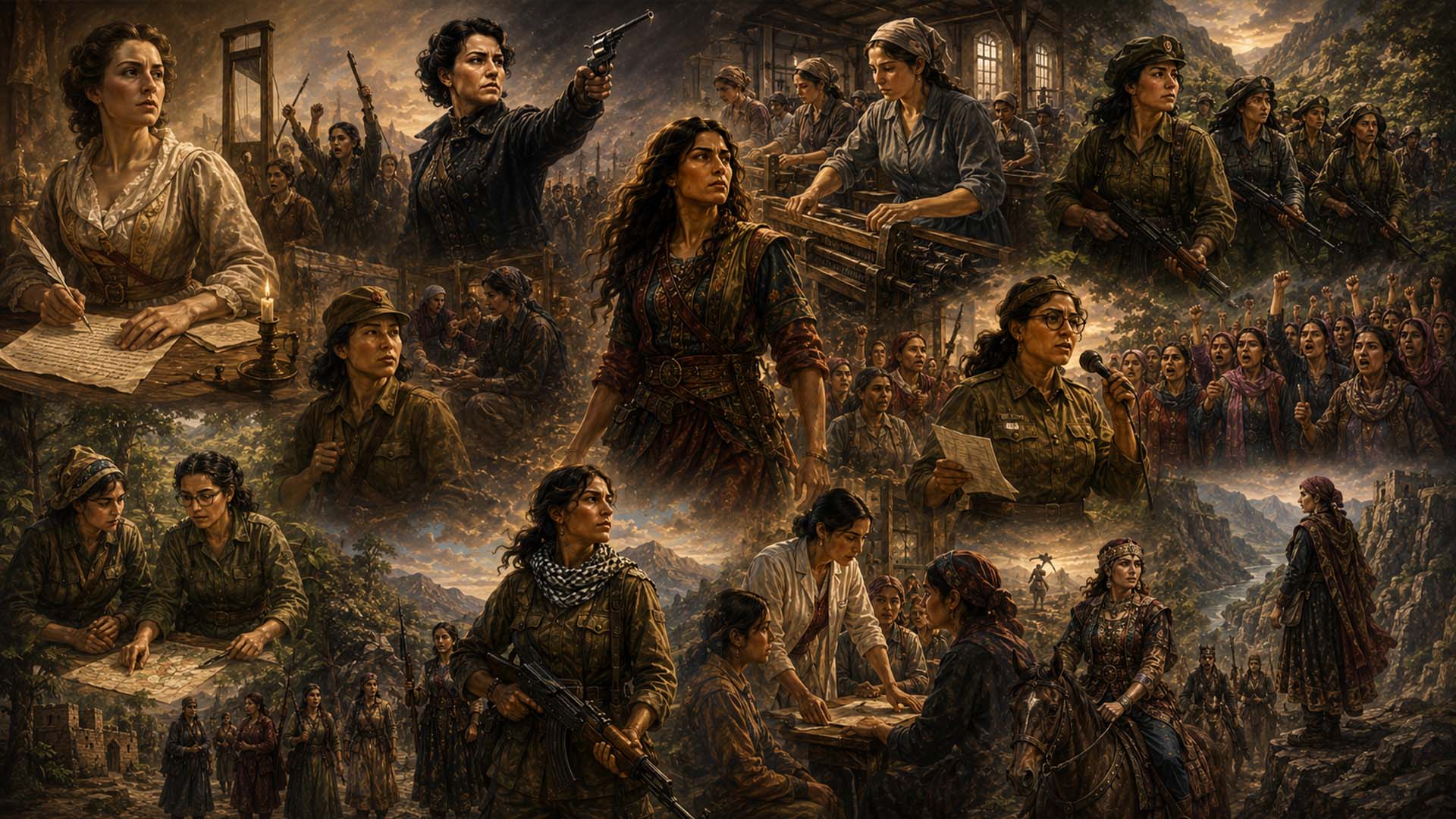
The women’s resistance symbolized by March 8 against the capitalist system has, since the very emergence of capitalism, confronted its expansion into all countries and peoples that it sought to reach and colonize. To give some examples:
Although women played a leading role in the French Revolution, they were denied their rights after the revolution. Therefore, Olympe de Gouges argued that human rights should begin within the family through the reorganization of domestic life. She prepared the “Declaration of the Rights of Woman and the Female Citizen.” She maintained that if a woman could be sent to the guillotine, she could also engage in politics. Although she faced the violence of male domination and was executed by guillotine, history recorded her name among the women of resistance. She became a rebel woman whose path has inspired generations of women.
Before the October Revolution, four women organized an assassination attempt against Tsar Alexander II. Sofia Perovskaya became the first female assassin in the world to be executed for carrying out an assassination attempt against the Tsar. It was also women workers who initiated the October Revolution of 1917. Women workers in textile factories sent their delegates to neighboring factories and organized strikes. Likewise, a battalion formed by women displayed great resistance on the front lines against fascism.
Mao described the role of women in the Chinese Revolution with these words: “Half of the sky rests on the shoulders of women. The revolutionary army of women calls for the destruction of all demons that invite women to surrender their material and spiritual freedom.” Nevertheless, because of the dominant feudal structure in China, women were kept on the rear fronts during the war. Yet women such as Kuo Ch’un-Ch’in played active roles in combat, even at the cost of disguising themselves as men. Kuo Ch’un-Ch’in earned the right to receive the highest military award, but her identity as a woman was only revealed after she was wounded.
The resistance of the Vietnamese people drove the soldiers of colonial states, especially those of the United States, into psychological crisis. During the Vietnamese resistance, women established the “Women’s Union for the Liberation of South Vietnam.” Women within this organization participated alongside men on the same fronts and at every level of activity, while also taking active roles in leadership. Nguyen Thi Dinh not only served as the president of the Women’s Union but also became the first female deputy military commander in the army. This organization also rescued women who had been forced into prostitution by the United States and integrated them into the people’s war. Around 1970, women in Saigon formed the Women’s Council to defend their honor. Women who were captured displayed epic resistance in the prisons of Saigon.
When the Cuban Revolution is mentioned, Che Guevara and Fidel Castro usually come to mind. However, Celia Sanchez was the woman at the center of the Cuban Revolution and is said to have played an influential role in decision-making. After the coup of March 10, 1952, Celia joined the resistance against the Batista government. She was one of the founders of the July 26 Movement and led combat units throughout the revolution.
India is known for its cultural, religious, linguistic, and ethnic diversity. Lakshmi Sehgal was one of the revolutionaries of the Indian independence movement. She served in the Indian National Army and later held the position of Minister for Women in the Azad Hind government. She commanded the “Rani of Jhansi Regiment,” a military unit composed entirely of women that fought to overthrow British rule. The Rani of Jhansi Regiment was one of the few all-female military formations among the armies that participated in World War II. Even today, women in India continue their organization through the “Pink Gang” as a form of women’s self-defense against male domination, violence, rape, injustice, and the state’s protection of male privilege. Armed with bamboo sticks, the Pink Gang has many supporters and a strong organizational structure.
Even these few examples are concrete expressions of the fact that women are in resistance all over the world. Wherever there is resistance, women have been present. Women are not beginning resistance today. They have been resisting since the first day male domination attacked women’s labor. The history of women’s resistance, which has largely remained unwritten, awaits research, exposure, and recognition as the shared heritage of all women. Women have actively participated in and strengthened revolutions, yet revolutions have rarely made women’s liberation a distinct agenda. A specific focus on women’s freedom was often considered unnecessary, while a superficial understanding of equality assumed that women would automatically become free when society as a whole was liberated. However, the historical depth of the slavery imposed on women has left profound marks upon them. Women constitute a distinct identity with their own history, social identity, and mentality. Breaking the slavery imposed upon women and revealing their true essence once again requires a specific struggle for women’s freedom. One of the greatest shortcomings of revolutions has been their failure to sufficiently address women’s liberation, because women’s freedom is the key to the freedom of the entire society.
One of the oldest resisting peoples in history is the Kurdish people. From the first emergence of dominant mentality, the geography of Kurdistan has been a land where women have always been part of resistance. Throughout history, Kurdish women have been among those who challenged dominant civilizations and male domination the most. Whether protecting their tribes or rebelling against dominant systems, Kurdish women have always stood in the ranks of resistance. The resistance of Kurdish women is marked by the courage to fight rather than fall captive to the enemy and, when necessary, to throw themselves from cliffs. Yet just as the resistance of the Kurdish people has often been omitted from history, so too has the heroism of Kurdish women. A few examples of women who played leading roles in Kurdish history may help illustrate this.
Dayfa Khatun was the niece of Salahaddin Ayyubi. She was married to the governor of Aleppo. After her husband’s death, she assumed power and governed Aleppo for ten years. When her son later took power and then died, she once again assumed leadership. This was a period of Mongol and Crusader attacks. Dayfa Khatun personally led her military forces and successfully defended Aleppo against attacks from both east and west.
During the legendary resistance of Dimdim Castle, hundreds of women took their own lives rather than be captured. After the fall of Dimdim Castle, Zadine Khatun assumed regional leadership and, seeking revenge for the women, attacked the castle with a thousand soldiers and recaptured it. Her army was known as the “Çengzerîn Army.”
Shehnaz Khatun was the wife of the Ardalan Bey in Eastern Kurdistan. During a war against the Persians, when the battle intensified, Ardalan gathered five hundred women. To avoid being recognized and captured by the Persians, they disguised themselves as men, joined the battle, and changed its course. Likewise, in Luristan, Eastern Kurdistan, Qedem Xêr worked for Kurdish unity. Seeing this as a threat, the Shah attempted to intimidate her. He sent three sacks of rice through an envoy, implying, “My soldiers are as numerous as these grains.” Qedem Xêr fed the rice to her chickens, demonstrating the intelligence and courage behind her own strength.
During the Crimean War, Kara Fatma supported the Ottoman Palace with three hundred cavalry under her command and displayed great heroism and courage. Although she was known to be Kurdish, and although Turks later attempted to claim her as their own, she became known throughout the world as Kurdish Fatma.
Leyla Qasim of Southern Kurdistan joined the Peshmerga against the oppression, persecution, and massacres imposed on the Kurds by the Ba’ath regime. To make the voice of the Kurdish people heard around the world, she participated in an airplane hijacking operation. She was captured during the operation and, after a formal trial, was executed within twenty days. With her words, “Kill me, but know this truth: with my death, thousands of Kurds will awaken. I feel joy and pride because I sacrifice my life for the freedom of Kurdistan,” Leyla Qasim became a symbol of the Kurdish woman’s passion for freedom and the sacrifices she is willing to make for it.
During the Republican era, Gülnaz Xanım played a leading role in the Ağrı Rebellion. In the uprising led by Seyit Rıza, the struggles of Bese and Zarife represented the Kurdish woman’s struggle to preserve dignity and honor. Zarife was the wife and comrade of Alişer. It is said that she was the only woman who sat at Seyit Rıza’s table and exercised the right to speak. During the Garzan Rebellion, when Rinde Xan was captured, she requested to see the Malabadi Bridge as her final wish. Upon reaching the bridge, she threw herself into the waters of the Tigris River.