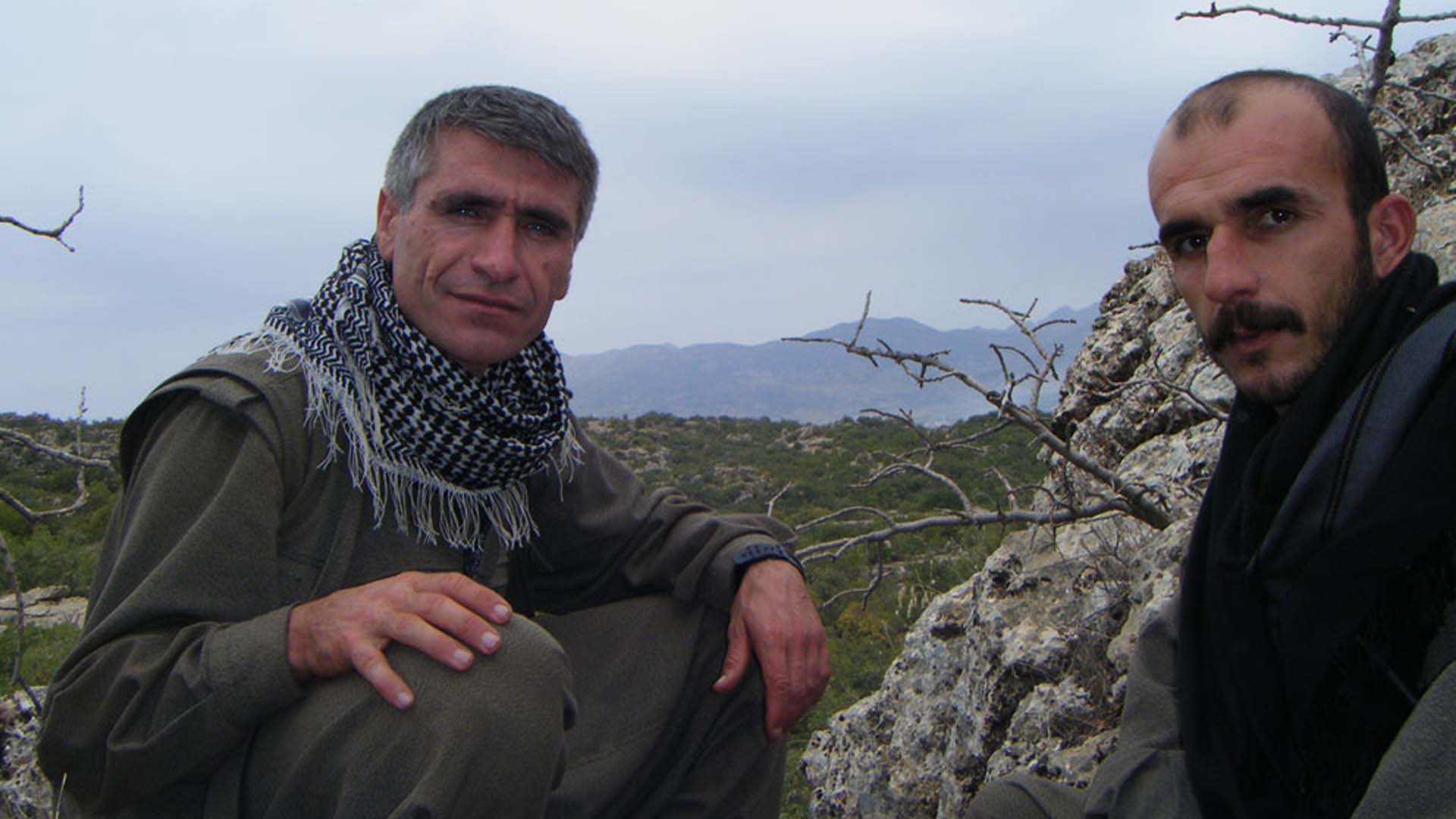
One of the most fundamental features distinguishing PKK ideology and the guerrilla struggle from other movements, especially the traditional Kurdish organisations, is the creation of a great, epic life without stooping to petty, simple interests.
That is why extraordinary seekers meet in the PKK in the struggle to create what is most honourable, defying the ordinary and simple. Whatever system or geography they come from, their powerful common bond is their acquaintance with Apoist philosophy and, consequently, their great and rebellious hearts. In the PKK movement, where cultures, geographies and societies are lived as a source of richness, achieving a strong coming together despite the fragmentation and alienation Kurdistan has experienced down to its very cells may no longer be something new and extraordinary today, but it still requires attention. There are many aspects of the PKK to examine, understand correctly and put into practice in life. A fundamental source that teaches us most in understanding what has happened from the beginning to the present is our martyrs' life stories. Every martyrdom represents Apoist philosophy in some way and is therefore instructive, moving and also a guide. This is why the life story of comrade Mervan is striking and instructive too. He is one of our comrades who grew up in Sulaymaniyah but followed his dreams and faith to Zara, rejected the encirclement around him and remained committed to the idea that ‘if there is to be a new life, it must be meaningful’.
Yes, comrade Mervan is born in the city of Sulaymaniyah in Southern Kurdistan. His family and surroundings belong to the YNK and KDP. He learns what a tribe is as a child. He witnesses tribal fights and also sees the contradictions between Kurdish organisations. He witnesses displacement and massacres in Southern Kurdistan. The people's hunger and poverty affect him deeply, and he begins working as a child. He understands the value of labour. He is a quiet child when young and never accepts what is happening around him. He dislikes the situation of the Kurdish organisations, which ought to provide a solution. Therefore he joins neither the KDP nor the YNK and keeps his distance from them.
The organisation he imagines is one that puts the interests of all Kurds first, makes no distinctions and has neither poor nor rich. As a Kurd from the South, he had done everything. Now he wanted to live humanely. Now he wanted to live freely. While he is thinking this way, discussions about the PKK take place around him, and he always listens. Because his relatives are peshmerga, they talk about the 1992 Southern War. They also recount comrade Beritan's resistance. What he hears meets his own searching and affects comrade Mervan. In these conversations and discussions he clarifies his contradictions: ‘So they did not surrender to you or the Turks. What sort of Kurdish organisation are you, joining the Turkish army to fight a Kurdish organisation, and on your own soil at that?’
The PKK now attracts his interest, and he wants to meet the comrades. Not knowing how to reach them, he searches for them for a while. Later he meets comrades working here. He discusses matters with them for some time and becomes convinced on many issues. He then decides to join. He joins the party in 1997, first arriving in Xakurke. In this way he breaks the silence he has carried for years. For the first time, he does something he himself wants; this time he makes his own decision. Here he receives new-fighter training and has no difficulty with military training, since he has known all the weapons since childhood. He attaches greater importance to political training. He wants to know the party well. After completing his training, he goes to the battalions.
Although new, he too takes part in the fighting because of the military operation in 1997, when war is being fought throughout the South. He participates in the Hacı Ümran–Çoman actions. Within a short time he becomes a professional guerrilla. Here he becomes a team commander. He is much loved among the comrades.
He is known chiefly for his diligence and fighting spirit. He observes life closely and is not very talkative. His personality has not been affected by the damage done to the South. He would engage in neither materialistic relationships nor cronyism. He is a very different person, whose modesty draws attention. He values all comrades. He does not base his approach on a hierarchical system. He does not attach himself to commanders, his superiors, but is never lacking in respect; organisationally, he values the hierarchical system and commanders. Yet he values comradeship more. In this he is without shortcomings.
After 1999 he works even harder. In Xakurke he takes part in the first and second offensives against the YNK. He fights voluntarily. Although he dislikes the shedding of brothers' blood, he fights them because of their collaborationist character. Here too he plays his role. He stays in Qandil for a while, then moves to the Behtinan area. Here he stays in the Zap, Metina and Gare areas. He goes everywhere. He has made the North his goal. The goals he sets are always directed forwards. Even if conditions in the South improve and some gains are made, these do not concern comrade Mervan or satisfy him. What matters to him is resolving the issue as a whole and a national stance. In this he is exceptionally persistent and consistent.
When groups begin forming for the North, he too joins them. He especially wants to be in the Amed group. He is overjoyed, saying, ‘We will go to the capital and meet its history. I will get to know the people of the North. We will eat Amed's watermelons.’ There is no hesitation in his character. Comrade Mervan is a team commander. During this period he attends training, making a substantial contribution to military training. He has also learned Kurmancî. Because he is going to the North, he learns Turkish too. He himself is Soran, but nobody can tell where he comes from, and he jokes, ‘I'm from Lice.’ He always says he will go to Zara. In geography lessons, it was the place he liked most.
All preparations were complete, and the days of our departure had arrived. The removal of Southern comrades from the group and their assignment to PÇDK work came onto the agenda. Comrade Mervan was called in, and they spoke to him. They wanted to remove him from the group too and send him to political work. Yes, the renewed move into the North coincided with organising PÇDK work to expand in Southern Kurdistan. During that period, all Southern comrades in this field were being drawn into this work because they knew the area and the people. Apart from a few who stayed through their own insistence, many comrades had been withdrawn from Behdinan for this work. Comrade Mervan refused to go. Saying, ‘I will go to the North. The HPG is a national force. You cannot remove me,’ he did not go into political work. He took a determined stance and did not change his decision. He thought many comrades sent to this work were ideologically inadequate and would be unable to represent the organisation there. He also knew the people of the South well. For all these reasons, despite the discussions and the atmosphere that developed, he remained fixed on the North towards which he had turned. His stance and manner seemed to say: I know what I am doing; now it is time to go to the lands where I must go.
We walked together on a month-long journey. On the way he enjoyed getting to know the people and land of the North. Our journey was successful, and we finally reached the North and the capital, Amed. I want to recount an interesting memory from our time together. We had just reached Amed and were going from the Martyr Remzi area to the Akdağ area. We were walking along railway tracks beside the Murat River, then entered a tunnel. Shortly before we were due to emerge, we heard a train. We all ran out of the tunnel and escaped it. At that moment a headcount was requested, and the count came back complete. Everyone was asked whether the comrades ahead of and behind them were present; the answer was yes. After about another hour's walking, comrade Mervan's absence was noticed. The entire group stopped. He was the comrade behind Şiyar, who had not noticed because of tiredness. Of course, when we stopped and searched, we found him. With reproach mingled with humour, Mervan said to Şiyar, ‘Why were you so inattentive? I know nobody here. I don't know their customs and traditions or the people. What would I have done? I wish Yusuf had got lost instead of me. He would have found us.’ At the same time he said, ‘Anyway, it was a lesson for me too.’
We finally reached Akdağ, stayed a few days and received our assignments. Comrade Mervan went to the Ape Musa area. Its terrain is fairly gentle. Its mountain is Sele, and it also has patches of forest. Its most beautiful place is Çimsek, a rocky spot whose rocks are all like labyrinths. It partly resembles Kato. Comrade Mervan's favourite place is Büyük Ziyaret, which is wooded. There is also Küçük Ziyaret. Mervan would say, ‘Everything here comes in pairs.’ Ape Musa's problem is water. The people are generally Zaza; only one village is Kurmanc. Comrade Mervan worked here for two years. The people loved him very much. His moral qualities and stance were very pure, and his being from the South aroused the people's interest. Through his modesty, he set an example for the comrades.
Here he participated in an action once or twice. In his first action, in Hane, he strikes soldiers in an ambush. Two soldiers are killed. In his second, he attacks police buildings with a B7. At the time this action was talked about everywhere. He was therefore active in practical work and fighting too, never holding himself back. He always lived naturally and simply. Besides being a practical worker, the comrade held responsibility: he was a platoon commander.
He left Ape Musa in winter. With spring, he was assigned to the Martyr Kendal area. This is the Lice area. Its geography is rocky and wooded, and it is very extensive, reaching as far as Silvan, Kulp, Lice, Hazro, Karaz and Hane. Its basic problem is water. Areas with water problems always fell to him. He had no problem with that and never tired of carrying water on his back. Because the areas where he stayed were hot, water did not last them. In the heat they would drink half of it before arriving. But he would say, ‘Never mind, as long as we're well.’ He was a comrade who knew how to love the area where he stayed, with its beautiful and difficult sides, and who succeeded in practical work and command according to its conditions. Therefore nothing became a serious problem for him.
Later he goes from the Martyr Kendal area to Zara as the person responsible. This is the very Zara whose name he had heard before coming to the North and about which he had said, ‘I will go to Zara’; distant though it was, it had settled in his heart. Now he reaches his intended destination. Zara has a narrow geography, with Hane on one side, Silvan on another and Lice on another. After going there, comrade Mervan truly gets work done and masters the area's practical work. He stays here to the end.
During his time here, he was a guerrilla in war as in every sphere of life, because he was a comrade conscious of the responsibilities falling to him. Thus he also knew how to be at the front when the moment came. Once again such a moment arrives: they reconnoitre a military post for an action. It is reconnaissance for the action against Hazan post. All preparations are completed. Comrade Mervan, who makes a great effort to bring about this action, participates as a column commander.
The moment has arrived. Preparations before the action have taught all the comrades great excitement, waiting and patience. But the most important moment, of course, is when the action takes place, for Mervan as for all the comrades. With the great excitement and responsibility of commanding the assault, he advances on the enemy. They overrun the post. Twenty-two soldiers are killed in this action. They have achieved an important result and succeeded. Despite this, however, comrade Mervan attains martyrdom in the action.
Yes, he attains martyrdom during an action, an assault, a moment of fierce struggle and fighting, taking the most active part in the offensive. In other words, he falls a martyr heroically. We remember him with respect.