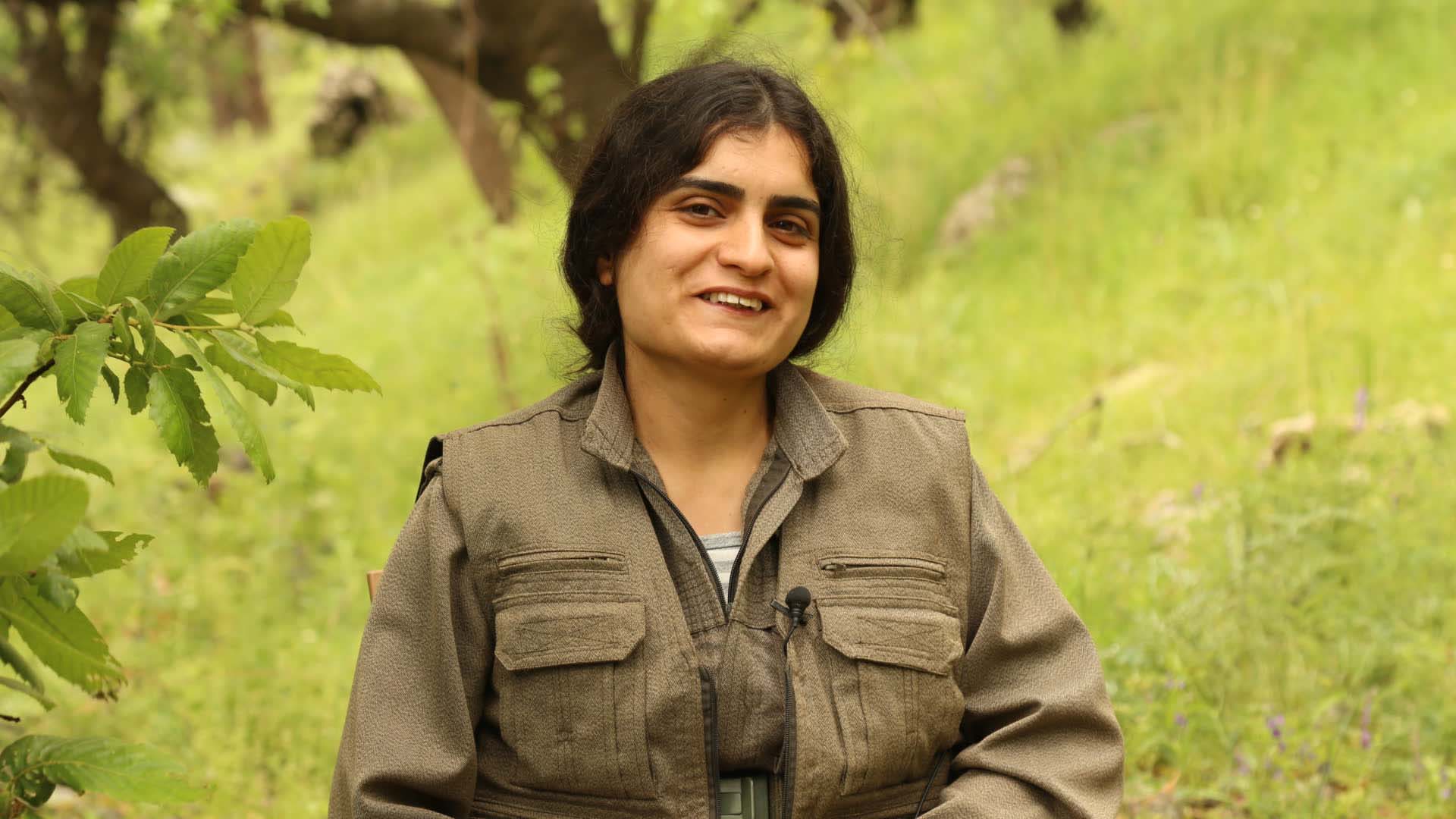
The darkness over Kurdistan continues. Children do not smile, flowers do not bloom, and everything that exists is buried.
Those who do not let the Kurds be forgotten are once again on the battlefield. From the poem of revolution, they gather words onto the notebook on which they have drawn their hearts. They gather them with great patience and calm.
“The March of Freedom towards True Love”
A rebellious girl opens her eyes to life, to sustain a free country moving towards victory. This rebellious girl is born in Botan, in Silopya, the capital of uprising. With her eyes resembling rays of sunshine, she creates a colourful picture on the summit of Cudî. The brave-hearted Jînda grows up amid resistance and receives an authentically Kurdish culture from her patriotic family. In every moment she lives in her country, she sees the reality of the occupation imposed upon its soil. With her small hands and her great heart, she picks up stones from the soil of Kurdistan and throws them at the enemy’s tanks. She comes to know her enemy and sees as strangers those occupiers who have come onto her colourful land, onto the soil of Kurdistan. Kurdish children always grow up with uprising and resistance, always listening to their families’ stories of those heroes. Jînda too is one of those children who imagine themselves within those stories and epics.
For them, the mountains are the sanctuary of truth. They want to reach the sun on the highest rocks, and for that they face whatever price there may be, overcoming any obstacle before them without hesitation. They walk through the most difficult watercourses, through cold and frost, to reach the guerrilla ranks. They rise from dreams woven with thick clouds, rise from that life wrapped in black, dark clouds, and twist their braids of vengeance. They rejoice in their comrades’ melodies, and in the later years of their lives they draw still closer to the freedom movement. Upon the braid of their voices, they adorn their embrace with violets so that it may hold peace. In 2011, Jînda Jîn too sets out towards the free mountains.
“A Corner for Happiness”
The children of this soil have never found a corner for their happiness in this universe without support. On this dark, black continent, at every dawn a dove was wounded in their hearts. In the bottomless void, they adorned themselves with love of country to bind the wounds of their wounded. Day and night, in the mountains’ embrace, they left unique traces behind them on every path. Jînda too, to leave a trace behind her, deepens and refines herself with great enthusiasm and desire through the ideological education of the Apoist movement. Jînda receives her basic training in Botan, the home of Adil and Nûda and their comrades. In Botan, the home of Egîd and his comrades, Jînda begins a long, far-reaching journey to attain free days and a free Leadership. She remains in Botan until 2013 and lives those two years there to the full. She comes to know guerrilla life and earns the title of a guerrilla skilled in style and tactics. Despite the difficulties of the terrain, she does not make them an obstacle for herself and acts with self-sacrifice. In 2013, to take another step closer to her dreams and goals, she transfers to the Special Forces of the Battalion of the Immortals. Among the self-sacrificing forces, she works with great devotion. In the depth of the pioneering commander Zîlan, she shapes herself into a free and intelligent woman. With every cell of her being, she binds herself to the cause of freedom and the heroic martyrs.
In this country, woman’s name is lioness; woman is the heart of life. Women who are always in revolt against oppression. Women of dignity and determination in this country. Women who have become the song of love, freedom and dignity. Women who have woven themselves with the philosophy of the Kurdish people’s Leader have raised their heads against the occupiers and brought forth revolutionaries like Jînda on the soil of Mesopotamia.
“An Apoist Stance in Every Circumstance”
Jînda now has experience; in life and war, she is a pioneer for her comrades. After a time, because of her experience in life and war, Jînda becomes a combat commander, taking part in every action carried out and always wanting to participate. She knows that only in this way can she drive occupation out of her country. Guerrilla Jînda successfully carries out every action in which she takes part. Jînda’s intelligence makes itself felt among her comrades too. Wherever help was needed, Jînda was there. She had a firm stance not only in practical work but also in ideological work. She was always beside her comrades, supporting her fellow fighters with her morale and enthusiasm. Jînda was known in many guerrilla areas because she crowned every action she developed against the enemy with success; there was no place left where she had not struck the occupiers. From Haftanîn to Metîna, the name of the intelligent, brave-hearted Jînda could be heard. She loved her country and therefore recognised no obstacle before her; ahead of her lay only hope and faith in a free tomorrow. Whether in the heat of July or the cold of winter’s depths, with her courageous heart she guided her comrades on these paths, embodying an Apoist stance.
In the cold of torture, in the darkness of a cell, in a lover of the homeland’s distance from it, they want a handful of your laughter to warm themselves by. With the warmth of a freedom-lover’s heart, they will draw your laughter on the canvas of their hearts, for a fistful of spring, the smile of a dream of freedom, the March of a lifetime, for lovers who have raised love high. With the laughter of revolutionaries, life laughs and death weeps. The dead speak; souls rain down. Everything forbidden becomes permissible. Dreams become reality, realities become dreams, and at last they reach the true truth.
The love lived most deeply is love of country. Every love ends, but however many years pass, love of country and longing for it never end. Guerrilla Jînda too loves her country and struggles to attain a free love. Now a long, far-reaching road begins for her, a road with hardship, a road from which there is no return, to reach a free country. At her own request and proposals, Jînda is reassigned to Botan. Botan, where she was born; Botan, which taught her life; Botan, which opened its embrace to her and now awaited her.
Jînda now moves to Cudî. Every moment she spends there, she leaves her traces on life through her labour and self-sacrifice. Jînda knows this is no time to let a single moment pass empty. Whenever attacks are made on the Kurdish people and her comrades, she must fulfil her duty and play her role. Just as she is a pioneer for her comrades in life, she is also their pioneer in war. The brave-hearted Jînda is always thinking about how to strike the enemy and drive those occupiers from the soil of Kurdistan. On 30 April 2019, when the enemy seeks to launch an operation in Cudî, Jînda and her comrades Ekîn Çaldiran and Roza Eylem do not allow this occupation. They fight it to their last drop of blood and join the caravans of the immortals.
“Free Flight”
Departure is not fate in every country. Sometimes it is revolution, sometimes hope, sometimes freedom. Through their departure, they make love smile. Through their departure, they scatter mourning. They bring freedom and joy, join hands and put an end to the wounds in the hearts of their country’s children. They fly freely through the skies. They give spirit; they give life. They become an adornment to their comrades’ laughter; they become remembrance. Those who have taken a step towards their country’s liberation are never forgotten. Guerrilla Jînda too is one of those who carried on the struggle without hesitation until the last moment of their lives and took their place in immortality.